


Syllabus: GS2/ Governance
Context
- The Ministry of Tribal Affairs launched the National FRA Digital Platform during Janjatiya Gaurav Pakhwada to digitise the claims process under the Forest Rights Act (FRA), 2006.
Background
- For generations, forest-dwelling communities have lived in and depended on forests for their homes and livelihood.
- However, many of their land rights went unrecorded when state forests were consolidated during the colonial period and after independence.
- The Forest Rights Act (FRA), 2006 was enacted to recognise these historical rights and address the injustice caused by their non-recognition.
About the Forest Rights Act, 2006
- The Scheduled Tribes and Other Traditional Forest Dwellers (Recognition of Forest Rights) Act, 2006, recognises the historical rights of forest-dwelling Scheduled Tribes (STs) and Other Traditional Forest Dwellers (OTFDs) over forest land.
- The Act received the President’s assent on 29 December 2006 and came into force on 31 December 2007.
- It gives legal recognition to both individual and collective rights of these communities on forest land through titles, which are official documents that record forest rights.
- The objectives of the Act are:
- To recognise forest rights that could not be recorded earlier.
- To give forest-dwelling Scheduled Tribes and other traditional forest dwellers secure rights to their land (land tenure), livelihood and food security.
- To strengthen forest conservation by giving forest rights holders the responsibility and authority to use forests sustainably and to conserve biodiversity and ecological balance.
- The Act enjoins upon the Gram Sabha and rights holders the responsibility of conservation and protection of biodiversity as well as to stop any destructive practices affecting these resources or the cultural and natural heritage of the tribals.
- The Gram Sabha is also a highly empowered body under the Act, enabling the tribal population to have a decisive say in the determination of local policies and schemes impacting them.
What is a Forest Rights Title?
- A title is the official document that records a forest right. It shows who holds the right, in which village, and over which land or forest, and its boundaries.
- Three district officers sign it for the State Government: the Divisional Forest Officer, the District Tribal Welfare Officer and the District Collector.
- The holder gets a certified copy. For a community title, the Gram Sabha (the village assembly) gets it. A title passes to the holder’s heirs. It cannot be sold or transferred.
Eligibility and Coverage under the Act
- The Act covers two groups:
- Forest-Dwelling Scheduled Tribes (FDSTs): Members of Scheduled Tribes who primarily reside in forests or forest land and depend on them for bona fide livelihood needs.
- Other Traditional Forest Dwellers (OTFDs): Individuals or communities who have primarily resided in and depended on forests for at least three generations (75 years) before 13 December 2005.
- For land held for a home or for cultivation, the right covers only the area actually occupied, up to four hectares.
- The Act covers different categories of forest land, including reserved forests, protected forests, wildlife sanctuaries and national parks.
- Diversion of forest land for specified government facilities, such as schools, hospitals, anganwadis, drinking water facilities and roads, is permitted subject to statutory conditions, including a Gram Sabha recommendation and the one-hectare limit.
Types of Rights Recognised under the FRA
- Individual Forest Rights (IFRs): Recognises individual or family rights over forest land occupied for habitation or self-cultivation, subject to the four-hectare ceiling.
- Community Forest Rights (CFRs): Recognises community rights over resources traditionally accessed by forest-dwelling communities.
- Includes rights over grazing areas, fishing grounds, water bodies and minor forest produce.
- Community Forest Resource (CFR) Rights: Empowers Gram Sabhas and forest-dwelling communities to protect, regenerate, conserve and manage community forest resources within their customary boundaries.
- Habitat Rights: Recognises the customary habitat and livelihood rights of Particularly Vulnerable Tribal Groups (PVTGs).
Institutional Mechanism for Recognition of Forest Rights
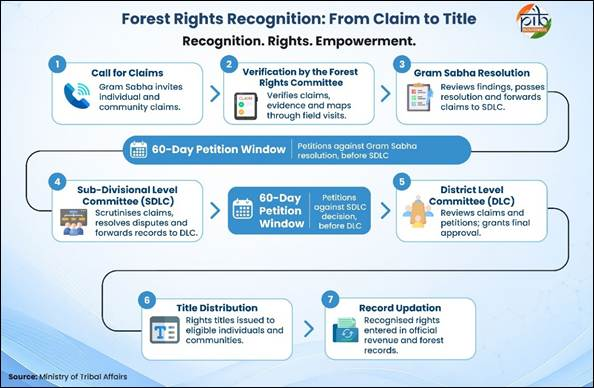
Challenges in the Implementation of FRA
- Weak recognition of community rights: Implementation has largely focused on individual titles, with community forest resource rights receiving comparatively less attention.
- Conflicts with conservation and development projects: Overlapping claims involving forest conservation, protected areas, mining and infrastructure projects create tensions between statutory rights and competing land-use priorities.
- Limited awareness and capacity: Many forest-dwelling communities lack adequate information about their rights, claim procedures and available grievance-redressal mechanisms.
Way Ahead
- The Forest Rights Act, 2006, represents an important shift from viewing forest-dwelling communities merely as beneficiaries of welfare measures to recognising them as rights-holders and partners in forest conservation.
- Its effective implementation requires moving beyond the distribution of individual titles towards stronger community rights, secure livelihoods and participatory forest governance.
- Recognising the rights of forest-dependent communities is essential for achieving both social justice and sustainable forest conservation.
Source: PIB
Previous article
23rd ASEAN-India Summit
