


Syllabus: GS2/ International Relations
Context
- The 23rd ASEAN-India Summit was held in Manila, the Philippines, with the theme “Navigating Our Future, Together”.
Key Outcomes of the Summit
- Disaster Management: Adopted the ASEAN-India Joint Statement on Cooperation in Disaster Management to strengthen early warning systems, satellite-data sharing, disaster preparedness and humanitarian assistance.
- Cybersecurity: Proposed a Joint Cyber Forensics Training Programme to enhance regional cybersecurity capabilities.
- Nuclear Energy: Proposed ASEAN-India technical exchanges in nuclear energy to promote cooperation in peaceful applications of nuclear technology.
- Space Cooperation: Proposed an ASEAN-India Space Hackathon to encourage innovation and collaboration in space technology.
- The year 2026 is being observed as the ASEAN-India Year of Maritime Cooperation.
- Tourism and Cultural Cooperation: Proposed free e-visas for ASEAN tourists visiting India and an ASEAN-India Creative Partnership Pavilion at WAVES 2027.
Association of Southeast Asian Nations (ASEAN)
- About: It is a political and economic organization aimed primarily at promoting economic growth and regional stability among its members.
- History: It was established in 1967 in Bangkok, Thailand, with the signing of the ASEAN Declaration (Bangkok Declaration) by the Founding Fathers of ASEAN: Indonesia, Malaysia, Philippines, Singapore and Thailand.
- Brunei Darussalam joined ASEAN in 1984, followed by Vietnam in 1995, Lao PDR and Myanmar in 1997, and Cambodia in 1999.
- Timor-Leste acceded to the bloc in 2025, expanding ASEAN to 11 nations.
- ASEAN Summit: It is the highest policy-making body in ASEAN comprising the Head of States or Government of ASEAN Member States.Summit is held twice annually.
- The First ASEAN Summit was held in Bali, Indonesia in 1976.
Brief on India-ASEAN Relations
- Foundation: India formally began its engagement with ASEAN in 1992 as a sectoral dialogue partner.
- Milestones in the Partnership:
- 1996: Elevated to Full Dialogue Partner.
- 2002: Partnership upgraded to the summit level, with the first ASEAN-India Summit held in Cambodia.
- 2012: Elevated to a Strategic Partnership.
- 2022: Upgraded to a Comprehensive Strategic Partnership (CSP), marking 30 years of ASEAN-India dialogue relations.
- Policy Framework: The “Look East Policy” initiated in the 1990s was transformed into the “Act East Policy” in 2014, marking a more action-orientated approach to deepen ties with ASEAN.
- Trade and Investment: India and ASEAN have established a Free Trade Area through agreements covering goods, services and investment.
- ASEAN is an important trading partner of India, accounting for approximately 10.55% of India’s total global trade in FY 2025–26.
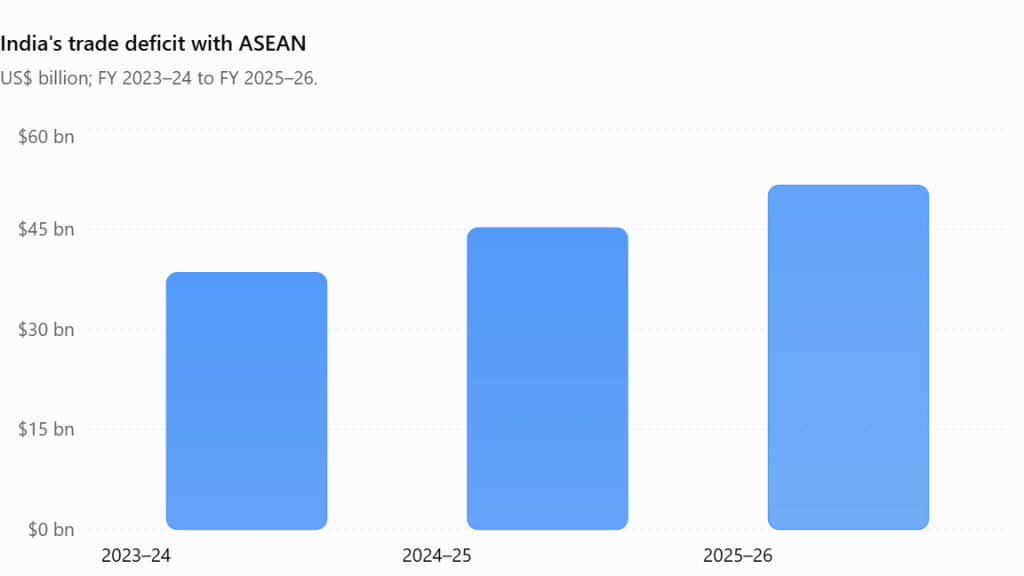
- Bilateral merchandise trade reached US$128.4 billion in FY 2025–26, compared to US$120.9 billion in FY 2023–24.
- Trade composition in FY 2025–26:
- India’s exports to ASEAN: US$38.4 billion.
- India’s imports from ASEAN: US$90 billion.
- Cumulative investments from ASEAN countries into India amounted to approximately US$196.96 billion during 2000–2025.
- Regional connectivity: India is working to improve connectivity with ASEAN through projects like the India-Myanmar-Thailand (IMT) trilateral highway and the Kaladan Multimodal Transit Transport project.
- Defence and Security Cooperation: Defence ties between India and ASEAN have deepened through joint military exercises such as the ASEAN-India Maritime Exercise and participation in the ASEAN Defense Ministers’ Meeting Plus (ADMM+).
Significance of ASEAN for India
- Strategic Importance: ASEAN occupies a central position in India’s Act East Policy and the MAHASAGAR vision, strengthening India’s engagement with the Indo-Pacific region.
- Economic Cooperation: ASEAN is an important economic partner for India, offering opportunities for trade, investment, supply-chain diversification and regional economic integration.
- Maritime Security: Cooperation with ASEAN is important for maintaining freedom of navigation, maritime security and stability in strategically important sea lanes, particularly the South China Sea.
- Connectivity: India seeks to strengthen physical, digital and maritime connectivity with Southeast Asian countries to enhance regional integration.
- Civilisational Linkages: Historical trade, cultural exchanges, Buddhism and shared maritime traditions provide a strong foundation for India-ASEAN relations.
Challenges in India-ASEAN Relations
- Trade Imbalance: India’s trade with ASEAN continues to face concerns relating to the trade deficit and market-access barriers.
- Connectivity Constraints: Delays in implementing regional connectivity projects have constrained deeper integration.
- Geopolitical Rivalries: China’s growing economic and strategic influence in Southeast Asia creates challenges for India’s regional engagement.
- Myanmar Crisis: Political instability in Myanmar has affected regional connectivity, border management and India’s engagement with Southeast Asia.
Way Ahead
- India should focus on strengthening trade integration, accelerating connectivity projects, enhancing maritime cooperation and deepening people-to-people ties with ASEAN.
- It should also promote cooperation in emerging areas such as digital technology, clean energy and critical minerals to build resilient regional partnerships.
- A robust India-ASEAN partnership is essential for advancing India’s Act East Policy and ensuring a peaceful, stable and prosperous Indo-Pacific.
Source: AIR
Previous article
Berlin Conference 1884-85 and the Partition of Africa
Next article
Forest Rights Act (FRA), 2006
