


Syllabus: GS1/ World History
Context
- On November 15, 1884, the Berlin West Africa Conference began under the leadership of German Chancellor Otto von Bismarck with the objective of regulating European colonial expansion in Africa.
Background
- By the late 19th century, European powers were increasingly competing for African territories, natural resources, trade routes and strategic locations.
- The Berlin West Africa Conference, held from November 15, 1884, to February 26, 1885, resulted in the adoption of the General Act of Berlin (1885).
- The conference brought together the major colonial powers, including Great Britain, France, Germany, Portugal, Belgium, the Netherlands, Spain and the United States.
- Other countries in attendance included Austria-Hungary, Sweden-Norway, Denmark, Italy, Turkey and Russia.
- No African representatives were invited.
Major Reasons Behind Convening the Conference
- Growing Colonial Rivalries: Competition among Britain, France, Germany, Portugal and Belgium intensified as European powers sought greater territorial and commercial influence in Africa.
- Congo River Dispute: An Anglo-Portuguese agreement (1883) threatened to recognise Portuguese control over the mouth of the Congo River, potentially restricting access for other European traders.
- Expansion of Leopold II: Belgium’s King Leopold II, through the International Association of the Congo (AIC), was expanding his influence over the Congo Basin, raising concerns among other European powers.
- Commercial Interests: European countries sought access to Africa’s raw materials, markets, waterways and strategic trade routes.
Key Outcomes of the Berlin Conference
- Recognition of Congo Claims: Recognised the territorial claims of King Leopold II’s International Association of the Congo, which laid the foundation for the Congo Free State under his personal rule.
- Effective Occupation Principle: Any power claiming coastal territory in Africa was required to notify the other signatories and establish sufficient authority to protect existing rights and, wherever applicable, guarantee free trade.
- Free Trade in the Congo Basin: Provided for freedom of trade and commercial access in the Congo Basin.
- It also guaranteed freedom of navigation along the Congo and Niger rivers to facilitate international commerce.
- Suppression of Slave Trade: Committed participating powers to cooperate in suppressing slavery and the slave trade in Africa.
- Protection of Indigenous Populations: Declared commitments to protect local populations and promote their moral and material well-being, although these commitments were not effectively enforced.
Did the Berlin Conference Actually Divide Africa?
- Established Rules for Territorial Expansion: The principle of effective occupation encouraged European powers to establish a visible administrative and military presence in territories they intended to claim.
- It provided a framework for European powers to legitimise their territorial claims and resolve competing colonial interests.
- Accelerated the Scramble for Africa: European powers intensified territorial expansion before and after the conference to strengthen their claims.
- Germany established protectorates over Togoland and Cameroon in 1884, while France and Britain expanded their influence across different regions.
- Institutionalised Colonial Competition: The conference transformed colonial expansion into a more structured process governed by agreements between European powers.
- It helped European countries manage their competing ambitions without direct military confrontation among themselves.
Scramble for Africa
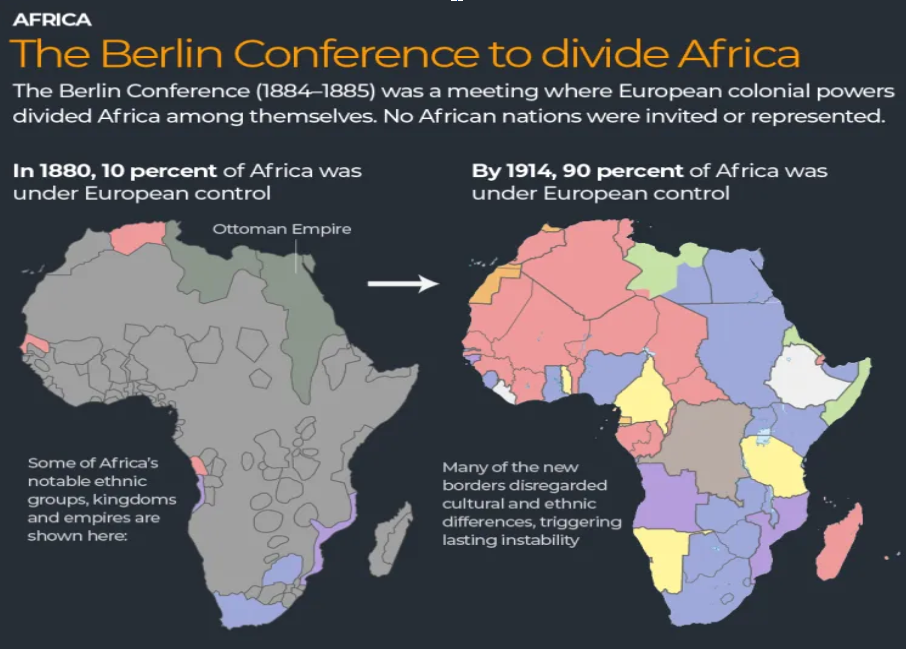
- It is the rapid territorial occupation and colonisation of African territories by European powers, particularly between 1880 and 1914.
- Before the conference (1880): European colonial possessions were largely concentrated in coastal regions and selected territories, including Algeria, Senegal, the Gold Coast, Angola and Mozambique.
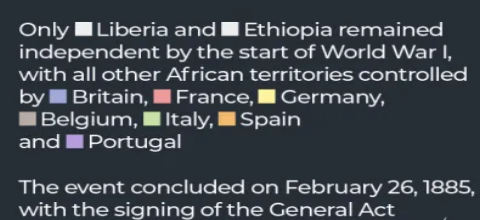
- After the conference (1914): Almost the entire African continent had come under European colonial control, with Ethiopia and Liberia remaining largely independent.
- Major colonial powers: Britain, France, Germany, Belgium, Portugal and Italy.
Consequences of the Partition of Africa
- Artificial Boundaries: Colonial boundaries divided ethnic and cultural communities and combined historically distinct groups, contributing to future political tensions.
- Economic Exploitation: European powers extracted minerals, agricultural products and other natural resources to serve their industrial and commercial interests.
- Political Subordination: Traditional African kingdoms and political institutions were weakened or dismantled and replaced by colonial administrative systems.
Concluding remarks
- The Berlin Conference did not legally partition Africa into colonies or provide particular regions to specific European countries. It, however, greatly helped the later split of the continent.
- It remains a stark example of colonialism motivated by commercial interests, geopolitical competition and the exclusion of indigenous populations from decisions that affect their sovereignty.
Source: IE
Previous article
News In Brief 16-11-2026
Next article
23rd ASEAN-India Summit
