


Syllabus: GS3/ Economy
Context
- Ten years after demonetisation, Reserve Bank of India (RBI) data show that the exercise has had little impact on reducing cash in circulation and that detection of counterfeit notes.
Background
- Announcement: The government on November 8, 2016, stated that the ₹500 and ₹1,000 notes would cease to be legal tender.
- Impact: The measure wiped out about 86% of the value of the cash in circulation.
- Objectives:
- Curb black money and corruption.
- Eliminate counterfeit currency.
- Disrupt terror financing and hawala transactions.
- Promote digital payments and a less-cash economy.
- Encourage the economy’s formalisation.
Earlier Instances of Demonetisation in India
- Demonetisation of 1946: During the Second World War, the British Indian Government had withdrawn the legal tender character of high denomination notes of Rs. 500, Rs. 1,000 and Rs. 10,000 by the High Denomination Bank Notes Ordinance, 1946.
- Demonetisation of 1978: The government withdrew ₹1,000, ₹5,000 and ₹10,000 notes from circulation.
- It was Implemented by the High Denomination Bank Notes (Demonetisation) Act, 1978.
- This was as per the recommendations of the Wanchoo Committee (Direct Taxes Inquiry Committee) which had enquired into black money and tax evasion.
Key Findings After 10 Years
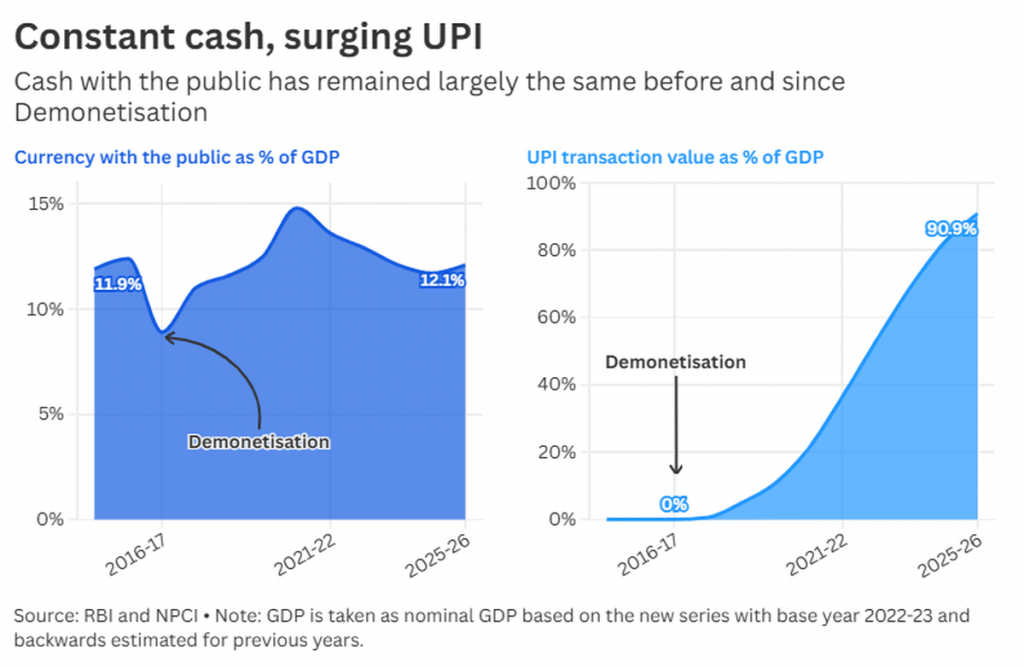
- Limited Reduction in Cash Circulation: Currency with the public as a percentage of GDP has remained largely unchanged.
- Currency with the public as a percentage of GDP stood at 11.9% in 2015-16, the financial year preceding demonetisation, and rose marginally to 12.1% by March 31, 2026.
- The value of UPI transactions as a percentage of GDP has grown from zero in 2016-17 to nearly 91% in 2025-26.
- Curbing Counterfeit Currency: Across all denominations, counterfeit notes detected per one crore notes in circulation declined from 70.1 in 2015-16 to 13.4 in 2025-26.
- However, the detection of counterfeit new-series ₹500 notes increased from 0.3 per crore notes in 2016-17 to 20.1 in 2025-26.
- Detection of counterfeit ₹2,000 notes also increased after the RBI initiated their withdrawal from circulation in 2023.
Supreme Court Judgement
- In Vivek Narayan Sharma v. Union of India (2023), a five-judge Constitution Bench of the Supreme Court examined the legality of the 2016 demonetisation decision.
- The Supreme Court upheld the validity of the demonetisation exercise.
- It held that the Central Government could exercise its powers under Section 26(2) of the RBI Act, 1934, on the recommendation of the RBI’s Central Board.
Way Ahead
- Improve coordination among RBI, Financial Intelligence Unit-India (FIU-IND) and enforcement agencies to identify suspicious financial transactions and curb money laundering.
- Target Sources of Black Money: Focus on benami properties, shell companies, tax evasion and undisclosed assets rather than relying primarily on currency withdrawal.
- Improve Tax Compliance: Simplify tax procedures, strengthen information-sharing and encourage voluntary tax compliance to reduce the informal economy.
Source: TH
Previous article
National Entrepreneurship Day
Next article
News In Brief 10-11-2026
