


Syllabus: GS3/ Economy/ Animal Husbandry
Context
- The Union Government is focusing on island fisheries to unlock India’s marine fisheries potential, particularly in tuna, seaweed and ornamental fisheries.
Potential of India’s Fisheries Sector
- India has a coastline of about 11,098.81 km, of which 3,083.50 km is along the Andaman & Nicobar (A&N) Islands and 144.8 km is along Lakshadweep.
- The country has a large network of fisheries with 1,537 fish landing sites and 3,432 fishing villages(settlements).
- India is the second largest fish producing country in the world accounting for about 8 per cent of the world’s fish production.
- India’s Exclusive Economic Zone (EEZ) has over 2.02 million sq. km with an estimated annual marine fisheries potential of 7.16 million tonnes, according to NITI Aayog.
- Seafood export from India was worth over ₹73,890 crore in FY 2025-26.
Significance of Island Fisheries for India’s Blue Economy
- Untapped Marine Resources: The two island groups together account for nearly 40% of India’s EEZ, providing access to rich oceanic fishing grounds and tuna migration routes.
- Export Potential: High-value species such as tuna strengthen India’s position in the global seafood market.
- Diversification of Fisheries: Seaweed cultivation and ornamental fisheries expand income opportunities beyond traditional capture fisheries.
- Strategic Importance: Their location in the Arabian Sea and Bay of Bengal strengthens India’s maritime presence and ocean-based economic activities.
Government initiatives
- Marine Products Export Development Authority (MPEDA): It facilitates technology upgradation, market development, and quality certification.
- National Marine Fisheries Action Plan (NMFAP): The plan includes measures to improve fishery resources assessment, enhance infrastructure and technology in the fisheries sector, and promote aquaculture development.
- Pradhan Mantri Matsya Sampada Yojana (PMMSY): It was implemented to bring the Blue Revolution through sustainable and responsible development of the fisheries sector in India from FY 2020-21 to FY 2024-25.
- The Sustainable Harnessing of Fisheries in the Exclusive Economic Zone Rules, 2025, establish a formal legal and regulatory framework for deep-sea and offshore fishing across India’s Exclusive Economic Zone (EEZ) extending from 12 to 200 nautical miles.
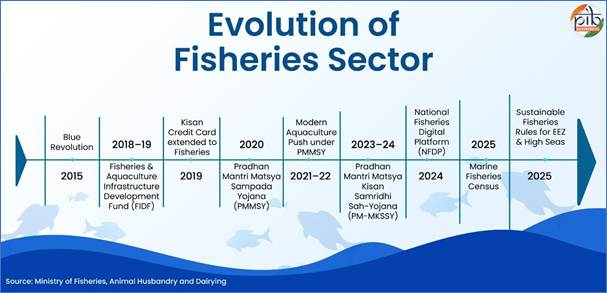
Focus on the A&N and Lakshadweep Islands
- The Andaman & Nicobar Islands account for 6.6 lakh sq km of EEZ, roughly one-third of India’s total maritime zone.
- A dedicated “tuna cluster” has been notified, which includes on-board processing and freezing facilities, licensing of deep-sea tuna vessels, and a single-window clearance system administered by the Andaman & Nicobar Administration.
- The Lakshadweep Islands cover an EEZ of 4 lakh sq km, about 17% of India’s total EEZ, along with a lagoon area of 4,200 sq km.
- Lakshadweep has been notified as a dedicated seaweed cluster.
- The government has placed a major strategic focus on establishing medium-scale ornamental fish rearing units in Lakshadweep.
Challenges in Developing Island Fisheries
- Ecological Fragility: Coral reefs, lagoons and marine biodiversity are vulnerable to overfishing, habitat degradation and unsustainable fishing practices.
- Climate Change: Rising sea temperatures, ocean acidification and coral bleaching can affect fish populations and marine ecosystems.
- Infrastructure Gaps: Limited cold storage, processing facilities, transportation and connectivity increase post-harvest losses.
- Limited Technical Capacity: Traditional fishers lack access to modern fishing technologies, scientific information and improved preservation techniques.
- Market Access Constraints: Distance from major seafood markets and inadequate export infrastructure limit the competitiveness of island-based fisheries.
- Risk of Overexploitation: Expansion of commercial fishing without scientific stock assessment can threaten the long-term sustainability of marine resources.
Way Ahead
- Invest in modern harbours, cold-chain logistics, and processing facilities to reduce post-harvest losses and enhance export competitiveness.
- Expand training and skill development programmes for traditional and small-scale fishers to enable their participation in deep-sea and High Seas fishing.
- Adopt science-based fishing practices, regular assessment of fish stocks and regulated fishing to prevent overexploitation of marine resources.
Source: PIB
Previous article
Need to Review Safe Harbour for Social Media Companies
Next article
National Entrepreneurship Day
