


Syllabus: GS3/ Science and Technology/ Energy
Context
- Recent developments in nuclear fusion research have renewed interest in fusion power, particularly in plasma confinement using tokamaks.
About Tokamak
- A tokamak is a device (experimental fusion reactor) that uses magnetic fields to confine extremely hot plasma within a toroidal (doughnut-shaped) vacuum chamber.
- Origin: Developed in the Soviet Union during the early 1950s, primarily by physicists Igor Tamm and Andrei Sakharov.
- Meaning: The word Tokamak is derived from a Russian abbreviation for ‘toroidal chamber containing magnetic coils’.
- Plasma is the fourth state of matter, made up of unbound electrons and positively charged ions. It is prepared by heating a gas to a very high temperature.
How Does a Tokamak Work?
- Creation of Superheated Plasma: Hydrogen isotopes, primarily deuterium and tritium, are heated to temperatures of around 150 million °C.
- At these temperatures, their nuclei can overcome electrostatic repulsion and undergo nuclear fusion.
- Magnetic Confinement through Magnetic Fields: Since no physical material can withstand the extreme temperatures of plasma, a tokamak uses powerful magnetic fields to keep it away from the reactor walls.
- External magnetic coils generate a magnetic field around the toroidal chamber, while an electric current induced through the plasma by a central solenoid generates a second magnetic field.
- The interaction of these magnetic fields produces helical magnetic field lines that help to confine the plasma and minimise particle losses.
- Nuclear Fusion Reaction: Deuterium and tritium nuclei combine to form helium and a high-energy neutron, releasing energy.
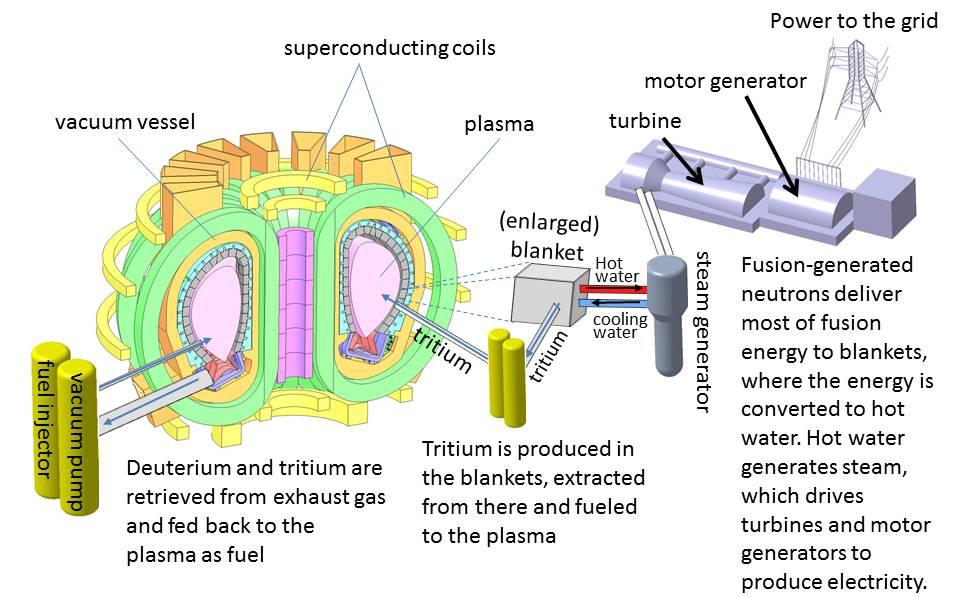
How Is Electricity Generated?
- Energy release: Approximately 80% of the energy released during deuterium-tritium fusion is carried by neutrons, while 20% is carried by helium nuclei (alpha particles).
- Heat generation: High-energy neutrons strike the surrounding blanket, transferring their energy as heat.
- Tritium breeding: The blanket contains lithium, which reacts with neutrons to produce tritium, helping replenish the reactor’s fuel.
- Electricity generation: A coolant transfers the heat to a steam-generation system, which drives turbines to generate electricity.
Why haven’t tokamaks produced energy so far?
- Extreme temperature requirements: Maintaining plasma at temperatures exceeding 100 million °C is technically challenging.
- Plasma instability: Plasma can develop instabilities that lead to energy and particle losses, disrupting confinement.
- Material limitations: Reactor-facing components must withstand intense heat, radiation and neutron bombardment.
- Tritium availability: Tritium is scarce and radioactive, requiring reliable breeding and fuel-handling systems.
- High costs: Constructing and operating fusion reactors requires advanced materials, superconducting magnets and sophisticated control systems.
Major Developments in Tokamak Technology
- International Thermonuclear Experimental Reactor (ITER): A major international collaboration involving seven members; China, the European Union, India, Japan, South Korea, Russia and the United States.
- Located at Cadarache, France, it aims to demonstrate the scientific and technological feasibility of fusion energy.
- It is designed to produce 500 MW of fusion power using 50 MW of external plasma heating power (a fusion energy gain factor, Q, of 10).
- Under its revised baseline, deuterium-tritium operations are planned for 2039.
- China’s EAST Tokamak: The Experimental Advanced Superconducting Tokamak (EAST) in China sustained high-confinement plasma for 1,066 seconds in 2025.
- However, EAST has not achieved net energy production.
India’s Progress in Tokamak Research
- The two main machines are at the Institute for Plasma Research (IPR) in Gandhinagar.
- ADITYA, India’s first tokamak, began operating in 1989 and was rebuilt as ADITYA-U, which resumed operations in 2017.
- SST-1, the Steady State Superconducting Tokamak, produced its first plasma in 2013 and uses superconducting magnets.
- PRAGYA: An experimental compact tokamak unveiled by Bengaluru-based Pranos Fusion, aimed at developing capabilities in plasma control and magnetic confinement.
- ITER participation: India is a member of ITER and contributes through the development and supply of several specialised reactor components.
Alternatives to Tokamak Technology
| Technology | Key features | Example |
| Stellarator | Uses complex external magnetic coils to confine plasma without relying on a large plasma current. | Wendelstein 7-X, Germany |
| Inertial Confinement Fusion | Uses powerful lasers or particle beams to compress a small fuel pellet, initiating fusion. | National Ignition Facility, USA |
| Magnetic Mirror | Uses magnetic fields to confine plasma, with stronger fields at the ends to reflect charged particles. | Mirror fusion experiments |
Concluding remarks
- Tokamak technology represents a major pathway to controlled nuclear fusion.
- However, achieving stable plasma confinement, sustainable fuel supply and a positive overall energy balance remains essential before fusion can become a commercially viable source of clean energy.
Source: TH
Previous article
Asset Monetisation
Next article
India’s Push Towards Debris-Free Space by 2030
