


Syllabus: GS3/Environment
In News
- International Day for Biosphere Reserves is observed every year on November 3.
What are Biosphere Reserves?
- They are areas identified by national governments for conserving biodiversity and promoting sustainable development.
- They protect natural habitats, maintain ecological balance and promote the sustainable use of biological resources.
- They cover approximately 5% of Earth’s terrestrial surface, yet sustain over 60% of the world’s terrestrial vertebrate species richness.
- The first biosphere reserves were designated in 1976. Biosphere reserves are found on every continent. except Antarctica.
- Mata Atlantica Biosphere Reserve is the largest biosphere reserve in the world. It is located in Brazil
- As per the Map of the World Network of Biosphere Reserves 2025-26, about 40% of Biosphere reserves may face more extreme climate events by 2050 and more than 50% of all biosphere reserves overlap with another international designation.
Zones of Biosphere reserves
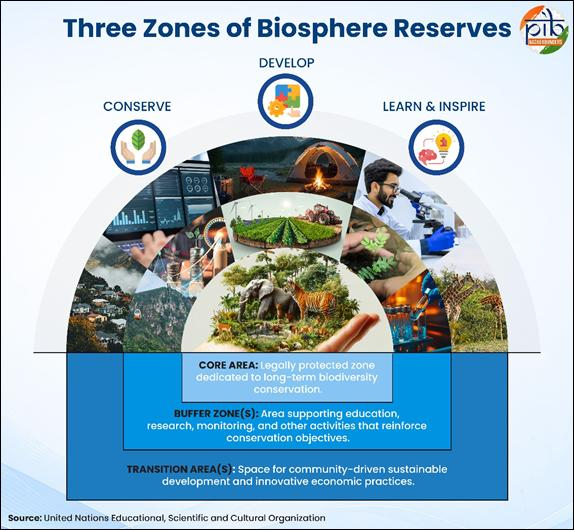
- Core Area: The core area provides the highest level of protection for ecosystems and biodiversity.
- It conserves habitats, species and genetic diversity while maintaining essential ecological processes. Human activities are strictly limited, with compatible research and monitoring supporting long-term conservation.
- Buffer Zone: The buffer zone surrounds or adjoins the core zone.
- It accommodates activities compatible with conservation, including environmental education, scientific research and regulated ecotourism.
- These activities improve ecological understanding while helping reduce pressures on strictly protected areas.
- Transition Area: The transition area supports settlements, livelihoods and sustainable economic activities.
- Communities can practise responsible agriculture, sustainable forestry, ecotourism and other locally appropriate activities.
- This area promotes livelihoods while encouraging the sustainable use of natural resources.
Functions of Biosphere Reserves
- Conservation: Protect biodiversity, genetic resources, ecosystems and landscapes, including associated cultural diversity.
- Sustainable Economic Development: Encourage economic and social activities that respect ecological limits and local cultural values.
- Scientific Support: Underpin scientific research, environmental monitoring, education, training and knowledge exchange to improve conservation practices.
- Achieving Global Goals: They help in achieving global development targets such as those set by the Kunming-Montreal Global Biodiversity Framework, inter alia, on protecting and restoring significant portions of the Earth’s ecosystems by 2030.
How are Biosphere Reserves Different from Other Protected Areas?
- Protected areas such as National Parks and Wildlife Sanctuaries primarily focus on protecting wildlife and their habitats under India’s wildlife protection laws.
- Biosphere reserves adopt a broader approach. They connect protected ecosystems with surrounding communities, making biosphere reserves a model for demonstrating how biodiversity and human well-being can coexist.
Various Steps
- UNESCO’s Man and the Biosphere (MAB) Programme : It was launched in 1971 and it promotes scientific approaches to improving relationships between people and their environment.
- It comprises 797 biosphere reserves across 145 countries.
India’s Status
- India’s Biosphere Reserve network represents its varied ecosystems and diverse ecological heritage.
- The country has 18 notified Biosphere Reserves, of which 13 belong to UNESCO’s World Network of Biosphere Reserves (WNBR).
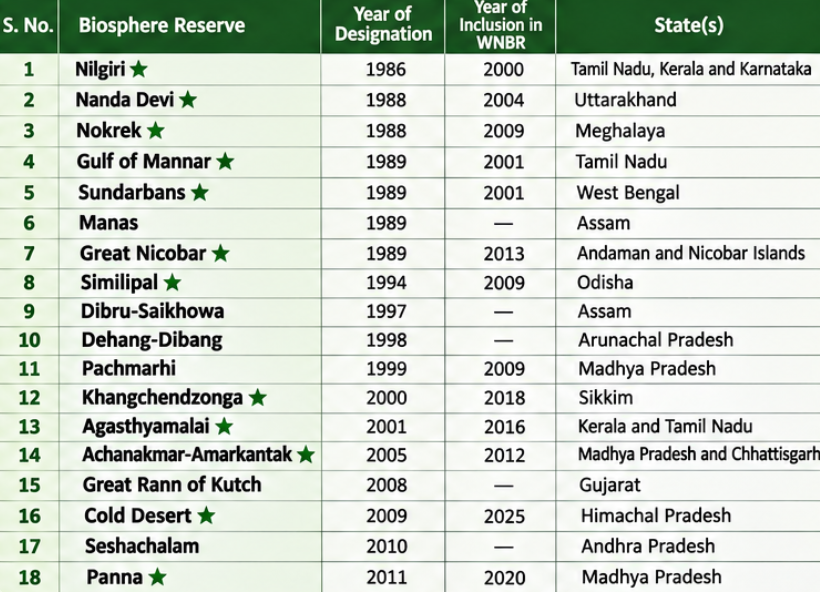
Note: An (*) indicates Biosphere Reserves included in UNESCO’s World Network of Biosphere Reserves (WNBR).
Source : PIB
Previous article
India-Origin Buddha Relics to Be Enshrined in 108 Chortens in Bhutan
Next article
New Grievance Rules Under the VB-G RAM G Act
