


Syllabus: GS3/ Economy
In News
- An unofficial IPO grey market is gaining traction in India amid a surge in companies raising funds through Initial Public Offerings (IPOs).
- The Small Investors Welfare Association (SIREN) has urged the Securities and Exchange Board of India (SEBI) to intervene against alleged illegal trading, manipulation and inflated Grey Market Premiums (GMPs).
What is an IPO?
- An Initial Public Offering (IPO) is the process through which an unlisted company offers its shares to the public for the first time and gets listed on a recognised stock exchange.
- It is a primary market mechanism through which companies raise capital and provide an opportunity for investors to acquire ownership in the company.
Types of IPO
- Fresh Issue: The company issues new shares and receives the proceeds for business expansion, capital expenditure, debt repayment or research and development.
- Offer for Sale (OFS): Existing shareholders, such as promoters or private equity investors, sell their shares to the public. The proceeds go to the selling shareholders, not the company.
Objectives of an IPO
- Raising long-term equity capital.
- Financing business expansion and capital expenditure.
- Repaying debt and improving the company’s financial position.
- Providing an exit opportunity to founders, promoters and early investors.
Categories of IPO Investors
- QIBs (Qualified Institutional Buyers): Such as mutual funds, insurance companies and eligible financial institutions
- NIIs (Non-Institutional Investors): Including high-net-worth individuals
- Retail Individual Investors: Applying within the prescribed retail investment limit.
- Anchor Investors: Eligible QIBs who invest before the public issue opens.
How does an IPO Work?
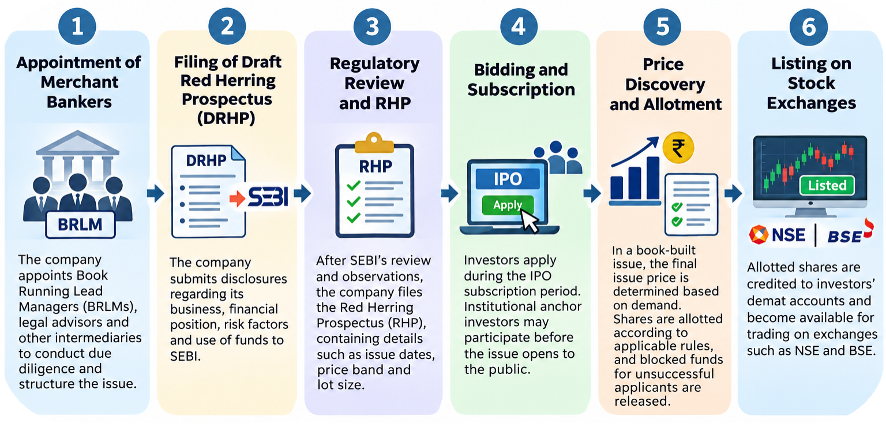
What is the IPO Grey Market?
- The IPO grey market is an unofficial, unregulated market where shares of companies yet to be listed are traded, outside recognised stock exchanges.
- Transactions take place through informal networks, brokers and private arrangements.
- Such trades are not conducted through the official stock exchange mechanism.
- Grey Market Premium (GMP) refers to the unofficial premium at which IPO shares are traded before listing.
- GMP is often used by investors to estimate the possible listing price of an IPO.
How Does the Grey Market Operate?
- Suppose a company launches an IPO at an issue price of ₹1,000 per share.
- The share is traded in the grey market at a premium of ₹300.
- The unofficial expected listing price becomes ₹1,300.
- If the share lists at ₹1,400, the buyer gains ₹100.
- If it lists at ₹1,200, the buyer loses ₹100.
Why is the Grey Market Growing?
- IPO boom: Increasing number of public issues attracts speculative activity.
- Expectation of listing gains: Investors seek quick profits from IPOs.
- Information asymmetry: Retail investors rely on unofficial GMP figures to assess demand.
- Digital platforms: WhatsApp, Telegram and public tracking portals facilitate circulation of unofficial premiums.
- Regulatory gaps: Transactions occurring outside recognised exchanges are difficult to monitor.
- Market euphoria: High GMPs create expectations of strong listing performance.
Major Concerns
- Misleading demand signals: Publicised GMPs are read as proof of strong subscription, though they do not reflect verified orders. Retail investors mistake hype for fundamentals and skip scrutiny of valuation, financials, and business risks.
- Market Manipulation: Unofficial premiums can be artificially inflated to create hype.
- Retail investor vulnerability: The lure of quick gains pushes unsophisticated investors to borrow or commit savings. For example, the Reliance Power IPO showed despite a heavy pre-listing premium, the stock fell nearly Rs 100 below its Rs 450 offer price on listing.
- Financial Stability and Market Integrity: Speculative activity can weaken confidence in the primary market. It may distort price discovery and undermine fair participation.
Way Forward
- Clarify legality: SEBI should issue a clear stance distinguishing permissible conduct from actionable violations.
- Inter-agency coordination: SEBI, state police, the Enforcement Directorate and the Financial Intelligence Unit should share intelligence and act jointly.
- Platform accountability: Social media intermediaries and websites publishing GMPs should face advisories and takedown norms.
- Investor awareness: SEBI and exchanges should run advisories stating that GMP is not a reliable indicator and that IPOs carry no guaranteed listing gains.
Source: IE
Previous article
New Grievance Rules Under the VB-G RAM G Act
Next article
News In Brief 03-11-2026
