


Chola-era Idols Unearthed in T.N
Syllabus: GS1/Art and Culture
In News
- Tamil Nadu State Department of Archaeology (TNSDA) has unearthed bronze alloy idols of Lord Nataraja and Goddess Sivagami, along with their respective pedestals, during the ongoing excavations at Nagapattinam.
Cholas
- They were a dominant power in peninsular India in the 10th and 13th centuries, under rulers like Rajaraja I, Rajendra I and Rajadhiraja I, who expanded their authority by military victories in Sri Lanka and Southeast Asia.
- The control they had over the fertile Kaveri delta, which allowed agriculture, trade, and urban growth, was partially the basis of their economic prosperity.
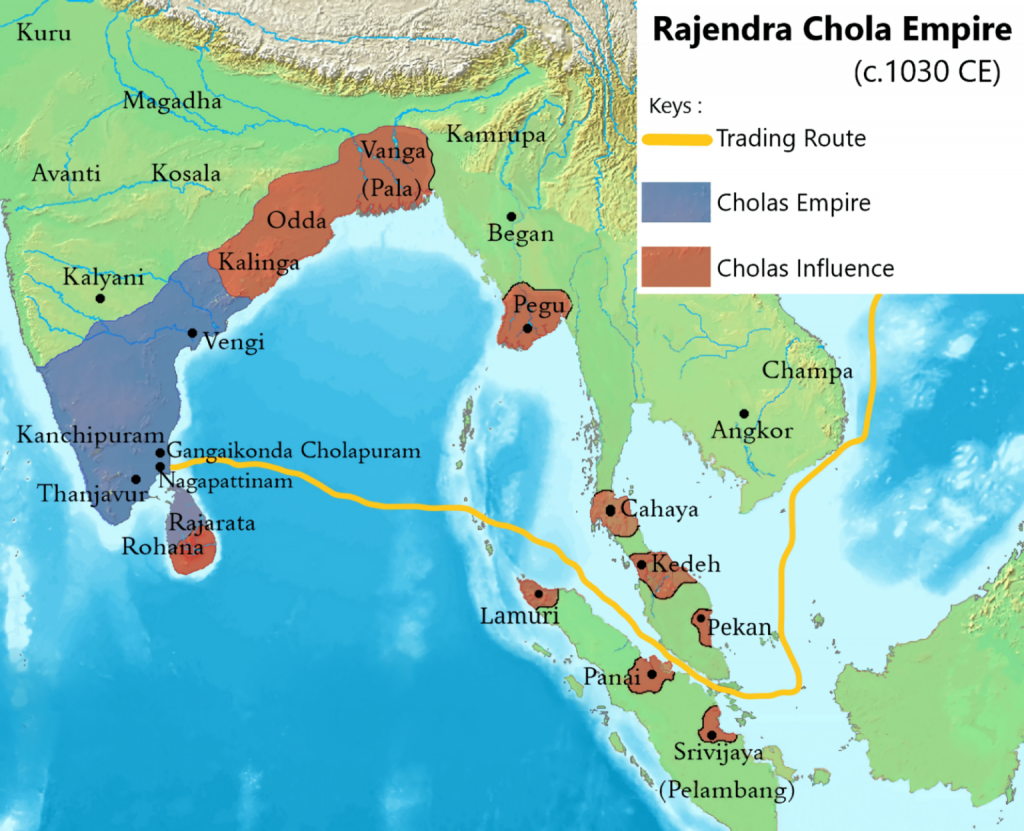
- The Chola economy was founded on commercial towns known as nagaram, which linked merchant groups with religious establishments.
- Temples, especially Brahmanical temples, stimulated regional and international trade through the demand they created for ritual and luxury goods.
- Temple urbanisation is the close relationship between temples, trade and the growth of towns.
Recently Discovered Idols
- The idol of Lord Nataraja is depicted in the ‘Ananda Tandava’ posture with four arms and measures 110 cm in height and 100 cm in width.
- The idol of Goddess Sivagami is depicted in the ‘Tribhanga’ posture with two arms and measures 82 cm in height and 23 cm in width.
Features
- The idols are estimated to date back to the 12th century AD based on their physical structure, iconographic features, ornamental designs, and the construction of the pedestals.
- The idols belong to the Chola period and were unearthed at a depth of one metre.
Importance of discoveries
- These discoveries provide crucial archaeological evidence for understanding the religious practices, art, and history of metal sculpture in Nagapattinam during the Chola period.
Source: TH
National Unity Day
Syllabus: GS1/History; Miscellaneous
Context
- The Rashtriya Ekta Diwas, or National Unity Day, is observed annually on October 31.
About National Unity Day
- Introduced in 2014, the day commemorates the birth anniversary of Sardar Vallabhbhai Patel, India’s first Deputy Prime Minister and Home Minister.
- Patel, along with V.P. Menon, played a key role in integrating more than 560 princely states into the Indian Union through diplomacy and negotiations.
- Theme 2026: “Ek Bharat Shreshtha Bharat”, highlighting national integration and unity in diversity.
Do You Know?
- The Sardar Patel National Unity Award was instituted by the Ministry of Home Affairs (MHA) in 2019 to recognise outstanding contributions towards national unity and integrity.
Source: AIR
Fiscal Deficit
Syllabus: GS3/Economy
Context
- India’s fiscal deficit widened in the first six months of FY27, as capital spending and subsidy outlays continued to rise.
About
- The fiscal deficit stood at ₹7.14 trillion at the end of September, this amounts to 42.1% of the full-year budget estimate.
- The higher proportion of the budgeted fiscal deficit already incurred in the first half of FY27 indicates mounting pressure on the government’s fiscal balance.
- The Centre has budgeted a fiscal deficit of ₹16.96 trillion, or 4.3% of GDP, for FY27.
- It is relying on robust tax collections and higher non-tax revenues in the coming months to meet this target.
What is the fiscal deficit?
- Fiscal Deficit is defined as excess of total budget expenditure (revenue and capital) over total budget receipts (revenue and capital) excluding borrowings during a fiscal year.
- Fiscal Deficit = Total Expenditure – (Revenue Receipts + Non-Debt Creating Capital Receipts).
Implications of fiscal deficit
- Inflationary Pressure: Persistently high fiscal deficits lead to inflation as governments resort to central bank-issued money to finance the deficit.
- Crowding Out effect: When the government borrows a large portion of available funds from financial markets to finance its deficit, it crowds out private investment with reduced access to credit for businesses and individuals.
- Reduced Fiscal Space: A high fiscal deficit limits the government’s ability to respond to economic shocks or crises.
- Difficulty in borrowing: As a government’s finances worsen, demand for the government’s bonds begins to drop, forcing the government to offer to pay a higher interest rate to lenders.
Source: LM
High-Level Committee on Banking for Viksit Bharat
Syllabus: GS3/ Economy
Context
- The Government of India has constituted a High-Level Committee on Banking for Viksit Bharat, chaired by former Central Vigilance Commissioner Suresh N. Patel.
Terms of Reference of the Committee
- The committee will examine existing banking practices, prudential norms and international best practices to develop a roadmap for creating globally competitive Indian banks.
- Develop a roadmap to create Indian banks capable of competing with leading international banking institutions, with the aspiration of having at least one or two Indian banks among the world’s top 20 by 2047.
- State Bank of India is the only public sector bank in the top 100, with its rank falling to 45 in the latest list, down from 43.
- HDFC Bank is the only other Indian bank in the top 100, with its ranking falling from 73 to 76.
- The committee will prepare a roadmap for adopting artificial intelligence and digital innovation across banking institutions while recommending safeguards against cybersecurity risks.
- The panel will review the existing Priority Sector Lending framework and Lead Bank Scheme to assess their effectiveness in expanding access to credit.
Source: IE
Dr Homi Jehangir Bhabha
Syllabus: GS3/ Science and Technology
Context
- Dr Homi Jehangir Bhabha is remembered as the father of India’s nuclear programme.
About
- Homi Jehangir Bhabha was born on October 30, 1909.
- He helped conceptualise India’s Three-Stage Nuclear Power Programme.
- He presided over the First United Nations International Conference on the Peaceful Uses of Atomic Energy, held in Geneva in 1955.
Scientific Contributions
- He calculated the probability of scattering between electrons and positrons, a process known as Bhabha scattering, which became important in particle physics experiments.
- Along with Walter Heitler, he developed the theory of cosmic ray showers, explaining how high-energy cosmic particles produce cascades of secondary particles when they enter the Earth’s atmosphere.
Institutional Foundations of India’s Nuclear Programme
- Tata Institute of Fundamental Research (TIFR): In 1945, with support from the Tata Trust, Bhabha helped establish the TIFR in Mumbai, becoming its first director.
- Atomic Energy Commission (AEC): Bhabha played a key role in establishing the Atomic Energy Commission (AEC) in 1948 and became its first chairman.
- The Department of Atomic Energy (DAE), 1954, was established under the direct charge of the Prime Minister, with Bhabha as its first Secretary.
- Atomic Energy Establishment, Trombay (AEET): Bhabha led the establishment of the Atomic Energy Establishment at Trombay in Mumbai in 1954.
- Later, in 1967, it was renamed the Bhabha Atomic Research Centre (BARC) in his honour.
Awards & Honours
- He was awarded the Adams Prize (1942).
- He was awarded Padma Bhushan in 1954, the third-highest civilian award in India.
- He was also nominated for the Nobel Prize for Physics in 1951 and 1953–1956.
Source: DD News
Bihar Museum in World Top 10
Syllabus: Miscellaneous
Context
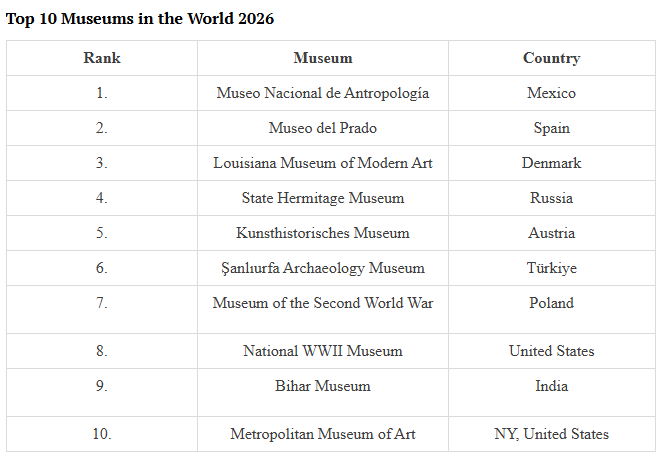
- Patna’s Bihar Museum has been ranked the top museum in Asia and ninth globally in a list of the world’s 100 best museums for 2026 by German travel guide and digital magazine.
About
- The ranking list covered 3,800 venues across 142 countries.
- Eligible museums were required to have a permanent collection or exhibition open to the public.
- Categories included art museums, history and archaeology museums, science and natural history museums, technology and transport museums, and open-air museums.
About Bihar Museum
- The museum was inaugurated in 2015, with its development continuing over the subsequent years.
- Its design was led by Japanese architect Fumihiko Maki, a recipient of the prestigious Pritzker Architecture Prize.
- One of its most celebrated treasures is the Didarganj Yakshi, a remarkable Mauryan-era sculpture known for its distinctive polished finish and intricate craftsmanship.
- From the Mauryan, Gupta and Pala periods to Buddhist and Jain heritage, its galleries preserve stories that have shaped India’s past.
Source: IE
Previous article
Cloud Ecosystem in India
Next article
News In Brief 31-10-2026
