


Victoria Mode (VM) Phenomenon
Syllabus: GS1/ Geography; GS3/ Environment and Climate Change
Context
- A recent study by the India Meteorological Department (IMD) has linked changes in India’s climate zones to the Pacific Ocean phenomenon known as the Victoria Mode (VM).
What is Victoria Mode?
- Victoria Mode (VM) is a recurring pattern of warm and cool sea-surface temperature variations in the North Pacific Ocean.
- It influences atmospheric circulation and the movement of moisture, affecting rainfall patterns over distant regions, including India.
- The study associates the negative phase of Victoria Mode with reduced moisture transport towards northern India, contributing to declining rainfall and the expansion of drier climate zones.
Key Findings of the Study
- Northwest India: The area under the hot, semi-arid steppe climate increased from 25.7% in 1951–80 to 33.1% in 1991–2020. The temperate zone declined from 25.8% to 18.7%.
- The steppe zone’s eastern edge moved from west Uttar Pradesh to the eastern part of the state.
- Northeast India: The tropical savannah zone contracted from 18.4% to 11.8%, while the temperate zone expanded from 74.8% to 82.5%.
- Gangetic plains: The study observed a shift from savannah to temperate conditions in parts of Gangetic West Bengal, alongside drying trends across the northern plains.
- Peninsular India: The hot semi-arid steppe zone fell from 30.3% of the region’s area in 1951-80 to 16.4% in 1991-2020. Tropical savannah rose from 61.6% to 75.7%.
- Konkan and Goa, coastal Karnataka, and Kerala and Mahe saw their tropical monsoon zones expand.
- Western India: Parts of Saurashtra and Kutch shifted from arid to semi-arid conditions, while West Vidarbha and Marathwada shifted towards a semi-arid steppe climate.
Source: TH
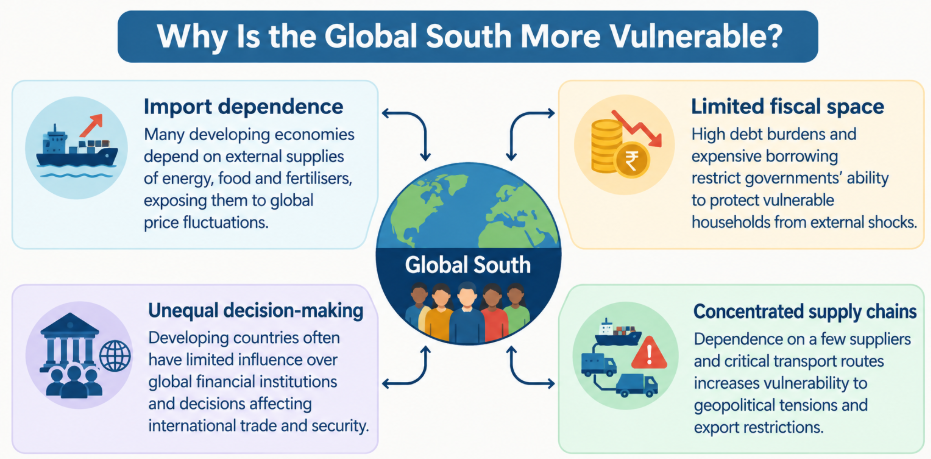
The Global South Faces a ‘4F Crisis’
Syllabus: GS2/International Relations
Context
- External Affairs Minister S. Jaishankar said the 4F crises of finance, fuel, food and fertilisers facing the Global South owing to wars in Ukraine and West Asia need increased accountability from the Global North.
About 4F Crisis
- Fuel: Conflicts and disruptions to maritime chokepoints such as the Strait of Hormuz, the Red Sea, etc. restrict oil and gas supplies, increasing transportation costs and fuel inflation.
- Fertilisers: Natural gas shortages and shipping disruptions raise nitrogen fertiliser production costs, increasing farmers’ expenses and threatening crop yields and food security.
- Food: Higher energy, fertilizer and freight costs raise food-production and distribution expenses.
- The World Bank reported in September 2026 that global cereal prices had risen since June, with wheat prices up 22% and maize prices up 26%.
- Finance: Developing countries are facing high borrowing costs, debt-servicing pressures and constrained access to development finance.
Source: HT
Integrated Atmospheric Chemistry and Aerosol Toxicity Analysis Laboratory
Syllabus: GS3/Environment
In News
- Recently, the Union Minister of State (Independent Charge) for Science and Technology and Earth Sciences inaugurated the world’s first- of -its-kind ‘Air Pollution Analysis’ facility for Delhi NCR.
Integrated Atmospheric Chemistry and Aerosol Toxicity Analysis Laboratory
- It is the world’s first- of -its-kind ‘Air Pollution Analysis’ facility
- It is known as ‘Integrated Atmospheric Chemistry and Aerosol Toxicity Analysis Laboratory ‘ (AATAL).
- It has been established under ‘Mission Mausam’ to strengthen scientific understanding of atmospheric pollution and provide actionable evidence for air-quality management in Delhi-NCR.
Features
- It brings together advanced atmospheric measurement instruments, detailed chemical analysis, pollution-source identification, and decision-support capabilities within an integrated framework.
- It is equipped with advanced instruments for analysing the chemical composition of atmospheric gases and aerosols, including fine particulate matter (PM2.5), metals, toxic elements, and other components.
- It would take air-quality assessment beyond simply reporting pollution levels to identifying the composition of pollutants, their sources, their relative contributions, and their potential health implications
Importance
- It will help understand the composition of pollution as well as the contribution of different sources, which is important for addressing the concerns of the people of Delhi and ensuring that action is based on scientific evidence
- It will help scientists distinguish between different sources of air pollution, including vehicular emissions, industrial activity, biomass and crop-residue burning, construction and road dust, and pollutants transported from surrounding regions.
Source: PIB
IAF Marks 94th Anniversary
Syllabus: GS3/Defence
Context
- Prime Minister Narendra Modi witnessed the Indian Air Force’s Wings Over Ganges aerial display in Varanasi as part of celebrations marking the IAF’s 94th anniversary.
About the Indian Air Force (IAF)
- Establishment: The IAF was officially established on 8 October 1932.
- First operational flight: 1 April 1933, with four Westland Wapiti aircraft.
- Royal prefix: The IAF received the prefix “Royal” in 1945 in recognition of its contribution during the Second World War.
- Post-independence: The prefix was dropped in 1950 when India became a republic.
- Role: Protecting Indian airspace, conducting air operations and supporting humanitarian assistance and disaster relief.
- Motto: Nabhah Sparsham Diptam, commonly translated as “Touch the Sky with Glory”, is derived from the 11th chapter of the Bhagavad Gita. It reflects the IAF’s association with the ideals of courage, service and excellence.
Source: IE
Previous article
Cross-Border Drug Trafficking in India
Next article
News In Brief 26-10-2026
