


Syllabus: GS1/ Climatology
Context
- The World Meteorological Organization (WMO) has indicated that the developing El Niño event could intensify towards the end of 2026, with its effects potentially extending into 2027.
About El Niño
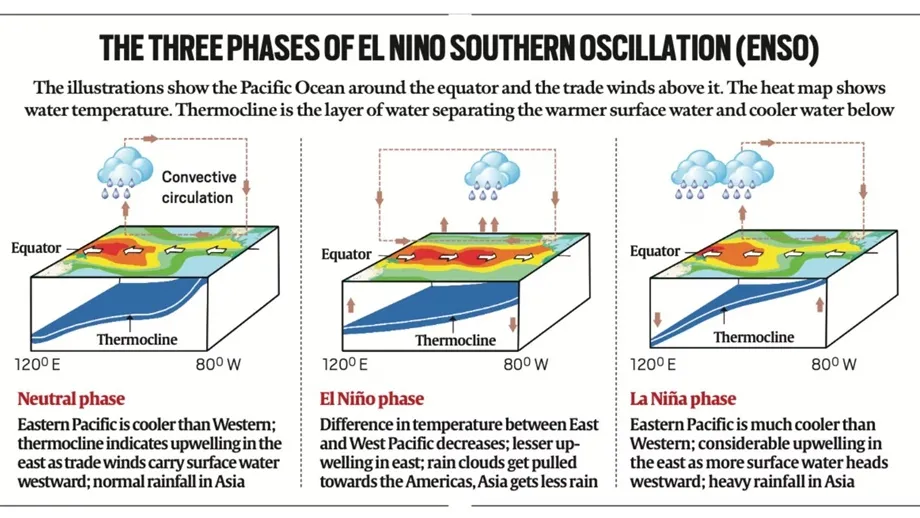
- El Niño is the warming of seawater in the central-east Equatorial Pacific that occurs every few years.
- During El Niño, surface temperatures in the equatorial Pacific rise, and trade winds, east-west winds that blow near the Equator, weaken.
- It is one of the three phases of a large ocean-atmosphere interaction over the Pacific region that influences weather patterns worldwide.
- This interaction is known as the El Niño Southern Oscillation, or ENSO. Its three phases are: warm (El Niño), neutral, and cool (La Niña).
- Godzilla El Niño is a term used to describe an exceptionally strong El Niño event associated with unusually high Pacific Ocean temperatures.
How do scientists measure the strength of El Niño?
- Sea-surface temperature anomalies: Scientists monitor sea-surface temperatures in specific regions of the equatorial Pacific, particularly the Niño 3.4 region, and compare them with long-term averages.
- Relative Oceanic Niño Index (RONI): It measures the temperature anomaly in the Niño 3.4 region relative to average tropical ocean warming.
- If the average RONI over a three-month period exceeds a value of 0.5 degrees Celsius, an El Niño is declared. An average RONI value less than -0.5 degrees Celsius leads to the declaration of La Niña.
- Duration and atmospheric conditions: Scientists also assess whether the temperature anomalies persist over time and are accompanied by characteristic changes in atmospheric circulation.
- The greater the positive temperature anomaly, the stronger the El Niño signal.
Impact on India
- Weakening of the monsoon: El Niño can weaken the southwest monsoon, which contributes around 70% of India’s annual rainfall.
- According to the supplied report, the 2026 monsoon ended at 87% of the Long Period Average (LPA).
- Agricultural losses: Low rainfall and increased temperature reduce yields from crops, increase irrigation needs and impact agricultural production.
- Water distress: Less rain and more evaporation deplete reservoirs and groundwater, reducing water for drinking and farming.
- Food inflation: Lower crop output increases food prices, disproportionately affecting low-income households.
- Warmer winter: Above-normal winter temperatures affect rabi crops, particularly wheat, by disrupting temperature-sensitive growth stages.
Global Impact
- In the northern hemisphere, above-normal temperatures are likely over parts of southern Europe and Africa, the Arabian peninsula, the Indian subcontinent and eastern Asia.
- Above-normal rainfall will likely affect the Arabian peninsula, central and east Asia, coastal Southeast Asia and North America.
- In the southern hemisphere, higher-than-normal temperatures are likely to sweep Africa, particularly the equatorial regions and the Greater Horn of Africa, along with South America and Australia.
- Many parts of the southern hemisphere are expected to see weak rainfall, particularly over southern Africa, southern Central America and the Caribbean.
Way Ahead
- India should strengthen climate forecasting along with early warning systems.
- Promote climate-resilient agriculture with water conservation techniques.
- Incorporate green infrastructure and heat mitigation techniques into urban planning.
- Public awareness of heat stress and disaster preparedness needs to be increased.
Concluding Remarks
- An exceptionally strong El Niño could intensify existing climate and economic vulnerabilities, particularly in countries dependent on rainfall-based agriculture.
- Strengthening climate-resilient farming, water management, early-warning systems and international cooperation will be essential to reduce its potential impact.
Source: IE
Previous article
News In Brief 24-10-2026
Next article
Cabinet Secretariat
