


Syllabus: GS3/Economy
Context
- People across European countries are protesting, drawing attention towards the economics of social unrest.
About
- France, Albania, Belgium, Italy, and Portugal are witnessing an outpouring of discontent on the streets.
- It is often argued that growing economic inequalities in an economy lead to such social unrest.
- Rising fuel costs, discontent with the state of schools, declining public services and a housing crisis are major reasons for the protests.
The Income Gap
- The income gap is a ratio and it measures the average income difference between the poorest half and the richest tenth within a population. The higher the ratio, the greater the inequality.
- The World Inequality Report of 2026 mentions that the top 10% to bottom 50% average income gap is the ratio between the income share of the top 10% and the bottom 50%.
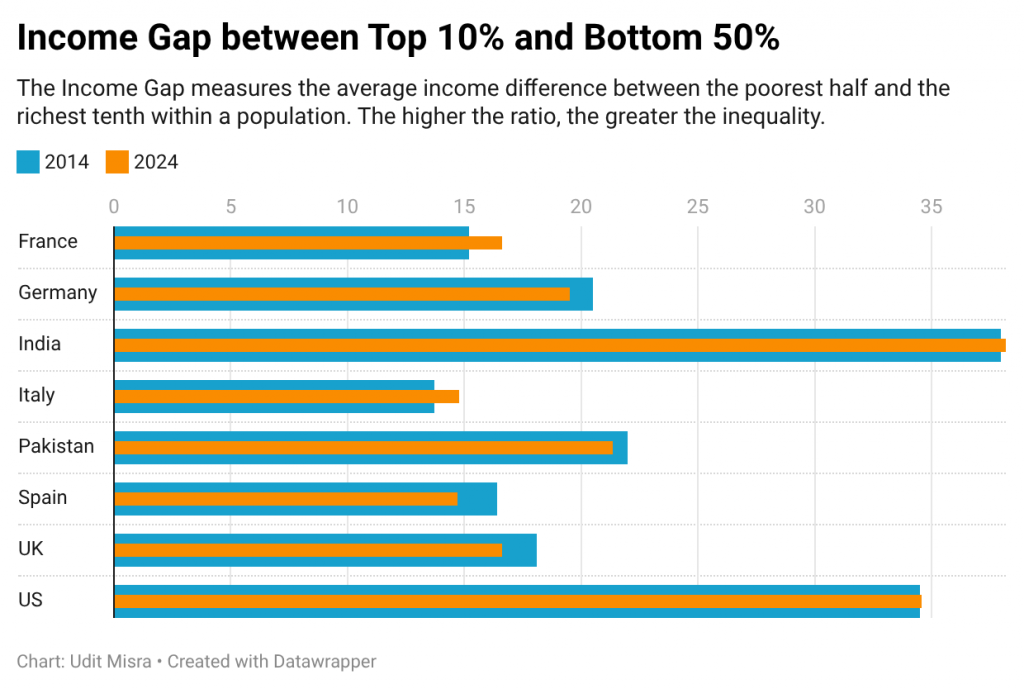
- For France, the income gap has increased between 2014 and 2024, and in Italy as well. But in the UK, Germany and Spain, it has fallen as well.
- While the income gap has increased in France, by itself it is among the lowest among peers such as Germany.
- In India, the income gap is 38 and in South Africa it is 118.
Economic Consequences of Social Unrest
- As per the IMF economist, on an average, major unrest events are followed by a one percentage point reduction in GDP, six quarters after the event.
- Unrest motivated by socioeconomic factors is associated with sharper GDP contractions than unrest associated with political motives.
- Disruption of Economic Activities: Protests, strikes and road blockades disrupt production, transportation, trade and supply chains, resulting in economic losses.
- Decline in Investment: Political and social instability creates uncertainty for businesses, discouraging domestic and foreign investment and delaying new projects.
- Rise in Inflation: Disruptions in the supply of essential commodities can cause shortages and increase prices, particularly affecting low-income households.
- Decline in Tourism and Trade: Social unrest can damage a region’s reputation as a safe destination, reducing tourist arrivals, local business revenues and trade opportunities.
- Pressure on Government Finances: Governments may incur additional expenditure on law enforcement, compensation, reconstruction and rehabilitation, diverting resources from developmental activities.
Conclusion
- Social unrest can impose significant economic costs, but it may also draw attention to genuine grievances and structural inequalities.
- Sustainable economic stability requires addressing the underlying causes of unrest through inclusive growth, responsive governance and peaceful conflict resolution.
Source: IE
Previous article
Proposed Amendments to Driving Licence Rules
Next article
News In Brief 24-10-2026
