


Kerala’s Jewish Communities
Syllabus: GS1/ History
Context
- Recent incidents involving the Kadavumbhagam Synagogue in Ernakulam and the heritage Koder House in Fort Kochi have renewed attention to Kerala’s declining Jewish community.
About
- Jewish migration to Kerala is associated with the region’s flourishing ancient spice trade. The state’s Jews are divided into two distinct communities — the Malabari or “black” Jews and the Paradesi or “white” Jews.
- There were two other smaller Jewish communities in Cochin.
- The Arab-speaking Baghdadi Jews, who arrived in the 18th and 19th centuries from places in present-day Iran, Iraq, and Afghanistan, gradually came to be considered as “white” Jews.
- Meshuchrarim: A term used to refer to a group who were part of the Paradesi community, which included freed slaves brought from parts of Europe as well as converts and their descendants.
Malabar Jews
- Malabar Jews, also known as the Cochin Jews, trace their history to the days of King Solomon (10th century BCE, almost 3,000 years ago).
- Initially, they settled in Cranganore (present-day Kodungallur in Thrissur district), which the community itself referred to as Shingly.
- After the arrival of the Portuguese in the 16th century, Malabar Jews moved further south from Cranganore to Cochin (Kochi).
- Kadavumbhagam Synagogue is a historic Jewish place of worship in Ernakulam, traditionally associated with the Malabari Jews of Kerala.
Paradesi Jewish
- Paradesi Jewish or “foreign” Jews, migrated to the Indian subcontinent in the 15th and 16th centuries from the Iberian Peninsula.
- They fled to India due to persecution by the Catholic rulers of Spain and Portugal, and settled on the Malabar coast alongside pre-settled Jewish communities, as well as in Madras (now Chennai).
- The Paradesi Jews of Cochin were active in Kerala’s spice trade, and those settled in Madras were involved in the trade of Golconda diamonds and other precious stones.
Dwindling population of Jews in India
- Since the 1950s, there has been a steady migration of Kerala Jews to Israel.
- Aliyah: Following the establishment of Israel in 1948, large-scale migration from Kerala to Israel took place.
- Aliyah refers to Jewish immigration to Israel.
- Queenie Hallegua, the last woman of Kerala’s Paradesi Jewish community died in Kochi in 2024.
Source: IE
Kashi Tamil Sangamam (KTS 5.0)
Syllabus: GS1/ Culture
Context
- The Education Minister launched the registration portal for the fifth edition of Kashi Tamil Sangamam (KTS 5.0).
- The theme of this edition is Thirukkural Payilvom – Let Us Learn the Thirukkural.
About Kashi Tamil Sangamam
- The programme celebrates, reaffirms and strengthens the age-old civilisational bonds between Tamil Nadu and Kashi, the two ancient seats of learning, and reinforces the spirit of Ek Bharat Shreshtha Bharat.
- The first edition of Kashi Tamil Sangamam was held in 2022 as a GoI Event of the Ministry of Education in collaboration with the State Government of Uttar Pradesh.
About Thirukkural
- Thirukkural is a classical Tamil literary work that provides ethical, philosophical and practical guidance on individual conduct, social life and governance.
- Author: Thiruvalluvar, a revered Tamil poet and philosopher.
- Composition: It consists of 1,330 couplets (kurals) divided into 133 chapters, with 10 couplets in each chapter.
- It is in three parts — Aram (virtue), Porul (wealth), and Inbam (love) — and these lead the way to Veedu (liberation).
Source: PIB
Pradhan Mantri Samajik Sahayata Yojana
Syllabus: GS2/Welfare Schemes
In News
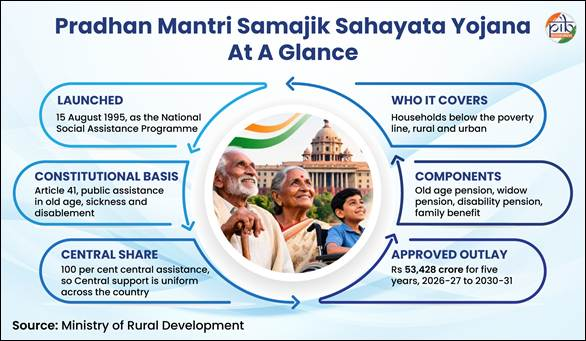
- The National Social Assistance Programme (NSAP) has been renamed the Pradhan Mantri Samajik Sahayata Yojana.
Background of National Social Assistance Programme (NSAP)
- It was launched in 1995 and gives effect to Article 41 of the Constitution, which directs the State to provide public assistance in cases of unemployment, old age, sickness and disability.
- It is a fully funded centrally sponsored scheme and carries 100 per cent central assistance.
- It ensures that a person below the poverty line receives at least the minimum support anywhere in the country.
- It covers both rural and urban areas, and the basic condition across its components is that the household is below the poverty line.
- Components: The programme has following components. There are monthly pensions, for the old aged, for widows and for persons with disabilities. The fourth is a one-time family benefit on the death of a household’s primary breadwinner.
Latest Developments
- Extension: The Union Cabinet has approved the continuation of the National Social Assistance Programme (NSAP) for five years, from 2026-27 to 2030-31, with a total outlay of ₹53,428 crore.
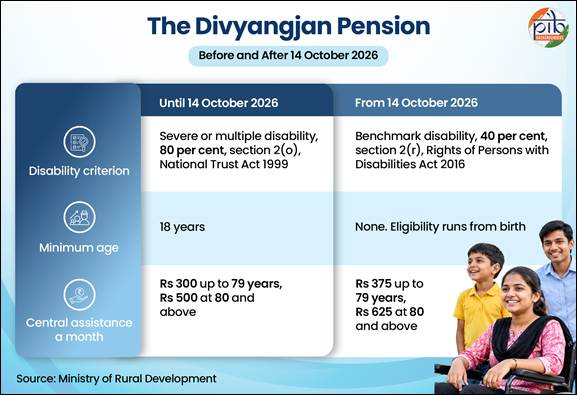
- Revised nomenclature: Under the revised nomenclature, the four components have been renamed the Pradhan Mantri Vridhavastha Pension Yojana for old-age pensions, Pradhan Mantri Vidhawa Pension Yojana for widow pensions, Pradhan Mantri Divyangjan Pension Yojana for disability pensions, and Pradhan Mantri Parivar Labh Yojana for family benefits.
- Change in Eligibility of Disability Pension: The scope of eligibility has been expanded under the revised Indira Gandhi National Disability Pension Scheme by reducing the threshold of disability from 80% to at least 40% under the Rights of Persons with Disabilities Act, 2016 and also by removing the minimum age limit which will allow the beneficiaries to get the benefit from the time of birth itself.
Source :PIB
Shamonda Virus
Syllabus: GS2/ Health
In News
- French health authorities reported the first known human case of Shamonda infection.
About
- Shamonda is a midge-borne animal virus from the Simbu serogroup of orthobunyaviruses. The same group includes Schmallenberg virus and Akabane virus.
- It mainly infects cattle. The usual signs are fever, diarrhoea and a drop in milk yield.
- It was first detected in Nigeria in the mid-1960s. Until 2026 it was reported only sporadically in West, East and Southern Africa and in Japan.
- It spreads through the bites of Culicoides midges, the same vector that carries bluetongue and epizootic haemorrhagic disease.
Source: TH
eMudhra Exited Digital Certificates biz
Syllabus: GS3/Economy
In News
- Digital security firm eMudhra is exiting its global business of issuing security certificates for websites including India’s tax portal after major browser makers blocked them for vulnerabilities that sparked worldwide cybersecurity concerns.
eMudhra Certificates
- eMudhra is a Bengaluru-based Certificate Authority (CA). It issues digital certificates that prove a website or software publisher is genuine.
- Browsers use these certificates to confirm a site’s identity and set up an encrypted (HTTPS/TLS) connection. Code-signing certificates do the same job for software, showing that it comes from a real publisher and hasn’t been tampered with.
- eMudhra was founded in 2008 and is licensed by the Controller of Certifying Authorities (CCA) under the IT Act, 2000.
- It became India’s very first eSign Service Provider in 2015, as per the company website, which also stated that it had issued over 60 million certificates by 2022-23.
- It also runs a digital document signing service in the country, along with enterprise Public Key Infrastructure (PKI) solutions, and other identity and authentication solutions.
Reason for Blocking
- The eight intermediate certificates were created in a key-generation ceremony on April 30, 2025. A flaw in a key wrap/unwrap step produced a second, weak set of keys alongside the strong ones, and the weak ones were published to browser root stores.
- All eight certificates used P-384 private keys with values smaller than 256, so anyone could recover them by testing just 256 numbers.
- An intermediate’s private key can sign a valid certificate for any website. That opens the door to fake sites, man-in-the-middle attacks and malicious software signed as genuine.
Source :IE
PHP2Shell
Syllabus: GS3/ Science and Technology
Context
- Two critical flaws in PHP, a programming language used by websites, led to emergency security updates and precautionary shutdowns worldwide.
About PHP
- PHP, short for Hypertext Preprocessor, is an open-source programming language used to develop dynamic websites and web applications.
- It helps websites process information, whether someone is logging into an account, submitting an application or making an online purchase.
- PHP is free to use and maintained by volunteers.
- WordPress, which powers more than 40% of websites worldwide, is powered by PHP. These websites include blogs, government portals, news websites and online shops.
What is PHP2Shell?
- PHP2Shell is the name given to two critical vulnerabilities in PHP that could allow attackers to remotely execute malicious code on affected web servers without logging in or accessing sensitive information stored in the server’s memory.
- The flaws exist in PHP itself and may be exploitable before a website’s own authentication checks are performed, depending on the affected configuration and attack conditions.
Source: IE
Chemical Signatures or Biomarkers
Syllabus: GS2/Health/GS3/Science and Technology
Context
- Chemical signatures or biomarkers are being studied to improve the diagnosis of several diseases, particularly those affecting the brain and nervous system.
About
- Chemical signatures/biomarkers are a unique pattern of molecules, elements, isotopes that can be measured in the body.
- The outcomes can indicate the presence of a disease or an underlying biological process.
- They may be detected in blood, cerebrospinal fluid (CSF) and other biological samples.
- They enable doctors to identify diseases before prominent symptoms appear.
- Applications:
- Alzheimer’s disease: Amyloid-beta and tau proteins, including phosphorylated tau (p-tau217), can help identify biological changes associated with Alzheimer’s disease.
- Parkinson’s disease: Alpha-synuclein is a protein being studied as a biomarker for detecting and understanding the disease.
- Autoimmune encephalitis: Detection of specific antibodies can help identify cases in which the immune system attacks the brain.
- Cancer detection: Changes in metabolites and proteins may help researchers identify molecular patterns associated with certain cancers.
Source: TH
Sakharov Prize 2026
Syllabus: Miscellaneous
Context
- The European Union has awarded the International Criminal Court (ICC) its top human rights honour, the Sakharov Prize for Freedom of Thought. The recognition comes amid US sanctions targeting the Court.
About the Prize
- Established in 1988, the Sakharov Prize for Freedom of Thought is named after Soviet dissident and Nobel Peace laureate Andrei Sakharov.
- It honours individuals and groups defending human rights and fundamental freedoms.
- The final winner or winners of the Sakharov Prize are chosen by the Conference of Presidents, a European Parliament body led by the president, which includes the leaders of all the political groups represented in the Parliament, making the choice of laureates a truly European choice.
- The award carries an endowment of €50,000 and is presented at the European Parliament in Strasbourg (France) each December.
Do you know?
- Several Sakharov laureates, including Nelson Mandela, Malala Yousafzai, and Venezuelan opposition leader María Corina Machado, later went on to win the Nobel Peace Prize.
International Criminal Court
- The International Criminal Court (ICC) is an international tribunal seated in The Hague, Netherlands, and is legally independent from the United Nations.
- Established in 2002 under the multilateral Rome Statute, the ICC is the first and only permanent international court with jurisdiction to prosecute individuals for the international crimes of genocide, crimes against humanity, war crimes, and the crime of aggression.
- The ICC currently has 125 States Parties, with Ukraine being the latest to join.
ICC vs ICJ
- ICC is distinct from the International Court of Justice (ICJ), an organ of the United Nations that hears disputes between states.
Source: DW
Previous article
Emission Gap Report 2026
Next article
News In Brief 23-10-2026
