


Syllabus: GS2/IR
Context
- Prime Minister Modi and Israel PM Netanyahu discussed India-Israel relations and the situation in West Asia over a phone call.
- The Israeli Prime Minister invited PM Modi and Indian pilot Captain Smit Machchhar to jointly light a torch on Israel’s Independence Day.
India and Israel Bilateral Relations & Evolving Ties
- Bilateral Relations: India announced its recognition of Israel in 1950. Regular embassies opened in 1992 when full diplomatic relations were established between the two countries.
- In 2017, both countries upgraded the ties to the Strategic partnership.
- In 2022-23, the two countries jointly celebrated 30 years of the elevation of bilateral ties to full diplomatic ties.
- Defense & Security: Israel has been a key supplier of advanced technology from AWACS (Airborne Warning and Control System) radars and drones to missile and surveillance systems making it one of India’s largest defense suppliers.
- Bilateral Trade: India is Israel’s 2nd trading partner in Asia and the 7th largest globally.
- In FY 2023-24 and FY 2024-25 the bilateral trade (excluding defense) was US$ 6.53 billion and US$3.75 billion respectively.
- Investment: During April 2000 – March 2024, Israel’s direct FDI into India was U.S. $334.2 million.
- There are over 300 investments from Israel in India mainly in the high-tech domain, agriculture and water.
- India and Israel signed a Bilateral Investment Agreement (BIA) in 2025, the BIA replaces the earlier investment treaty signed in 1996, which was terminated in 2017 as part of India’s policy overhaul on such agreements.
- Agriculture & Water Management: In 1993, the first Agreement on Cooperation in Agriculture was signed.
- 2006: Comprehensive Work Plan on Agriculture launched (3-year cycles) – implemented through MASHAV (Israel’s Agency for International Development Cooperation).
- 2025: Revised Agriculture Cooperation Agreement signed, expanding areas of partnership.
- The Indo-Israeli Centers of Excellence (CoE) demonstrate Israeli expertise, technologies and innovation in the horticultural field.
- Science, Technology, Counter-Terrorism & Innovation: India-Israel cooperation in Science & Technology (S&T) is overseen by the Joint Committee on S&T, established under the Agreement of Science & Technology cooperation signed in 1993.
- A US$ 40 million India-Israel Industrial R&D and Technological Innovation Fund (I4F) for joint projects was also set up.
- Multilateral Cooperation: Both are active members of the I2U2 group (India, Israel, USA, UAE), focusing on economic and space collaboration with projects like food parks and space-based environmental tools.
Significance for India
- Defence & security: Israel is a reliable partner for critical technologies for India and can be instrumental in India’s Self Reliance and Make in India.
- Agriculture & water: Israel is known for its model of innovation, water conservation, and high-yield farming, India can adopt these technologies with collaboration.
- Geopolitics: It is an important strategic partner for India in West Asia that complements India’s Act West policy.
West Asia
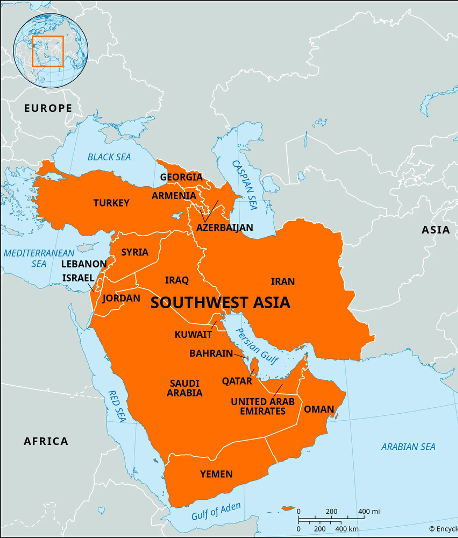
- West Asia is the westernmost subregion of Asia. It broadly includes the following countries:
- Arabian Peninsula: Saudi Arabia, Yemen, Oman, the United Arab Emirates (UAE), Qatar, Bahrain and Kuwait.
- Levant: Jordan, Lebanon, Syria, Israel and Palestine.
- Other major countries: Iraq, Iran and Türkiye.
- Other countries often included in broader definitions: Cyprus and parts of the South Caucasus, depending on the geographical classification.
- The terms West Asia and Middle East are often used interchangeably, although their precise geographical boundaries can differ.
- The region is strategically located, bordered by Africa to the west and Europe to the north, with significant bodies of water such as the Mediterranean Sea, the Persian Gulf, and the Caspian Sea surrounding it.
Implications of Crisis in West Asia on India:
- India’s Energy Security: The conflict directly threatens energy security because a large share of India’s crude oil imports comes from the Gulf region.
- Rising global oil prices increase India’s import bill, widen the current account deficit, and may contribute to inflationary pressures within the domestic economy.
- Indian Diaspora: Millions of Indian workers reside in Gulf countries, making their safety a key concern during periods of regional conflict.
- Remittances: India has nearly one crore expatriates who invest billions of dollars in the economy through remittances, real estate, stock markets, and more, the war can cause a big impact on it.
- Investments: The UAE’s Golden Visa has successfully attracted new-age tech and start-up millionaires and billionaires from India, many of whom live in Dubai and run enterprises in India.
- The war could impact these and can crash trillion-dollar brands and investments.
Way Ahead
- India–Israel ties are a strategic partnership spanning defence, agriculture, water, innovation, and trade.
- Defence and agriculture remain the strongest pillars, while cooperation is expanding into new domains like food security, startups, and I2U2 multilateralism.
Source: TH
Previous article
India and Poland Ties
