


Syllabus: GS3/Environment
Context
- The UN Environment Programme (UNEP) has released the Emission Gap Report 2026.
About
- It is UNEP’s report launched annually in advance of the annual Climate negotiations.
- It tracks the gap between where global emissions are heading with current country commitments and where they ought to be to limit warming to 1.5°C.
- Each edition explores ways to bridge the emissions gap.
- The report assessed countries’ Nationally Determined Contributions (NDCs), which they are required to update every five years, to determine how much the world might warm if these plans were fully implemented.
About The United Nations Environment Program (UNEP)
- It is the leading environmental authority in the United Nations system established in 1972.
- The UN Environment Assembly is the policy-making organ of UNEP.
- Headquarter: Nairobi, Kenya.
- Major Reports: Global Environment Outlook, The Rise of Environmental Crime Report, Actions on Air Quality, Frontiers Report, Adaptation Gap Report.
Major Highlights of the Report
- Global Emissions: Globally, greenhouse gas emissions in 2025 remained around the same levels as in 2024, around 58.4 billion tonnes of CO2 equivalent.
- Major Sources: More than two-thirds of all GHGs emissions are from fossil sources; the rest being CO₂ from the land use, land-use change and forestry (LULUCF), methane, nitrous oxide and fluorinated gas emissions (F-gases).
- Emission Trends: CO₂ emissions from fossil fuel combustion of oil, coal and gas, and nitrous oxide and fluorinated gases emissions continued to increase in 2025, while methane emissions remained almost the same as in 2024.
- Major Contributor: Collectively, G20 members, excluding the African Union, account for 76 per cent of global emissions.
- The 1.5 degree Target: The 1.5 degree Celsius temperature target is now completely out of reach and the best that the world can now hope for is to restrict the global rise in temperatures to 1.8 degree Celsius.
- The 1.5-degree target is the central climate goal of the 2015 Paris Agreement to limit long-term global warming to 1.5°C above pre-industrial levels (1850–1900).
- India Specific: Although India is the third largest GHG emitter it’s per capita emission is significantly lower than top two countries.
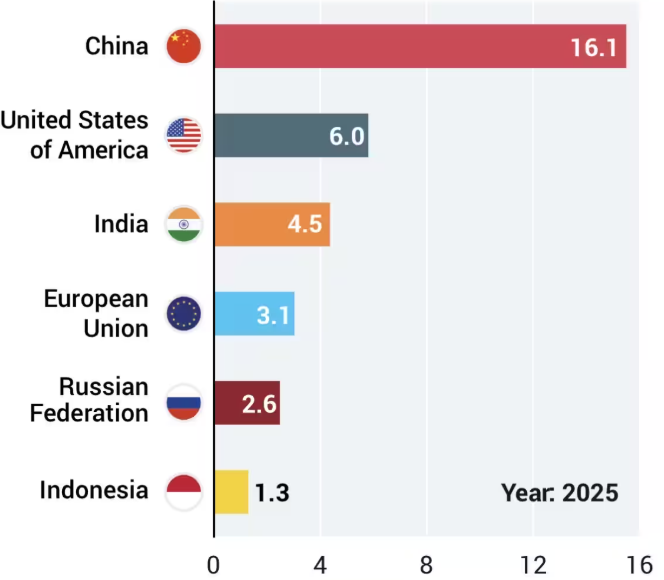
- Concern: Every additional fraction of a degree and additional year of warming above 1.5°C increases climate impacts and risks, such as the deadly floods, heatwaves and wildfires,
- Recommendation: To establish a pathway back to the 1.5°C target, global GHG emissions must fall substantially from their 2025 levels.
- GHG emissions would have to be reduced by 18 per cent by 2030, 45 per cent by 2035 and 69 per cent by 2040, all relative to 2025 levels.
Source: DTE
Previous article
Strengthening India’s Textile Industry Amid Rising Chinese Imports
Next article
News In Brief 23-10-2026
