


Electrical Interconnection Between India and Saudi Arabia
Syllabus: GS2/IR, GS3/Infrastructure
Context
- India and Saudi Arabia reviewed progress on their proposed electrical interconnection initiative and discussed opportunities to expand power-sector cooperation during a virtual bilateral meeting.
About
- The India-Saudi Arabia electrical interconnection is a proposed bilateral project to link the power grids of both nations via a long-distance undersea high-voltage direct current (HVDC) cable.
- Initial Agreement: A formal Memorandum of Understanding (MoU) was signed in 2023 in Riyadh, covering electrical interconnections, green hydrogen, and supply chains.
- It involves a planned 1,700 km undersea high-voltage power link valued at roughly ₹47,000 crore ($5.5 billion).
- The project aims to enable 2 GW of power exchange, emergency support, and renewable energy integration.
Source: DD News
China Merchants Withdraws from Colombo Port Project
Syllabus: GS2/IR; GS3/Economy
Context
- China’s state-owned China Merchants Port Holdings has withdrawn from a proposed $392 million logistics hub project at Sri Lanka’s Colombo Port.
About the Project
- The South Asia Commercial and Logistics Hub (SACLH) was announced in 2023, with China Merchants set to hold a 70% stake in the joint venture. The Sri Lanka Ports Authority (SLPA) and local construction company Access Engineering were each to hold 15%.
- The partners have agreed to terminate the project, citing changes in external circumstances, implementation timelines and commercial considerations.
- However, the withdrawal does not indicate a broader exit from Sri Lanka’s maritime sector. China Merchants continues to operate the Colombo International Container Terminal (CICT) and is involved in the management of Hambantota Port.
India’s Position
- Existing presence: India already has a strong presence through its investment in the Colombo West International Terminal. The Adani led terminal is a 35 year concession with John Keells and SLPA as partners.
- Neighbourhood First and SAGAR/MAHASAGAR: India’s approach stresses development partnership, connectivity and shared security rather than debt dependent leverage.
- Crisis support: India extended around $4 billion in assistance in 2022 and backed Sri Lanka’s IMF programme, which built goodwill.
- Domestic port capacity: Vizhinjam and planned mega ports such as Great Nicobar aim to reduce reliance on foreign transshipment hubs.
Source: TH
Space Radiation
Syllabus: GS3/Space
In News
- A study published in the Monthly Notices of the Royal Astronomical Society under the SNIFFLES programme found that low-Earth orbit (LEO) satellites from Starlink, OneWeb and China’s Guowang emit radio signals that interfere with radio astronomy.
Space Radiation
- It is high energy particles, mostly atomic nuclei without their electrons, that travel at close to the speed of light.
- Types:
- Particles trapped in the Earth’s magnetic field
- Particles shot into space during solar flares (solar particle events)
- Galactic cosmic rays, which are high-energy protons and heavy ions from outside our solar system.
- All of these kinds of space radiation represent ionizing radiation.
Latest Research
- A OneWeb signal at 1,613.19 MHz could interfere with observations of hydroxyl (OH) ions, while some emissions were up to 100 billion times brighter than typical astronomical sources, potentially overwhelming telescopes.
- The study recommends applying existing international radio-emission regulations to satellites and continuously monitoring emissions by satellite operators, designers and space agencies, particularly as direct-to-cell services expand.
Source :TH
Aditya-L1 Mission offers New Insights
Syllabus: GS3/Space
Context
- Scientists have generated Doppler velocity images of activities taking place in the solar corona using data from India’s maiden solar mission, Aditya-L1.
About
- The positive and negative Doppler velocities indicate solar plasma moving away from and towards the direction of the observer.
- Doppler velocities measure the speed and direction of moving objects by calculating the frequency shift of waves that reflect off them (known as the Doppler effect).
- These images are expected to provide information on the propagation of the coronal mass ejections along the Sun-Earth direction, which were unavailable till date.
About Aditya-L1
- Aditya-L1 was launched in 2023 and is the first space-based Indian observatory to study the Sun.
- It is placed at Lagrangian point L1 for observing and understanding the chromospheric and coronal dynamics of the Sun.
- L1 is a location in space where the gravitational forces of two celestial bodies, such as the Sun and Earth, are in equilibrium. This allows an object placed there to remain relatively stable.
- There are five Lagrange points, three are unstable and two are stable. The unstable Lagrange points are labeled L1, L2 and L3. The stable Lagrange points are labeled L4 and L5.
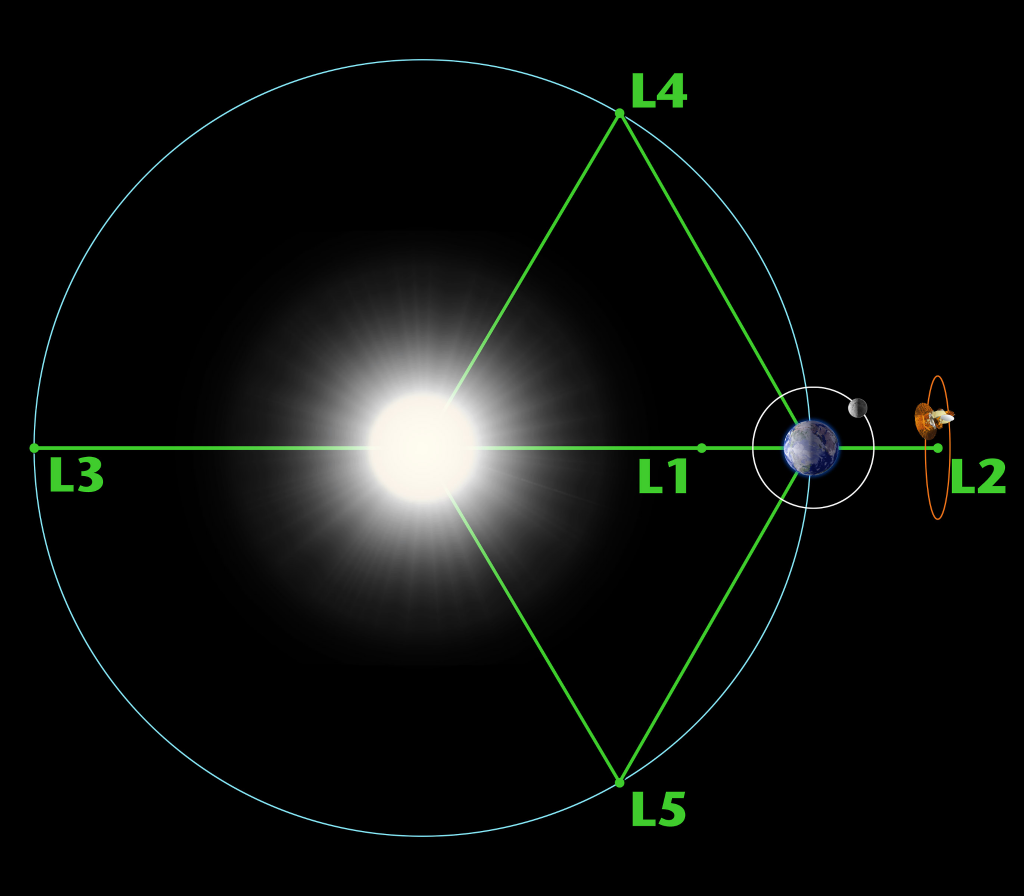
- Advantages of placing Aditya-L1 around L1 point as compared to Low Earth Orbit (LEO):
- It provides a smooth Sun-spacecraft velocity change throughout the orbit, appropriate for helioseismology.
- It is outside of the magnetosphere of Earth, thus suitable for the “in situ” sampling of the solar wind and particles.
- It allows unobstructed, continuous observation of the Sun, and view of earth for enabling continuous communication to ground stations.
- It is equipped with seven payloads (instruments) on board with four of them carrying out remote sensing of the Sun and three of them carrying in-situ observation.
Seven Payloads of Aditya L-1.
- The Visible Emission Line Coronagraph (VELC) will study the Corona, imaging and spectroscopy, and Coronal mass ejections.
- The Solar Ultraviolet Imaging Telescope (SUIT) will focus upon the Photosphere and Chromosphere imaging- narrow and broadband. It will also measure the solar irradiance variations.
- The Solar Low Energy X-ray Spectrometer (SoLEXS) and High Energy L1 Orbiting X-ray Spectrometer (HEL1OS) will study the soft and hard X-ray flares from the Sun over a wide X-ray energy range.
- The Aditya Solar wind Particle Experiment (ASPEX) and Plasma Analyser Package For Aditya (PAPA) will analyze the electrons and protons in the Solar wind or particles. It will also study the energetic ions.
- The Advanced Tri-axial High Resolution Digital Magnetometers will study the interplanetary magnetic field at L1 point.
Source: TH
Previous article
Disaster Resilience of Telecom Infrastructure
Next article
News In Brief 21-10-2026
