


Syllabus: GS3/Economy
In News
- The UDAN Scheme completed ten years and considerably expanded the regional aviation network of India by linking unserved and underserved areas.
UDAN Scheme
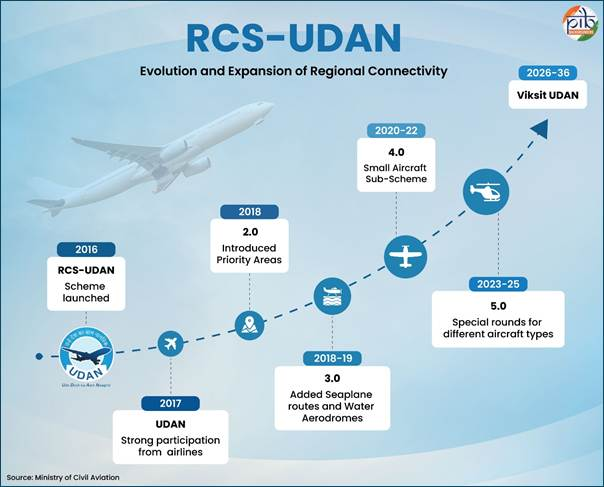
- The Prime Minister of India launched the Regional Connectivity Scheme (RCS) – UDAN (“Ude Desh ka Aam Nagrik”) in 2016.
- It was conceptualised under the National Civil Aviation Policy (NCAP) 2016 with a 10 year vision to connect Tier-2 and Tier-3 cities through a market driven and financially supported approach.
- It entered its operational stage with the inauguration of the first RCS-UDAN flight from Shimla to Delhi in April 2017.
- It incentivised the airlines with concessions and Viability Gap Funding (VGF) to fly on the rural routes with cheap rates and enhanced accessibility.
Progress
- Lines Operationalised: The plan has operationalised 687 regional lines in India.
- Aerodromes Operationalised: Total 95 aerodromes including 17 heliports and 02 water aerodromes have been operationalised.
- Flights Operated: Under the plan more than 3.68 lakh flights have been operated.
- Passengers Carried : The initiative has enabled 1.72 crore passengers to fly.
Latest Developments
- The Union Cabinet has approved the launch and implementation of the Regional Connectivity Scheme – Modified UDAN for a period of ten years from FY 2026-27 to FY 2035-36 with a total outlay of Rs.28,840 crore .
Components of the Modified UDAN scheme
- Development of 100 airports from existing unserved airstrips over a period of eight years with an outlay of ₹12,159 crore
- Construction of 200 modern helipads in remote, hilly, island and aspirational areas with an estimated cost of ₹3,661 crore
- Allocation of ₹10,043 crore over ten years as Viability Gap Funding (VGF) to the airlines for operating regional routes.
Significance
- Inclusive growth: Tier 2 and 3 cities are now integrated into the national market.
- For ex: Vijayawada to Kadapa, earlier 8 to 10 hours by road, is now a short flight.
- Infrastructure expansion: Operational airports rose from 74 in 2014 to 165 by July 2026.
- Strategic and regional balance: Connectivity to the North East, hills and islands strengthens border area integration.
- Economic multiplier: Regional airports support tourism, MSMEs and perishable exports.
- Industry demand: The scheme created demand for ATR and smaller aircraft, MRO services and pilot training, which supports aviation sector jobs.
Challenges and Concerns
- Route sustainability: Many routes collapse once VGF ends after three years. Airlines have little incentive to continue where load factors are low and demand has not matured.
- Dormant airports: Several airports were built or revived without demand assessment. Parliamentary and audit reports have flagged underused infrastructure and poor last mile connectivity to terminals.
- Fiscal burden: Dependence on subsidy raises questions about long term viability and fiscal prudence.
- Airline fragility: Small regional carriers face high ATF costs, VAT on fuel varying across states, leasing costs and aircraft shortages. Several operators have exited the market.
- Operational and safety issues: Hilly terrain, short runways, weather and thin MRO support increase risk and cancellations.
Way Forward
- Demand led planning: Assess catchment potential before awarding routes, and link airports with rail, road and local transport.
- Rationalise taxes: Bring ATF under GST or harmonise state VAT to lower operating costs.
- Support airlines: Encourage aircraft leasing, MRO hubs in India and pilot training to reduce structural costs.
- Phase out VGF gradually: Shift from subsidy to market viability through bundled routes, cross-subsidy, and bundling with commercial routes.
Source: PIB
Previous article
India’s Nuclear Programme
Next article
Disaster Resilience of Telecom Infrastructure
