


Syllabus: GS3/Disaster Management, Infrastructure
Context
- A study by the Coalition for Disaster Resilient Infrastructure (CDRI) and the National Disaster Management Authority (NDMA) has identified multi-hazard vulnerabilities in telecom towers across five high-risk states of India-Assam, Gujarat, Odisha, Tamil Nadu and Uttarakhand.
Key Findings of the Report
- The study mapped 48,416 telecom towers across Tamil Nadu and found 57% face high or very high cyclonic wind risk.
- In Gujarat and Uttarakhand, 28% and 25% of telecom towers are exposed to very high cyclonic winds, respectively.
- While 12% of Gujarat’s telecom towers face flood exposure, 10% of those in Uttarakhand are located in areas with high landslide susceptibility.
- Additionally, all towers in Assam and Uttarakhand, and 12% of towers in Gujarat, are located in high and very high seismic zones (Zone IV and V).
Coalition for Disaster Resilient Infrastructure (CDRI)
- Establishment: CDRI was established in 2019 under the leadership of the Government of India with the support of United Nations Office for Disaster Risk Reduction (UNDRR) during the United Nations Climate Action Summit in 2019 in New York.
- Members: It is a multi-stakeholder global partnership of national governments, UN agencies and programmes, multilateral development banks, the private sector, and academic institutions.
- Secretariat: New Delhi.
- CDRI aims to promote the resilience of infrastructure systems to climate and disaster risks, thereby ensuring sustainable development.
- The CDRI supports countries to upgrade their systems to ensure disaster and climate resilience of existing and future infrastructure.
National Disaster Management Authority
- It is the apex statutory body for Disaster Management in India, established through the Disaster Management Act, 2005.
- The Act envisaged the creation of the NDMA, headed by the Prime Minister, and State Disaster Management Authorities (SDMAs) headed by respective Chief Ministers, to spearhead and implement a holistic and integrated approach to Disaster Management in India.
- Functions & Responsibilities;
- Lay down policies on disaster management,
- Approve plans prepared by the ministries or departments of the Government of India in accordance with the National Plan,
- Lay down guidelines to be followed by the state authorities in drawing up the State Plan,
- Coordinate the enforcement and implementation of the policy and plans for disaster management,
- Recommend provision of funds for the purpose of mitigation etc.
Telecommunication Sector of India
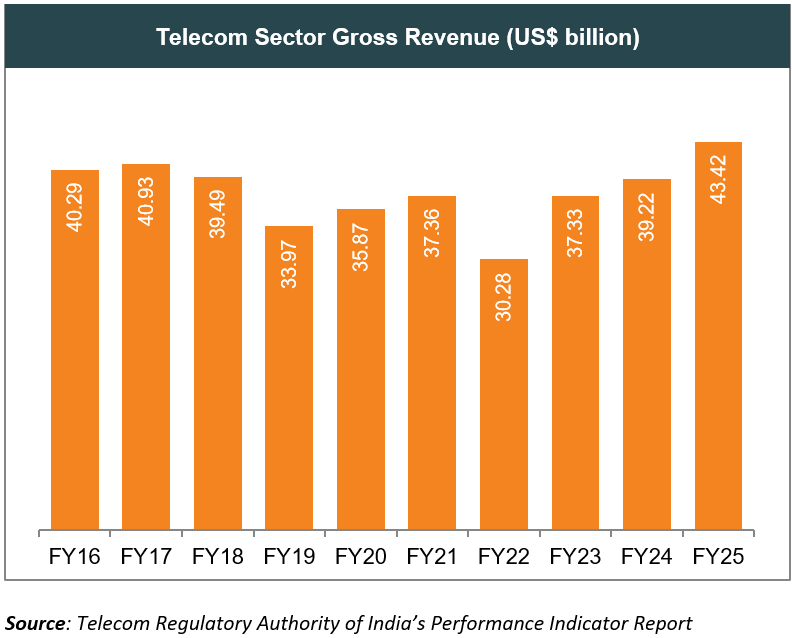
- India is the second-largest telecommunications market globally as of 2026, with a total telephone subscriber base of 1,337.54 million and a tele-density of 93.69% as of April 2026.
- The sector has contributed about 15% to global GDP in the past decade and is projected to reach a $2.8 trillion market by 2030.
- The total internet subscribers in the country reached 1.09 billion at the end of March 2026.
- As of April 2026, the Indian broadband market remains highly concentrated, with the top five service providers (Reliance Jio Infocomm Ltd., Bharti Airtel Ltd., Vodafone Idea Ltd , Bharat Sanchar Nigam Ltd., Atria Convergence Technologies Ltd.) accounting for 98.61 percent of the total subscriber base.
Initiatives taken by the Government
- GatiShakti Sanchar Portal: A single-window clearance platform that fast-tracks Right-of-Way (RoW) permissions for laying optical fiber and telecom towers across states.
- BharatNet Project: Focuses on connecting all Gram Panchayats and rural habitations with high-speed optical fiber broadband, backed by the updated Digital Bharat Nidhi framework.
- Production Linked Incentive (PLI) Scheme: Encourages domestic manufacturing of telecom and networking products to reduce import dependency and drive local exports.
- Bharat 6G Vision: It aims to transform India from a consumer of telecom technology into a leading global provider, developer, and exporter of affordable, advanced communications systems.
- Telecommunications Act, 2023: Replaces Indian Telegraph Act of 1885 to modernise spectrum management, strengthen public safety, and streamline licensing rules.
Way Ahead
- Improve local hazard mapping: Identify vulnerable sites at district and sub-district levels and prioritise investment according to overlapping risks.
- Enhance inter-agency coordination: Develop joint restoration protocols involving telecom operators, power utilities, road agencies and disaster management authorities.
- Strengthen restoration capacity: Maintain fuel reserves, emergency equipment and trained local teams to accelerate repairs following disasters.
Source: TH
Previous article
10 Years of UDAN Scheme
Next article
News In Brief 21-10-2026
