


Southern Indian Ocean Fisheries Agreement (SIOFA)
Syllabus: GS2/IR; GS3/Environment and Ecology
Context
- The Union Government approved India’s accession to the Southern Indian Ocean Fisheries Agreement (SIOFA), elevating its status from a Cooperating Non-Contracting Party to a full Contracting Party.
What is SIOFA?
- The Southern Indian Ocean Fisheries Agreement (SIOFA) is a regional agreement for the conservation and management of fishery resources in the high seas of the Southern Indian Ocean.
- It covers fish, molluscs, crustaceans and other sedentary species, while excluding highly migratory species listed in Annex I of the United Nations Convention on the Law of the Sea (UNCLOS) and sedentary species falling under the fishing jurisdiction of coastal states.
- The Indian Ocean has two major regional fisheries management frameworks: SIOFA and the Indian Ocean Tuna Commission (IOTC).
- India has been a contracting party to the IOTC since 1996, which manages highly migratory tuna and tuna-like species.
Do you know?
- The high seas account for approximately 65% of the global ocean. Fishing activity in these waters is dominated by China, Taiwan, Japan, South Korea and Spain, which account for 21%, 13%, 11%, 11% and 8%, respectively.
- Indian fishing vessels currently operate largely within 60–80 nautical miles of the coast. Accession to SIOFA could create opportunities for Indian fishers and entrepreneurs to access marine resources beyond their traditional operating areas.
Source: MoneyControl
Oman Replaces US as top LNG supplier to India
Syllabus: GS3/ Economy
In News
- Oman became India’s largest supplier of liquefied natural gas (LNG), replacing the United States.
India’s LNG Supplier Ranking
- India imported 2.17 million tonnes of LNG in September 2026, around 14% less than in August.
- Oman ranked first, supplying 27% of India’s total LNG imports and Nigeria ranked second.
- The United States fell to third place as its shipments to India declined by 59% from August.
- Qatar, traditionally a major supplier, ranked sixth, supplying around 94,000 tonnes.
What is LNG?
- LNG is natural gas cooled to approximately −162°C, turning it into a liquid for easier storage and transport.
- Liquefaction reduces its volume to about one-six-hundredth of its gaseous volume.
- LNG is transported in specially insulated ships and converted back into gas at import terminals through regasification.
Uses of LNG
- Power generation and fertilizer production.
- City gas distribution, including domestic cooking and transport.
- Industrial and other commercial applications.
Why Did Supplier Rankings Change?
- Geopolitical disruptions in West Asia affected energy supply routes and availability.
- Competition from European buyers for US LNG cargoes reduced their availability to India.
- Disruptions at Qatar’s Ras Laffan Industrial City following an Iranian strike in March 2026 affected Qatari shipments, according to the supplied report.
Significance for India
- Energy security: Diversifying suppliers reduces dependence on a limited number of countries.
- Price stability: Access to multiple suppliers can improve flexibility during supply disruptions.
- Import vulnerability: India remains exposed to geopolitical tensions, global competition for LNG and fluctuations in international prices.
Source: TH
India’s Coir Sector
Syllabus: GS3/Economy
Context
- India’s coir sector is gaining importance as a sustainable, export-oriented industry that promotes rural livelihoods, women’s empowerment and value addition to agricultural waste.
What Is Coir?
- Coir is a natural fibre extracted from the tough outer husk of coconuts. It is used to manufacture mats, ropes, brushes, mattresses and other products.
- India is the world’s largest producer and exporter of coir and coir products, accounting for around two-thirds of global production.
Coir Sector in India
- The sector provides direct and indirect employment to over 7 lakh people, around 80% of whom are women, mainly from rural households.
- In FY 2025–26, India’s coir exports reached ₹6,614.40 crore, up from ₹1,630.33 crore in FY 2014–15, an increase of approximately 306%.
- More than 21,000 coir units are registered on the Udyam registration portal, employing around 2.3 lakh people.
Coir Vikas Yojana (CVY)
- The Ministry of Micro, Small and Medium Enterprises implements the Coir Vikas Yojana, a Central Sector Scheme for the sustainable development of the coir industry.
- Its key interventions include:
- Skill development and training for artisans, including rural women.
- Research, technology development and improved machinery.
- Support for domestic sales, exports and participation in trade fairs.
- Financial assistance and development of production infrastructure.
Source: PIB
Pradhan Mantri Samajik Sahayata Yojana (PMSSY)
Syllabus: GS2/ Welfare Scheme
In News
- The Union Cabinet has reportedly approved the continuation of the National Social Assistance Programme (NSAP) for five years, from FY 2026–27 to 2030–31, with an outlay of ₹53,428 crore, renaming it the Pradhan Mantri Samajik Sahayata Yojana (PMSSY).
About the Scheme
- Launch: 15 August 1995, originally as the National Social Assistance Programme (NSAP).
- Ministry: Ministry of Rural Development, Department of Rural Development.
- Nature: A 100% centrally sponsored, non-contributory social assistance programme.
- Objective: To provide financial support to vulnerable BPL households, including elderly persons, widows and persons with disabilities, and to families that lose their primary breadwinner.
- Constitutional Basis: Article 41 of the Directive Principles of State Policy calls upon the State to provide public assistance in cases such as old age, sickness, disability and undeserved want, within its economic capacity.
Key Features
- Old-Age Pension: The former Indira Gandhi National Old Age Pension Scheme (IGNOAPS) is renamed Pradhan Mantri Vridhavastha Pension Yojana.
- Widow Pension: The former Indira Gandhi National Widow Pension Scheme (IGNWPS) is renamed Pradhan Mantri Vidhawa Pension Yojana.
- Disability Pension: The former Indira Gandhi National Disability Pension Scheme (IGNDPS) is renamed Pradhan Mantri Divyangjan Pension Yojana.
- Family Benefit: The former National Family Benefit Scheme (NFBS) is renamed Pradhan Mantri Parivar Labh Yojana and provides a one-time grant to eligible BPL households following the death of the primary breadwinner.
- Disability Eligibility: The supplied announcement states that the qualifying threshold has been reduced from 80% severe disability to 40% benchmark disability, in line with the Rights of Persons with Disabilities Act, 2016.
- Age and Assistance: The supplied announcement states that the minimum age requirement for disability pension has been removed and that monthly assistance is ₹375 for beneficiaries aged 0–79 years and ₹625 for those aged 80 years and above.
- Coverage: The announcement cites coverage of approximately 3.20 crore beneficiaries.
Source: AIR
Mining Project Threatens Future of Rare Jeypore Ground Gecko
Syllabus: GS3/Species in News
Context
- The bauxite mining project in the Odisha’s Balda hills threatens the future of rare Jeypore ground gecko.
About
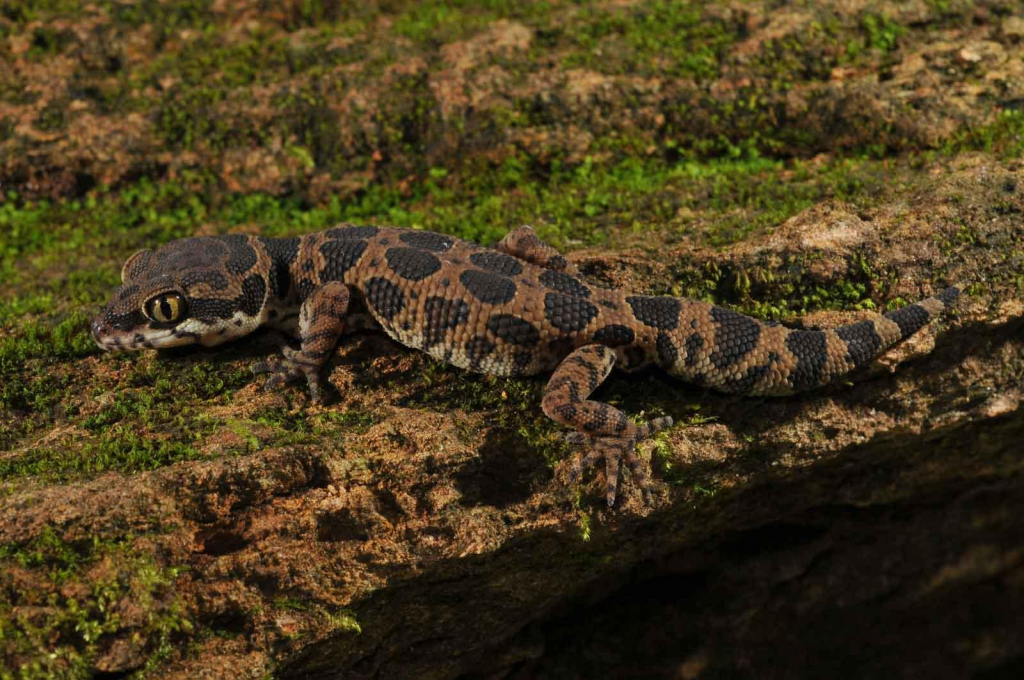
- In the hills of the Eastern Ghats in Odisha and Andhra Pradesh lives a tiny population of the strikingly-patterned Jeypore ground gecko.
- It was presumed extinct for 130 years until it was rediscovered in 2010 by an Indian scientist.
- Just four individuals of this endangered species have been documented in the past year in Odisha’s Balda hills.
Jeypore Ground Gecko
- The Jeypore Ground Gecko is a rare species of gecko (a type of lizard) associated with the Eastern Ghats region of Odisha, India.
- Scientific name: Cyrtodactylus jeyporensis.
- Description: The nocturnal gecko, some 3.6 inches long, with a comparatively large head, and a yellow-orange body, was originally described in 1878 by the British naturalist Richard Henry Beddome.
- Distribution: Endemic to the Eastern Ghats of India, recorded in southern Odisha and northern Andhra Pradesh.
- Habitat: High-elevation, moist semi-evergreen forests, generally around 1,200–1,300 metres.
- Threats: Its habitat is fast shrinking, owing to its transformation to coffee plantations, hydropower projects and mining.
- IUCN status: Endangered (EN), according to the cited IUCN assessment.
- CITES: Included in Appendix II, which regulates international trade to help prevent unsustainable exploitation.
Source: TH
Exercise IBSAMAR IX
Syllabus: GS3/Defence
Context
- Indian Naval Ship (INS) Tarkash, a frontline guided-missile stealth frigate of the Indian Navy is participating in the ninth edition of the India-Brazil-South Africa Maritime (IBSAMAR) Exercise 2026.
About
- Conducted biennially since 2008 under the India-Brazil-South Africa (IBSA) framework, IBSAMAR has emerged as a platform for collective training and the exchange of operational best practices among the three navies.
- The trilateral exercise cover a broad spectrum of maritime operations, including surface warfare, anti-air warfare, anti-submarine warfare, naval air operations, maritime interdiction, Visit Board Search and Seizure (VBSS), anti-piracy operations, search and rescue, damage control and firefighting.
Source: DDNews
Previous article
E-mobility is the Way Ahead for India
Next article
News In Brief 15-10-2026
