


Syllabus: GS3/Environment
Context
- The Lieutenant-Governor of Delhi said recently that E-mobility is the way forward for the nation’s strategic, growth, and ecological trajectory.
E-mobility
- E-mobility (Electric Mobility) refers to the use of electric-powered vehicles and transportation systems instead of vehicles that run primarily on petrol or diesel.
- It involves the use of electric vehicles (EVs), batteries, charging infrastructure and related technologies to make transportation cleaner and more energy-efficient.
Electric Vehicles
- An EV is a vehicle powered by an electric motor that uses energy stored in a battery. It can be recharged from an external power source.
- There are four types of EVs:
- Battery EVs (BEVs), that are fully electric.
- Hybrid EVs (HEVs) & Plug-in HEVs, that combine an internal combustion engine and an electric motor to power the vehicle. PHEVs additionally have externally rechargeable battery packs for extended electric-only operation.
- Fuel Cell EVs (FCEV), in which electric energy is produced from chemical energy.
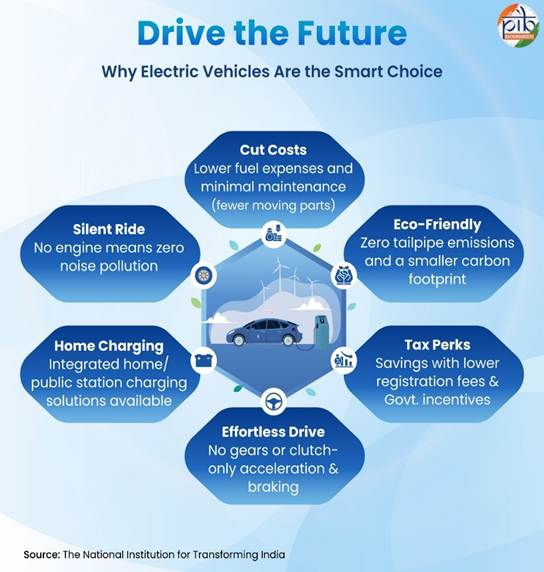
Adoption of EV’s in India
- EV adoption has seen a multifold surge, growing from 0.08% in FY15-16 to 8.26% in FY25-26.
- India’s growth has outpaced global trends, where EV sales increased ~20 times.
- India’s EV penetration was merely one-fifth of the global penetration in 2020. It ramped up to over two-fifths of the global penetration in 2024.
- In 2025, Uttar Pradesh emerged as the largest EV market, followed by Maharashtra and Karnataka.
- Exports have risen from USD 1.2 million in 2020 to USD 84 million in 2024. Top export destinations included Nepal, Indonesia and Japan.
- Infrastructure: According to Bharat Heavy Electricals Limited (BHEL), 16,561 of the 52,718 public charging stations available as of July 2026 are equipped with fast EV charging facilities.
- Investment: India’s EV ecosystem raised over USD1.4 billion in FY 2025, ~27% higher than 2024. In this, Delhi emerged as the top city for EV investments.
- e VITARA (2025): It is Suzuki’s first global strategic Battery Electric Vehicle (BEV), the Made-in-India BEVs are aimed to be exported to 100+ countries. With this milestone, India became Suzuki’s global manufacturing hub for EVs.
- India’s EV market, valued at USD 3.71 billion in 2025, is projected to grow to USD 191.04 billion by 2034, at a CAGR of 54.94%.
- The Indian EV battery market is likely to grow from USD 2.71 billion in 2025 to USD 15.90 billion by 2034, at a CAGR of 21.70%.
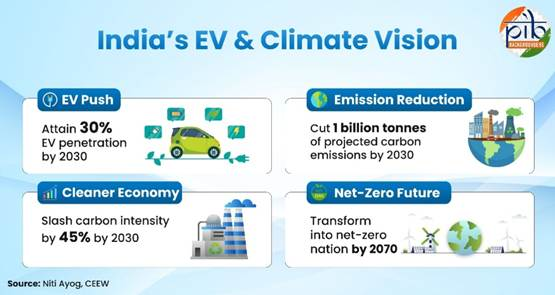
- Targets: India aims for 30% of all vehicle sales to be electric by 2030, aligning with the global EV30@30 initiative.
- The EV ecosystem is strengthened with the establishment of 1.32 million charging stations across India by 2030.
Challenges in Adoption
- High Initial Cost: The upfront cost of purchasing an electric vehicle in India is relatively high compared to traditional internal combustion engine vehicles.
- This cost includes not only the vehicle itself but also the cost of batteries.
- Limited Charging Infrastructure: The availability of charging infrastructure remains a significant barrier to EV adoption in India.
- Range Anxiety: Range anxiety, or the fear of running out of battery charge before reaching a charging station, is a prevalent concern among Indian consumers considering EVs.
- Battery Technology and Supply Chain: India relies heavily on imported lithium-ion batteries, which increases costs and makes EVs vulnerable to supply chain disruptions.
- Consumer Awareness and Education: Many consumers in India lack awareness and understanding of electric vehicles, including their benefits, technology, and available models.
Government Initiatives
- National Electric Mobility Mission Plan (2020) and FAME-I: NEMMP was brought into effect to accelerate the adoption and production of electric vehicles (EVs).
- As part of this mission, the FAME India Scheme (Faster Adoption and Manufacturing of Hybrid and Electric Vehicles) was implemented from 2015 to 2019 to encourage the adoption of electric and hybrid vehicles.
- FAME II (Faster Adoption and Manufacturing of Electric Vehicles) — Phase II: Launched in 2019, the scheme focuses on increasing EV adoption, expanding the e-bus network, and strengthening the charging infrastructure.
- Production Linked Incentive (PLI) Scheme for Automobile and Auto Component Industry in India (PLI-Auto): Launched in 2021, the scheme aims to boost domestic manufacturing of Advanced Automotive Technologies (AAT).
- Major players like Tata Motors and Mahindra & Mahindra have stepped up with significant EV production investments.
- A key mandate is that companies must ensure at least 50% domestic value addition (DVA) to qualify for incentives.
- Scheme for Promotion of Manufacturing of Electric Passenger Cars in India 2024 (SPMEPCI): To draw global automakers to invest, the scheme grants approved applicants a five-year window to import Completely Built-in Units (CBUs) of electric four-wheelers (e-4W) valued at a minimum CIF (Cost, Insurance, and Freight) of USD 35,000 at a significantly reduced customs duty of 15%.
- India Electric Mobility Index (IEMI): NITI Aayog unveiled the India Electric Mobility Index (IEMI) in 2025. It is designed to track, measure, and compare how States and Union Territories are progressing on their electric mobility ambitions.
- Based on these results, regions are ranked as frontrunners with thriving ecosystems; Delhi, Maharashtra, and Chandigarh are leading as ‘Frontrunners’ in the recent IEMI score.
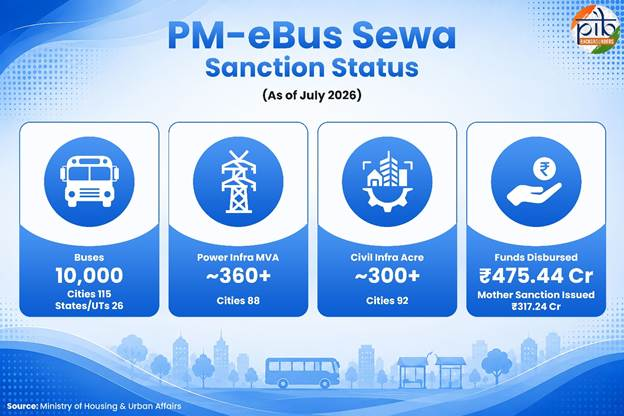
- PM e-Bus Sewa-Payment Security Mechanism (PSM) Scheme: It was notified in 2024 and provides payment security coverage to each bus deployed for up to 12 years.
- Delhi’s EV Policy: It aims to reduce vehicular emissions and improve air quality in the city. In 2026, the Government approved a comprehensive scheme to replace old, high-emission trucks and buses in Delhi-NCR.
- The two-year scheme will support the replacement of around 2.07 lakh commercial vehicles in Delhi-NCR (Delhi, Haryana, Rajasthan, Uttar Pradesh).
- National Mission on Manufacturing (NMM): The NMM (2025) identifies EVs as a key “seed” sector for innovation-led growth. It aims to double the manufacturing sector’s contribution to GDP from 12.9% (2023) to 25%.
- It strengthens India’s EV ecosystem by promoting advanced manufacturing, fostering technology development, and integrating EV production into global value chains.
- PM Electric Drive Revolution in Innovative Vehicle Enhancement Scheme (PM E-DRIVE Scheme): It aims to accelerate EV adoption through targeted demand incentives, support for domestic manufacturing, and expansion of charging infrastructure.
- Low GST on EVs: EVs in India attract a concessional GST rate of 5%, which applies to all electric cars, two-wheelers, and three-wheelers. This makes them significantly cheaper to tax than conventional vehicles.
Way Forward
- India is reshaping itself from an import-dependent market into a globally competitive hub for EV production.
- This is aligned with its strategic priorities of energy security, reduced oil imports, and achieving the 2070 net-zero vision.
- The Government is developing the next phases of Corporate Average Fuel Efficiency (CAFE) norms, CAFE III (2027–2032) and CAFE IV (2033–2037).
- These propose stricter CO₂ emission targets based on the Worldwide Harmonised Light Vehicle Test Procedure (WLTP).
- The road ahead will be shaped by deeper supply chain integration, accelerated localization of batteries and a robust charging infrastructure.
- Together, these pillars are poised to define India’s leadership in the global EV landscape.
Source: TH
Previous article
The Kigali Amendment at 10: Why India’s Cooling Choices Matter?
Next article
News In Brief 15-10-2026
