


Syllabus: GS3/Science & Technology
Context
- The 2026 Nobel Prize in Physics has been awarded to Francis Halzen for his pioneering contribution to the IceCube Neutrino Observatory and the discovery of high-energy neutrinos of astrophysical origin.
IceCube Neutrino Observatory at the South Pole
- The IceCube Neutrino Observatory, located at the South Pole in Antarctica, is designed primarily to detect high-energy astrophysical neutrinos.
- It occupies about 1 cubic kilometre of Antarctic ice & contains 5,160 optical sensors, called Digital Optical Modules.
- The observatory was completed in 2010. Halzen first proposed using Antarctic ice as a neutrino detector in 1988.
- In 2013, IceCube reported the first evidence of high-energy cosmic neutrinos including two, nicknamed Bert and Ernie.
- In 2018, one high-energy neutrino was traced to a distant blazar, an active galaxy containing a supermassive black hole whose relativistic jet points towards Earth.
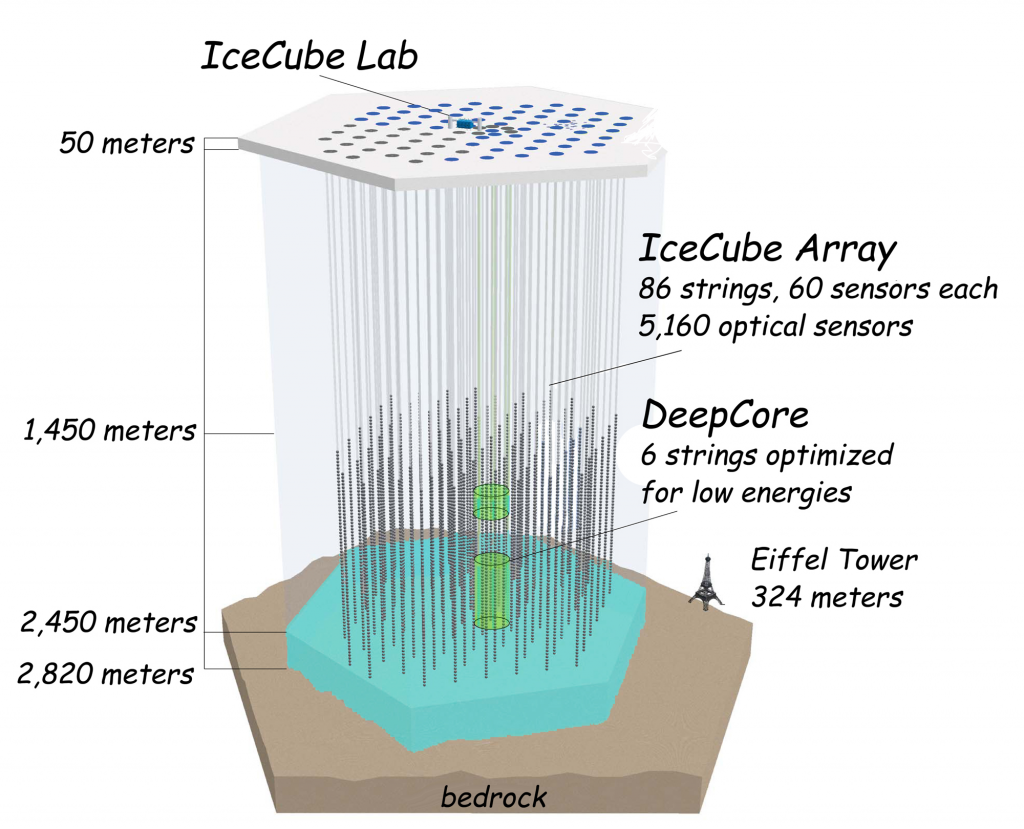
How does IceCube work?
- When a neutrino occasionally interacts with an atomic nucleus in the ice, it produces a charged particle.
- It emits Cherenkov radiation if this particle travels faster than light can travel through ice, observed as a faint blue flash by the optical sensors.
- The vast volume of exceptionally clear and stable Antarctic ice provides the enormous detection medium required because neutrino interactions are extremely rare.
What are Neutrinos and Why Do They Matter?
- Neutrinos are fundamental subatomic particles belonging to the lepton family of the Standard Model.
- It means that they cannot be broken down into any smaller bits, like quarks and photons and electrons.
- Produced in the Sun, nuclear reactions, supernovae, cosmic-ray interactions and other high-energy astrophysical processes.
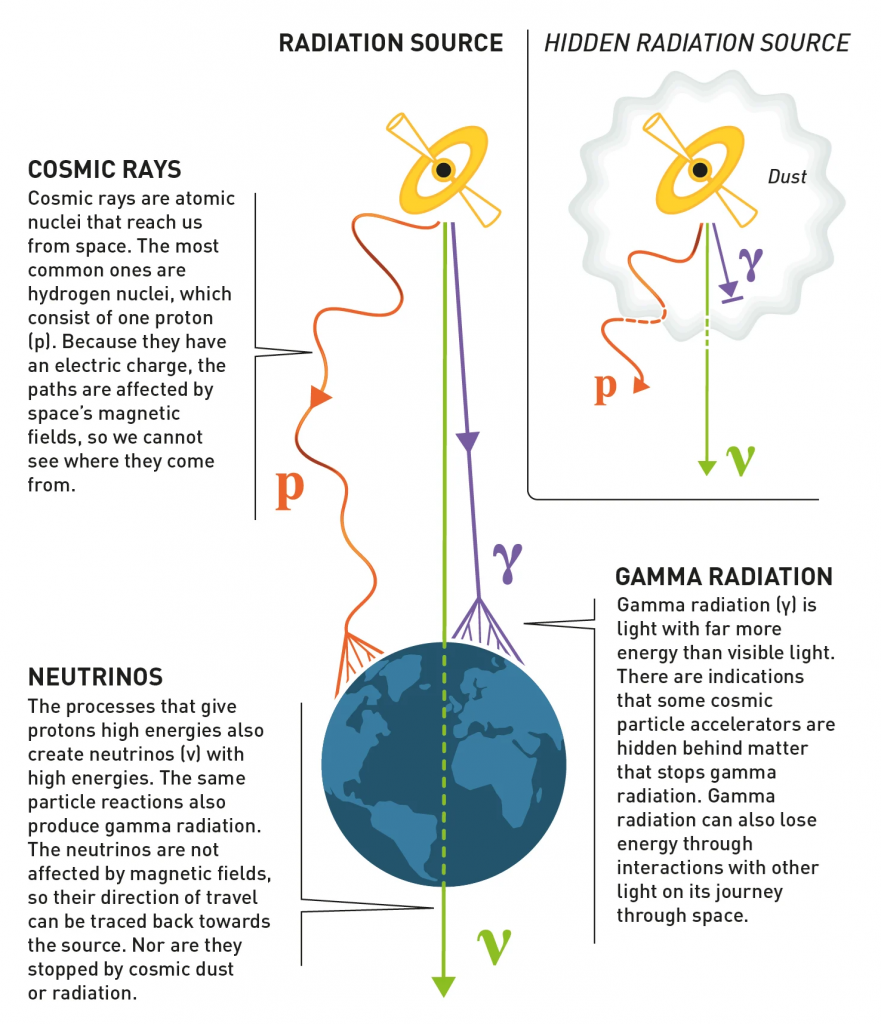
- They carry no electric charge, so they are not affected by electromagnetic forces.
- Neutrinos have a non-zero but very small mass. Their mass was established through the discovery of neutrino oscillations.
- They interact primarily through the weak nuclear force and gravity, making them extremely difficult to detect.
- Neutrinos come in three types, called flavors. There are electron neutrinos, muon neutrinos and tau neutrinos. They oscillate between all three.
- A neutrino can change from one flavour to another while travelling (Neutrino oscillation).
- Trillions of neutrinos pass through the Earth and human body every second, with very few interacting with matter.
- Neutrinos are not deflected by magnetic fields unlike charged cosmic rays. Hence, they can help identify the sources of energetic cosmic events.
- Because interactions are rare, detectors such as IceCube use enormous volumes of water/ice. Neutrino interactions can produce Cherenkov radiation, observed as a characteristic blue flash.
- Neutrinos provide insights into particle physics, astrophysics, cosmology and the extreme environments of the Universe.
India’s Contribution to Neutrino Physics
- 1950s–60s: TIFR scientists used the deep underground facilities of the Kolar Gold Fields (KGF), Karnataka, for cosmic-ray studies.
- 1964–65: Detectors installed about 2.3 km underground recorded atmospheric neutrinos, almost simultaneously with an experiment in a South African gold mine.
- KGF experiments continued for decades but ended after the mines closed in 1992.
- India later proposed the India-based Neutrino Observatory (INO) at Pottipuram, Theni, Tamil Nadu.
- Its proposed 50,000-tonne magnetised Iron Calorimeter (ICAL) was intended to study atmospheric neutrino oscillations and matter effects inside the Earth.
Previous article
A Nuclear Reactor on the Moon
Next article
India’s Aerospace Sovereignty
