


Five New Centres of Excellence for Studies in Classical Languages
Syllabus: GS1/ Culture; GS2/ Education
Context
- The Ministry of Education has approved five Centres of Excellence (CoE) for the study of classical languages.
More About the News
- The approved CoE are for the studies in Classical Assamese, Classical Bengali, Classical Marathi, Classical Pali and Classical Prakrit.
- These will be established at Tezpur University in Assam, Visva-Bharati University in West Bengal, Deccan College Post-Graduate and Research Institute in Pune, Central University of Odisha, and Central University of Gujarat.
- The initiative will provide dedicated institutional support for advanced academic research, preservation and digitisation of linguistic and literary heritage, and wider dissemination of knowledge relating to these Classical Languages.
Classical Languages
- India had 11 classical languages — Tamil, Sanskrit, Telugu, Kannada, Malayalam, Odia, Marathi, Assamese, Bengali (Bangla), Pali and Prakrit.
- Tamil was declared a classical language in 2004, Sanskrit in 2005, Kannada in 2008, Telugu in 2008, Malayalam in 2013, and Odia in 2014.
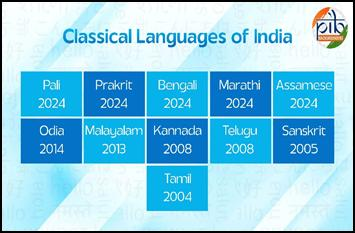
- Criteria: The criteria for a language to be classified as a classical language include the following:
- High antiquity of its early texts or recorded history, spanning a period of 1,500-2,000 years.
- A body of ancient literature or texts that is considered heritage by generations of speakers.
- Knowledge texts, especially prose texts, in addition to poetry, epigraphical and inscriptional evidence.
- The Classical Language and its literature may be distinct from its current form or show discontinuity with later forms derived from the original.
Source: AIR
Form 6 Controversy
Syllabus: GS2/Polity
Context
- The Chief Justice of India clarified that the Supreme Court has not approved any modified version of Form 6 used for inclusion of names in electoral rolls during the Special Intensive Revision (SIR).
Form 6
- Form 6 is issued by the Election Commission of India (ECI).
- It is the application for new voter registration.
- It’s also the same application for deleted voters who want to apply afresh.
- The form seeks personal details, proof of age and ordinary residence, and declarations about citizenship and whether the applicant is already registered elsewhere.

New Form 6
- In the new Form 6 published in July, applicants are asked to choose between three statements:
- whether their name appeared in the electoral roll during the last SIR held in the early 2000s,
- whether a parent’s or grandparent’s name appeared in that roll,
- whether neither their name nor that of their parents appeared in it.
- Although the new declaration is not marked as mandatory, applicants cannot submit the online form without filling it.
- Moreover, the guidelines warn that making a false statement in it is punishable under Section 31 of the Representation of the People Act, 1950.
Source: TH
Russia Plague Outbreak
Syllabus: GS2/Health
Context
- A suspected outbreak of pneumonic plague in Siberia, Russia, has triggered quarantine and precautionary measures after a laboratory worker at an anti-plague research institute died.
About
- Plague is an infectious disease caused by the bacteria Yersinia pestis, usually found in small mammals and their fleas. It occurs on all continents except Oceania.
- It is transmitted between animals through fleas. Humans can contract plague through the bite of infected vector fleas, unprotected contact with infectious bodily fluids or contaminated materials, or inhalation of respiratory particles from a patient with pneumonic plague.
- Types of plague: There are three main clinical forms:
- Bubonic plague: Usually follows an infected flea bite and causes painful, swollen lymph nodes called buboes.
- Septicemic plague: Occurs when Y. pestis infects the bloodstream.
- Pneumonic plague: Affects the lungs and can develop when plague spreads to the lungs from another form, or after inhaling infectious respiratory droplets from an infected person or animal.
- Symptoms: High fever, chills, severe headache and weakness, followed by shortness of breath, chest pain and cough.
- Fatality: It has a case-fatality ratio of 30% to 100% if left untreated.
- Treatment: Plague is treatable with antibiotics (such as gentamicin, ciprofloxacin, or doxycycline), making early recognition critical.
Source: IE
Desert National Park
Syllabus: GS3/ Environment
Context
- The Union Environment Minister and Wildlife Institute of India (WII) released two great Indian bustards (GIB) in Rajasthan’s Desert National Park.
About Desert National Park
- Location: Desert National Park is located in Jaisalmer and Barmer districts of Rajasthan, within the Thar Desert.
- It was established in 1980 under the Wildlife Protection Act, 1972, to safeguard the unique and fragile desert ecosystem of the Thar.
- Background: Declared a protected area in 1980 to combat desertification and conserve the unique Saharo-Thar desert ecosystem.
- Climate: It is in an extremely hot and arid region, receiving less than 100 mm of annual rainfall in parts of the park.
- Landscape: Barchan and longitudinal sand dunes, gravel plains, rocky areas and interdunal depressions.
- Vegetation: Vegetation is sparse and includes open grasslands, thorny bushes and desert-adapted plants.
- Khejri (Prosopis cineraria) is an important native tree associated with the Thar ecosystem and is traditionally protected by the Bishnoi community.
- Biodiversity: It is one of the most important habitats for the Great Indian Bustard (Godawan), a critically endangered grassland bird.
- It is also a habitat for Chinkara, Desert Cat, Desert Hare and Long-eared Hedgehog, Saw-scaled Viper, Persian Gecko and Toad-headed Agama.
Source: TH
Previous article
Coal Stocks Critically Low as Power Demand Rises in India
Next article
News In Short 06-10-2026
