


Syllabus: GS3/Energy
Context
- The depletion of coal inventories at domestic coal-based power plants this year is the highest in the past three years.
About
- Fuel stocks at domestic coal-based power plants have declined by around 66% this year.
- The same was 31.8% in 2024 and 36.8% in 2023 for the same period.
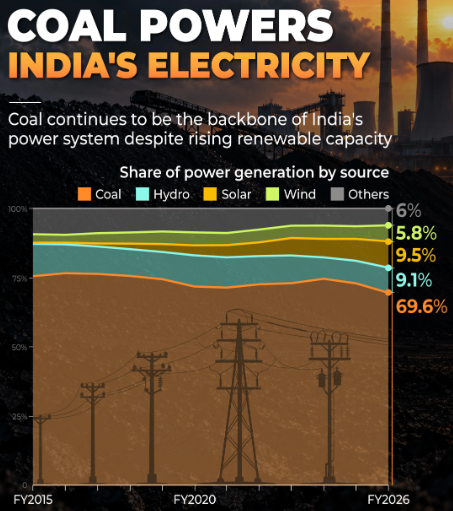
- Despite the growth of renewable energy over the years, coal remains by far the country’s biggest source of power generation.
Why is India Dependent on Coal for Electricity Generation?
- Domestic Coal Reserves: India has substantial coal reserves, especially in states such as Jharkhand, Odisha, Chhattisgarh and West Bengal. This reduces dependence on imported fuels.
- Reliable Supply of Energy: Coal-based power plants can generate electricity continuously, unlike solar and wind, whose output varies.
- Rising Electricity Demand: The demand for the electricity has been rising because of industrialisation, urbanisation, electrification and increasing use of appliances and cooling.
- Renewables are intermittent: Solar power is available mainly during daylight hours, while wind generation depends on wind conditions.
- Until sufficient battery storage, pumped-storage hydropower and flexible grids are available, coal helps maintain supply when renewable generation falls.
Concerns with India’s Coal Dependency
- Environmental Pollution: Coal-based power plants release pollutants such as particulate matter, sulphur dioxide and nitrogen oxides, contributing to air pollution.
- High Greenhouse Gas Emissions: Coal is a carbon-intensive fuel and contributes significantly to India’s CO₂ emissions, making climate-change mitigation more difficult.
- Water Consumption: Thermal power plants require significant quantities of water for cooling; this creates pressure on water resources.
- Environmental Damage: Coal mining can lead to deforestation, land degradation, displacement of communities and loss of biodiversity.
- Coal combustion produces large quantities of fly ash, whose improper disposal can contaminate land and water.
- Difficulty in Energy Transition: Heavy dependence on coal can create lock-in of coal-based infrastructure, making the transition towards cleaner energy sources more challenging and costly.
Government Initiatives
- National Solar Mission (NSM): It was launched in 2010, it has set ambitious targets for solar capacity installation, including grid-connected and off-grid solar power projects.
- National Green Hydrogen Mission: Promotes green hydrogen produced using renewable energy, with the aim of reducing dependence on fossil fuels in difficult-to-decarbonise sectors.
- National Clean Energy Fund (NCEF): It was established to support research and innovation in clean energy technologies and projects that help in reducing greenhouse gas emissions.
- National Wind Energy Mission: Focuses on the development and expansion of wind energy in India. The target for wind energy capacity is set at 140 GW by 2030.
- Financial Support & Incentives: Viability Gap Funding (VGF) for large-scale solar and hybrid projects.
- Production Linked Incentive (PLI) scheme for solar PV manufacturing.
- Subsidies for rooftop solar and off-grid systems.
- Renewable Energy Certificates (RECs) to promote green power trading.
- Infrastructure Development: Green Energy Corridor to improve RE grid integration.
- PM-KUSUM Scheme for solarizing agricultural pumps.
- Revamped Distribution Sector Scheme (RDSS) to strengthen DISCOMs.
- International Partnerships: ISA (International Solar Alliance) was launched by India to promote global solar cooperation, under which India collaborates with countries & global funds for clean energy investment and technology.
- Grid Integration Plan: India’s grid is being reimagined through the ₹2.4 lakh crore Transmission Plan for 500 GW, linking renewable-rich states with demand centres.
- The Government is prioritizing investment in transmission infrastructure through the Green Energy Corridors and new high-capacity transmission lines from Rajasthan, Gujarat, and Ladakh.
- While these projects are multi-year efforts, once operational they will unlock over 200 GW of new renewable capacity.
- Vision till 2032: Government has already planned for building High-Voltage Direct Current (HVDC) corridors and boosting inter-regional transmission capacity from 120 GW today to 143 GW by 2027, and 168 GW by 2032.
Conclusion
- India’s dependence on coal is therefore not simply because India lacks renewable energy.
- It is largely because coal currently combines availability, established infrastructure, continuous generation and system reliability.
- At the same time, India is expanding solar, wind, hydropower, nuclear power and energy storage to gradually reduce the relative dependence on coal.
Source: IE
Previous article
Three-Dimensional (3D) Printing Technology
Next article
News In Short 06-10-2026
