


Syllabus: GS3/Science
Context
- The Nobel Prize in Physiology or Medicine (2026) was awarded for discoveries that enabled optogenetics, a technique that uses light to precisely control selected nerve cells.
About Nobel Prize in Physiology or Medicine
- It is one of the five original Nobel Prizes established by Alfred Nobel, awarded by the Nobel Assembly at Karolinska Institutet for discoveries of major importance to medicine or human physiology.
- In 2026, the prize carries 12 million Swedish kronor (about ₹11.5 crore), shared equally among three laureates.
- Award in 2026: The 2026 laureates are:
- Karl Deisseroth – Stanford University, USA
- Peter Hegemann – Humboldt University, Berlin, Germany
- Georg Nagel – University of Würzburg, Germany
- Their work established the scientific foundations of optogenetics, enabling researchers to move from merely observing neural activity to testing the causal role of specific neurons and neural circuits in behaviour and emotions.
What is Optogenetics?
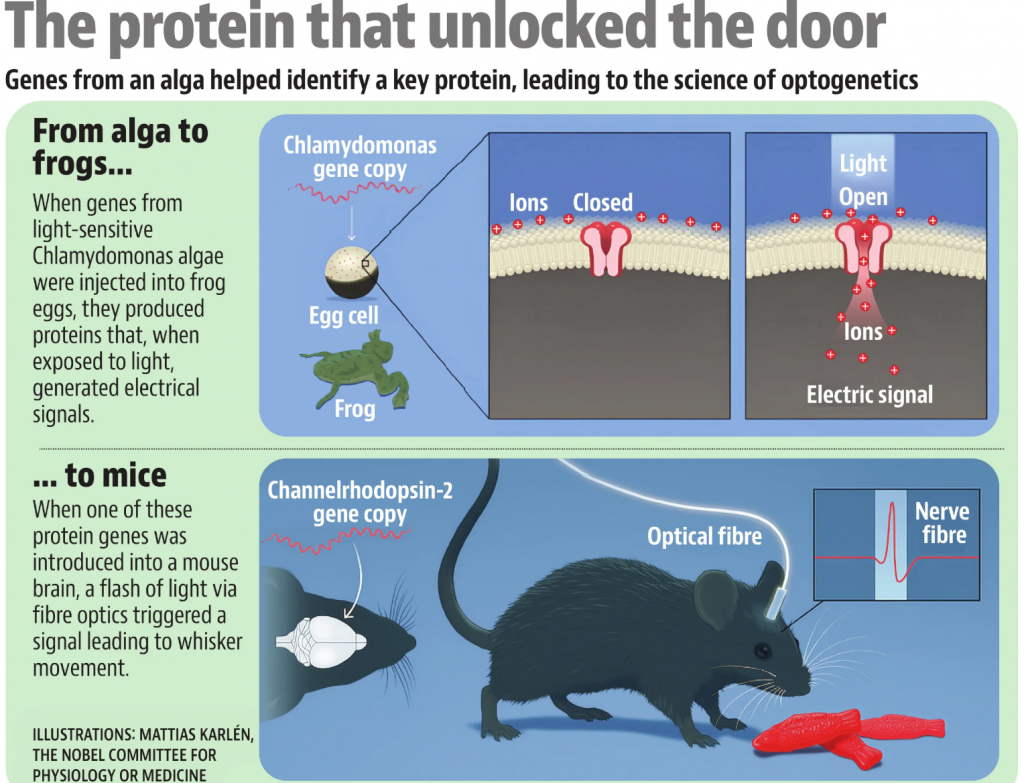
- Optogenetics combines genetic engineering and optics to control the activity of genetically selected cells using light.
- Light-sensitive proteins called opsins are introduced into specific neurons.
- These proteins regulate ion movement across the cell membrane when illuminated, thereby turning neuronal activity on or off.
- It provides much greater temporal and cellular precision than conventional methods such as drugs or electrical stimulation.
Foundations of Optogenetics
- The foundation was laid in the 1990s, when Peter Hegemann studied the microscopic alga Chlamydomonas and observed that light rapidly generated an electrical signal.
- Hegemann and Georg Nagel subsequently identified Channelrhodopsins, light-gated ion channels.
- Channelrhodopsin-2 (ChR2) was particularly important as it could open in about 0.2 milliseconds, allowing positively charged ions to enter cells and generate an electrical signal.
- Experiments showed that transferring its gene into mammalian cells made them light-sensitive.
- Karl Deisseroth recognised the potential of combining this discovery with genetic targeting of particular neurons.
Applications in Medicine and Neuroscience
- Optogenetics has transformed research on pain, attention, sleep, memory and social behaviour.
- It has contributed to understanding disorders such as:
- Schizophrenia and depression
- Alzheimer’s and Parkinson’s diseases
- Epilepsy and other neurological disorders
- Vision and hearing restoration
- A significant translational development involved introducing a channelrhodopsin-like protein into the retina of a blind person.
- Light stimulation enabled sufficient visual function to locate and pick up nearby objects.
Nobel Prize
- Origin: Established through the will of Alfred Nobel, Swedish inventor, engineer and industrialist, who died in 1896.
- The Nobel Prize seeks to recognise exceptional contributions that have produced significant benefits for humanity.
- First Awards (1901): Five years after Nobel’s death.
- Original Categories: Nobel established prizes in Physics, Chemistry, Physiology or Medicine, Literature, and Peace.
- Economic Sciences: The Sveriges Riksbank Prize in Economic Sciences in Memory of Alfred Nobel was established in 1968 and first awarded in 1969. It is not one of the original Nobel Prizes.
- Awarding Institutions:
- Physics & Chemistry: Royal Swedish Academy of Sciences
- Physiology or Medicine: Nobel Assembly at Karolinska Institutet
- Literature: Swedish Academy
- Peace: Norwegian Nobel Committee
- Economic Sciences: Royal Swedish Academy of Sciences
- Nobel Peace Prize: It is awarded in Oslo, Norway; the remaining Nobel Prizes are presented in Stockholm, Sweden.
- Prize Components: Each laureate receives a medal, diploma and monetary award.
- Selection: Laureates are selected through a process involving nominations, expert assessment and deliberation by the relevant awarding institutions.
Previous article
India-Switzerland Ties
Next article
Three-Dimensional (3D) Printing Technology
