


Syllabus: GS2/ Polity and governance
Context
- A continuing dispute before the Supreme Court over the career progression of Central Armed Police Forces (CAPF) officers has revived the debate over IPS deputation, Organised Group A Service status and promotion-related stagnation in the CAPFs.
Background
- The dispute primarily concerns five CAPFs: Central Reserve Police Force (CRPF), Border Security Force (BSF), Central Industrial Security Force (CISF), Indo-Tibetan Border Police (ITBP) and Sashastra Seema Bal (SSB).
- Each has its own cadre of Group A executive officers, generally recruited as Assistant Commandants, who can rise through the hierarchy to senior command positions.
- However, senior positions have traditionally also been filled through deputation, particularly by IPS officers.
- Before the Central Armed Police Forces Act, 2026, recruitment rules provided for 20% of DIG and 50% of IG posts to be filled through deputation.
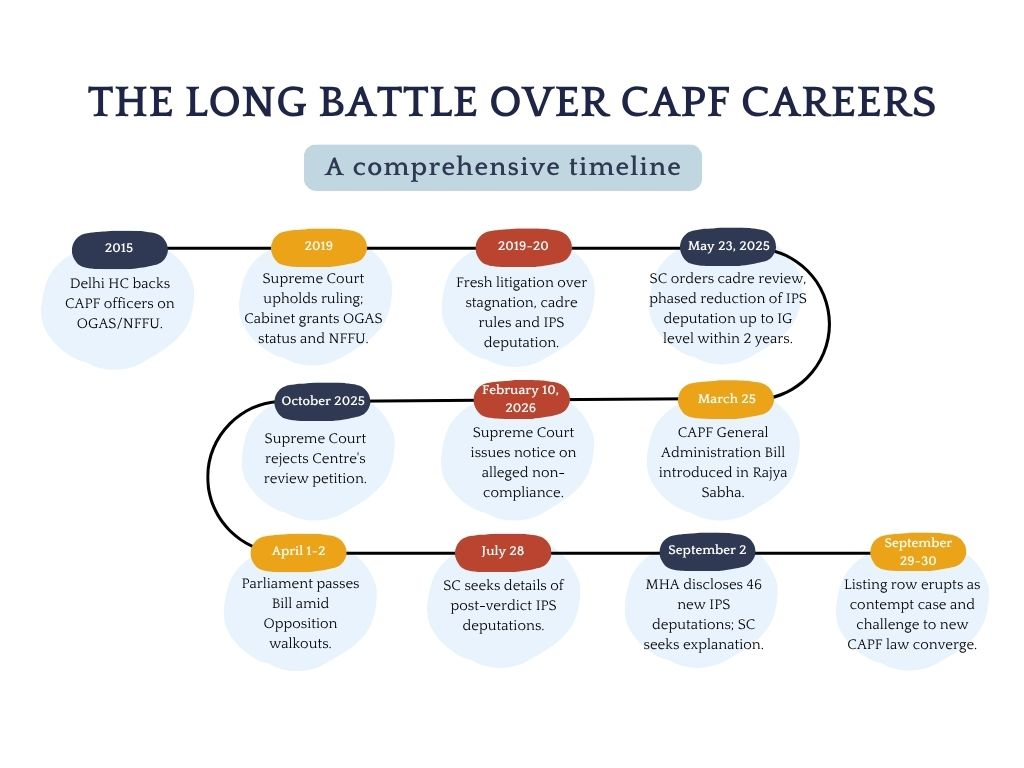
- In 2019, the Union Cabinet granted Organised Group A Service (OGAS) status and Non-Functional Financial Upgradation (NFFU) to Group A executive cadre officers of the CAPFs.
- NFFU enables eligible officers to receive the financial benefits of a higher grade when regular promotion is delayed because of inadequate vacancies.
Supreme Court Ruling
- In the case of Sanjay Prakash & Others vs Union of India, 2025, the Supreme Court ruled that:
- Group A officers of CAPFs are to be treated as “Organised Services” for all purposes.
- The deputation of IPS officers to Senior Administrative Grade (SAG) posts i.e., up to the rank of Inspector General (IG), in CAPFs should be progressively reduced within an outer limit of two years.
Central Armed Police Forces (General Administration) Act, 2026
- The Act creates an umbrella framework for Group A officers of the five CAPFs and empowers the Central government to frame rules governing recruitment, promotion, deputation and service conditions.
- Positions to be filled by deputation: The following positions in CAPFs must be filled by IPS officers on deputation:
- 50% of the posts in the rank of Inspector General,
- A minimum of 67% of the posts in the rank of Additional Director General, and
- All posts in the ranks of Director General and Special Director General.
- Overriding effect: In case of any inconsistency between the Act and any other law, the provisions of the Act will prevail.
Role of the Ministry of Home Affairs
- The Ministry of Home Affairs (MHA) serves as the administrative authority for both the Indian Police Service (IPS) and the Central Armed Police Forces (CAPFs).
- The MHA has traditionally justified the deputation of IPS officers on grounds such as;
- Bringing in policing experience from state cadres to strengthen central forces.
- Maintaining a uniform standard of leadership across all forces.
Concerns of IPS appointments in CAPFs
- Stagnation in Career Progression: Due to high reservation of senior ranks (e.g., 50% IG posts) for IPS officers, CAPF cadre officers face limited promotional opportunities.
- On average, a CAPF officer takes 25 years to reach the rank of Commandant, a position they should ideally achieve in 13 years.
- Violation of Organisational Integrity: The continued deputation of IPS officers hampers institutional autonomy and the long-term professionalization of CAPFs as elite forces.
- Violation of Natural Justice and Equality: Articles 14 (Right to Equality) and Articles 16 (Equality of Opportunity in Public Employment) come into play, as CAPF cadre officers are denied equal promotional avenues compared to their IPS counterparts.
Way Ahead
- The CAPF cadre and IPS deputation debate goes beyond a dispute over individual promotions.
- It concerns professionalisation, institutional continuity, operational efficiency and the design of India’s internal security administration.
- A sustainable framework should combine the operational advantages of limited deputation with meaningful career progression for permanent CAPF cadres, while maintaining clear and constitutionally consistent rules for recruitment, promotion and senior command.
Central Armed Police Forces (CAPF)
- The Central Armed Police Forces (CAPF) is the collective name of central police organizations under the Ministry of Home Affairs of India.
- These forces are responsible for internal security and guarding the borders. CAPF is classified as;
- Assam Rifles (AR): It is a central police and paramilitary organization responsible for border security, counter-insurgency, and law and order in Northeast India.
- Border Security Force (BSF): It is primarily deployed along the Pakistan and Bangladesh borders, since 2009 it is also posted in Left Wing Extremism (LWE) affected areas.
- Indo-Tibetan Border Police (ITBP): It is deployed for guarding duties on the Indo-China border
- Sashastra Seema Bal (SSB): It guards the Indo-Nepal and Indo-Bhutan borders.
- National Security Guard (NSG): It is a counter-terrorism unit under the Ministry of Home Affairs. All personnel are deputed from other CAPFs and the Indian Army.
- Central Reserve Police Force (CRPF): It is deployed for internal security duties and has a large presence in North East, LWE theater and Jammu and Kashmir.
- Central Industrial Security Force (CISF): It provides security to various Public Sector Undertakings (PSUs) and other critical infrastructure installations, major airports across the country and provides security during elections and other internal security duties and VVIP protection.
Source: IE
Previous article
News In Short 03-10-2026
Next article
Animal Diplomacy
