


Syllabus: GS3/Economy
Context
- After nine years of GST implementation, the government is introducing a new phase of reforms with the aim of reducing the compliance burden while supporting consumption and economic growth.
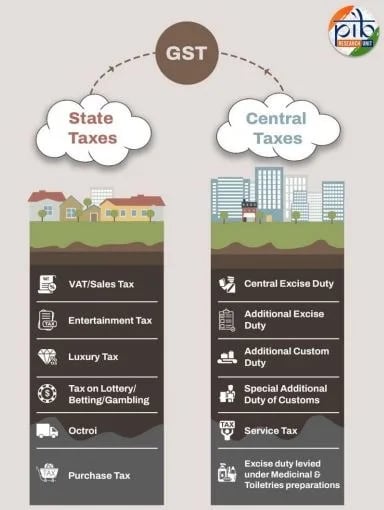
Goods and Services Tax
- The GST was introduced in 2017 by the 101st Constitutional Amendment Act, 2016 as a comprehensive indirect tax for the entire country.
- It is a destination based tax on consumption of goods and services.
- It is levied at all stages right from manufacture up to final consumption.
- Only value addition will be taxed and the burden of tax is to be borne by the final consumer.
- It accrues to the State or the Union Territory where the consumption takes place. It is of 3 types:
- Central GST (CGST): Levied by the Center.
- State/Union Territory GST (SGST/UTGST): Levied by States or UTs.
- Integrated GST (IGST): Tax levied and collected by the Center on all inter-state supplies of goods and/or services.
- The Center settles accounts with the States/UTs by transferring the SGST/UTGST portion of IGST to the destination state where goods/services were consumed.
- The GST Council is a constitutional body under Article 279A.
- It is a federal body comprising the Union Finance Minister as its Chairman and Finance Ministers of all States as members.
- The GST Council members take almost all decisions on GST with consensus.
- Exempted Items: The GST applies to all goods other than alcoholic liquor for human consumption and five petroleum products (common for the Center and the States): petroleum crude, motor spirit (petrol), high speed diesel, natural gas, aviation turbine fuel.
About Next-Generation GST
- After nearly nine years of implementation, the government has sought to address two broad concerns through Next-Gen GST:
- Rate rationalisation, which has already been implemented.
- Ease of compliance, which constitutes the next phase of reforms.
- Rate rationalisation was implemented from September 2025. There are three slabs for taxes for both goods and services: 5%, 18% and 40%.
- The reforms rationalised GST rates with the broad objective of reducing complexity and lowering the tax burden on several goods and services.
- The Next Phase of GST Reform: It focuses on different areas such as;
- Simpler registration: Small businesses should be able to obtain GST registration through a faster and more predictable process, particularly where the risk of tax evasion is low.
- Simpler return filing: Reducing unnecessary procedural requirements and increasing automation can lower the time and administrative resources spent by businesses on compliance.
- Faster refunds: Timely refunds are important for exporters and businesses with substantial input taxes because delays can lock up working capital.
- Better input tax credit: A predictable flow of eligible input tax credit can reduce the tax burden embedded in the supply chain and improve the working-capital position of businesses.
- Faster dispute resolution: It can reduce prolonged litigation and provide businesses with greater certainty regarding their tax liabilities.
Performance of GST After Rate Rationalisation
- Between October 2025 and July 2026, the value of reported taxable supplies grew by 25.8% over the corresponding period a year earlier.
- Gross GST collections reached Rs 12.46 lakh crore during April-September 2026, up 11.6% over the corresponding period last year.
- B2C sales increased by 26.7%, indicating stronger reported consumer-facing economic activity.
- GST registrations reached approximately 1.71 crore by August 2026, nearly 15% higher than a year earlier.
Challenges Ahead
- Compliance burden for small businesses: Despite digitalisation, smaller firms may continue to face difficulties in understanding rules, maintaining records and filing returns.
- Input tax credit disputes: Delays, mismatches and uncertainty surrounding eligible credits can block working capital.
- Refund delays: Delayed refunds can impose significant liquidity costs on exporters and other eligible taxpayers.
- Tax disputes: Frequent litigation over classification, valuation, exemptions and input tax credit can reduce tax certainty.
- Centre-State coordination: Further reforms require continued consensus within the GST Council because changes in GST directly affect the revenues and administrative responsibilities of both levels of government.
Way Ahead
- The next phase should prioritise taxpayer-centric GST administration rather than merely increasing revenue collection.
- Registration and return filing should become increasingly automated, risk-based and simple, particularly for low-risk taxpayers.
- The GST Council should continue to use cooperative federalism to balance tax simplification with the revenue interests of states.
Source: TH
Previous article
Animal Diplomacy
Next article
Green Energy Corridor Phase-III (GEC-III) Scheme
