


Interaction of Two Weather Systems
Syllabus: GS1/Geography; GS3/Disaster Management
Context
- The exceptionally heavy rainfall in Uttar Pradesh has been attributed to the likely interaction of a deep depression originating in the Bay of Bengal and a Western Disturbance over northwestern India.
Deep Depression over Central India
- A deep depression originating over the Bay of Bengal crossed the North Andhra Pradesh–South Odisha coast before moving inland and weakening.
- A depression is an organised low-pressure system in which atmospheric pressure is lower than that of the surrounding areas.
- Warm, moist air converges towards the low-pressure centre and rises. As the air rises, it expands and cools, causing water vapour to condense into clouds and produce rainfall.
- The intensity of rainfall depends on factors such as moisture availability, atmospheric instability, wind convergence and the system’s speed of movement.
Western Disturbance and Westerly Jet Stream
- Western disturbance refer to weather systems that usually travel into northern India from the west.
- These are east-moving rain-bearing wind systems that originate beyond Afghanistan and Iran and pick up moisture from the Mediterranean Sea, Black Sea, Caspian Sea, and the Arabian Sea.
- These are typically extra-tropical cyclones resulting from low-pressure areas, formed by interactions between polar and tropical winds.
- The subtropical westerly jet stream, a high-altitude, fast-moving air current that flows from west to east in the Earth’s atmosphere, carries these disturbances to the Himalayan and Tibetan highlands.
- As moisture-laden western disturbances hit the Himalayas, they rise and cool, bringing cloudy weather, rain, and thunderstorms, particularly over parts of north and northwest India.
Why Is the Terai Region Vulnerable to Flooding?
- The Terai is a low-lying, marshy belt situated south of the Himalayan foothills extending across parts of Uttar Pradesh, Bihar and other Himalayan foothill regions.
- Its relatively flat terrain, high groundwater levels and proximity to Himalayan rivers make several parts of the region susceptible to waterlogging and flooding.
- Intense rainfall can overwhelm local drainage systems, while high river levels impede the drainage of rainwater from adjoining areas.
Source: IE
Birth Anniversary of Shaheed Bhagat Singh
Syllabus: GS1/History
Context
- Prime Minister Narendra Modi paid tributes to freedom fighter Shaheed Bhagat Singh on his 119th birth anniversary.
About
- Bhagat Singh was born on 28 September 1907 in Banga village, Lyallpur district of Punjab (now in Pakistan).
- He studied at Dayanand Anglo-Vedic High School and later at National College, Lahore.
- He was a staunch advocate of socialism, believing in a society where wealth and resources were shared equally. He was also attracted to anarchist and Marxist ideologies.
Role in the Freedom Struggle
- He joined the Hindustan Republican Association (HRA), which was later reorganised as the Hindustan Socialist Republican Association (HSRA).
- In 1926, he founded the Naujawan Bharat Sabha in Lahore to mobilise young people against colonial rule.
- After Lala Lajpat Rai died following a lathi charge during a protest against the Simon Commission, Bhagat Singh and his associates decided to avenge his death. They intended to target James A. Scott, but mistakenly killed John P. Saunders, a British police officer, in 1928.
- On 8 April 1929, Bhagat Singh and Batukeshwar Dutt threw bombs inside the Central Legislative Assembly in Delhi to protest colonial policies, including the Public Safety Bill and Trade Disputes Bill. Their objective was not to cause deaths but to “make the deaf hear.”
- Bhagat Singh and Dutt were arrested and subsequently sentenced to life imprisonment for the Assembly bombing.
- Bhagat Singh later faced charges related to the Saunders murder, which formed the basis of the Lahore Conspiracy Case and ultimately led to his death sentence.
- He was executed along with Rajguru and Sukhdev on 23 March 1931, at the age of 23.
Literary
- His famous essay ‘Why I Am an Atheist’ was written in 1930 while he was imprisoned in Lahore.
- He also contributed to the Punjabi magazine Kirti and joined its editorial board in 1926.
Legacy
- 23 March is observed as Shaheed Diwas in memory of Bhagat Singh, Rajguru and Sukhdev.
Source: AIR
Pradhan Mantri Anusuchit Jaati Abhyuday Yojna (PM-AJAY)
Syllabus: GS2/Health
In News
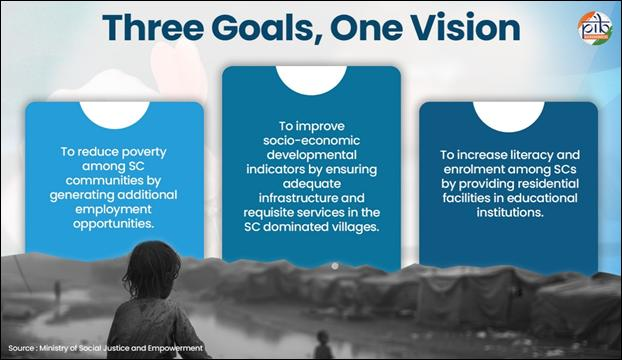
- The Government has launched ‘PM-AJAY’ Mobile App and ‘PM-AJAY’ Portal for expedited and quality implementation of the PM-AJAY Scheme.
Pradhan Mantri Anusuchit Jaati Abhyuday Yojna (PM-AJAY)
- It is a 100% centrally sponsored scheme launched in FY 2021-22.
- It envisions achieving socio-economic and educational empowerment of Scheduled Caste communities through a comprehensive and integrated approach.
- It is a merger scheme of three erstwhile centrally sponsored schemes, namely, Pradhan Mantri Adarsh Gram Yojana (PMAGY), Special Central Assistance to Scheduled Castes Sub Plan (SCA to SCSP) and Babu Jagjivan Ram Chhatrawas Yojana (BJRCY).
- It is implemented by the Ministry of Social Justice & Empowerment.
Source :PIB
Spontaneous Coronary Artery Dissection (SCAD)
Syllabus: GS2/Health
In News
- Spontaneous coronary artery dissection (SCAD) can trigger a heart attack in seemingly healthy women in their 30s and 40s, often without conventional risk factors
Spontaneous coronary artery dissection (SCAD)
- It is a sudden, often-unrecognized heart attack that occurs when a tear or leak forms in the wall of a coronary artery, causing the vessel to compress and limiting blood flow.
- It has a different mechanism from the traditional heart attack, which is normally caused by a cholesterol plaque rupturing and a clot forming.
- It primarily affects women under 50.
- Young women make up approximately 80-90 % of cases and up to one-third of all women with a heart attack.
- Some causes of SCAD are strenuous physical activity, hard lifting, emotional stress, pregnancy and hormonal changes, or underlying vascular problems.
- There is a strong association with fibromuscular dysplasia (FMD), a non-atherosclerotic disorder of medium-sized arteries. Other vascular abnormalities (ie, aneurysms and arterial tears) are also more prevalent in people with SCAD.
- In the instance of complete blockage in SCAD treatment may include angioplasty but in the absence of obstruction the artery normally heals without treatment and is treated conservatively unlike a typical heart attack.
- Beta-blockers may minimize recurrence. Statins and antiplatelets are used selectively.
Source :IE
Government Pushes Aquaculture Insurance with 40% Premium Incentive
Syllabus: GS3/Economy
Context
- The Union Government is promoting aquaculture insurance under the Pradhan Mantri Matsya Kisan Samridhi Sah-Yojana (PM-MKSSY) by providing an incentive of up to 40% of the insurance premium for one crop cycle.
Pradhan Mantri Matsya Kisan Samridhi Sah-Yojana (PM-MKSSY)
- The Union Government approved PM-MKSSY in 2024, with aquaculture insurance included under Component 1-B.
- Key Features of the Scheme:
- Eligible farmers can receive an incentive of up to 40% of the insurance premium.
- For pond-based aquaculture, the incentive is capped at ₹25,000 per hectare of water-spread area, subject to a maximum of ₹1 lakh for up to four hectares. Farms below one hectare are eligible for the incentive on a pro-rata basis.
- For advanced systems such as cage culture, Recirculatory Aquaculture Systems, biofloc and raceways, the incentive is 40% of the premium, subject to a maximum of ₹1 lakh and an eligible unit size of up to 1,800 cubic metres.
- SC, ST and women beneficiaries are eligible for an additional incentive of 10% of the incentive payable to general-category beneficiaries.
- Implementation is facilitated through the National Fisheries Digital Platform (NFDP), with benefits transferred directly through Direct Benefit Transfer (DBT).
India’s Aquaculture Growth
- Aquaculture accounts for around 74% of India’s total fish production.
- India recorded 19.8 million tonnes of fish production in 2024–25, making it the second-largest fish-producing country globally.
- Also, inland fish production increased to 14.74 million tonnes in 2024–25 reflecting the growing importance of inland aquaculture.
- India has substantial untapped potential, with around 1.95 lakh km of rivers and canals, 31.5 lakh hectares of reservoirs, 22.1 lakh hectares of ponds and tanks, and 14.1 lakh hectares of brackish-water area.
- Only around 17% of the available brackish-water area has been developed for aquaculture, indicating considerable scope for expansion.
Source: DD News
Green Highways
Syllabus: GS3/Infrastructure/Environment
Context
- India’s green highways approach is transforming road infrastructure through plantation, climate-resilient design and resource-efficient construction.
What is Green Highways?
- Green Highways refer to an approach to highway planning, design and construction that integrates transportation needs with ecological sustainability, while considering the environment, public health and surrounding communities.
- Plantation activities are undertaken by Self Help Groups, private agencies, State Forest Departments, Forest Corporations and contractors, according to the scope of sanctioned works.
- As of July 2026, more than 3.61 crore saplings have been planted across approximately 1.32 lakh km of National Highways during the last five years.
Green Highways Policy, 2015
- The greening of India’s National Highway network is guided by the Green Highways (Plantation, Transplantation, Beautification and Maintenance) Policy, 2015. The Policy was formulated to:
- Evolve a policy framework for plantation along National Highways.
- Reduce the impact of air pollution and dust, as trees and shrubs are known to be natural sinks for air pollutants.
- Arrest soil erosion at the embankment slopes.
- Moderate the effect of wind and incoming radiation.
- Create employment opportunities for local people.
Do you know?
- The National Highways Green Cover Index (NH-GCI) 2025–26 report provides the country’s first scientific and quantitative assessment of green cover within the Right of Way (RoW) along National Highways.
- Prepared in collaboration with the National Remote Sensing Centre (NRSC) of ISRO, the assessment covers nearly 30,000 km of National Highways under the Operation and Maintenance (O&M) phase across 24 states.
Source: PIB
Previous article
PRAHAAR: National Counter-terror Policy
Next article
News In Short 29-09-2026
