


Syllabus: GS3/Internal Security
In News
- The Union Home Minister inaugurated a conference on ‘PRAHAAR – CT Policy and Strategy’ in New Delhi.
PRAHAAR
- The Ministry of Home Affairs has unveiled ‘PRAHAAR’ as India’s first comprehensive National Counter Terrorism Policy & Strategy on 23rd February, 2026.
- It frames India’s counter-terrorism approach within a broad threat landscape that includes cross-border terrorism, global extremist networks (like Al-Qaeda and ISIS), and modern technological risks such as drones, encrypted communication, cyber attacks, crypto-financing, and CBRNED threats.
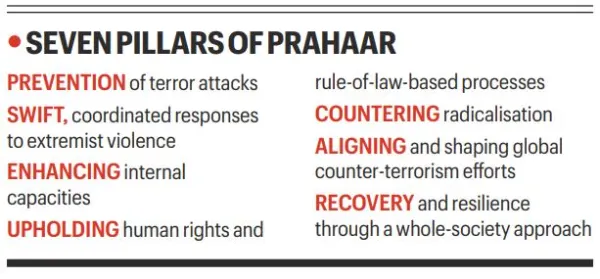
- It proposes a seven-pillar strategy focusing on intelligence-led prevention, rapid coordinated response, capacity building, human rights compliance, de-radicalisation, international cooperation, and societal recovery and resilience.
- It mainly consolidates existing institutions and laws (like NIA, NSG, UAPA, CAPFs) into a single national framework rather than creating new structures.
Importance
- First comprehensive national policy: Establishes a unified framework for counter-terrorism across agencies.
- Multi-domain protection: Covers threats via land, air, water, and cyberspace, safeguarding critical sectors like power, railways, aviation, ports, defence, space, and atomic energy.
- Zero tolerance principle: Reinforces India’s stance that terrorism cannot be linked to any religion, ethnicity, or nationality.
- Capacity building: Enhances coordination among intelligence, police, and paramilitary forces.
- Global alignment: Strengthens India’s role in shaping international counter-terrorism cooperation.
Emerging Challenges and Concerns of India’s Counter-Terror Architecture
- Cross-border terrorism: Persistent infiltration and support from state-sponsored groups in neighbouring regions.
- Cyber-enabled threats: Nation-states and criminal hackers targeting India’s digital infrastructure.
- Dark-web platforms allow anonymous purchase of weapons, explosives and stolen data, complicating intelligence tracking.
- Drone warfare: Increasing use of drones for smuggling arms and explosives, especially in Punjab and Jammu & Kashmir.
- Organised crime-terror nexus: Terror outfits collaborating with criminal networks for logistics and recruitment.
- Radicalisation: Online propaganda and sleeper cells of groups like Al-Qaeda and ISIS attempting to incite violence.
- Security agencies warn extremists increasingly use AI-generated propaganda and automated bot networks for radicalisation campaigns.
- Limited specialised counter-terror training capacity: Many police forces still lack advanced training in cyber intelligence, drone detection and digital surveillance technologies.
Way Ahead
- Strengthen intelligence integration: Expand real-time data sharing across central and state agencies.
- Cyber defence upgrades: Invest in AI-driven monitoring systems and indigenous cyber-security solutions.
- Drone countermeasures: Deploy anti-drone technologies and stricter border surveillance.
- Community resilience: Promote awareness campaigns against radicalisation, involving civil society and local governance.
- International cooperation: Deepen collaboration with UN and global partners to combat financing, arms smuggling, and extremist propaganda.
- Legal reforms: Update anti-terror laws to address emerging technologies while ensuring judicial oversight.
- Victim support systems: Institutionalise rehabilitation and compensation frameworks for victims of terror.
Conclusion
- PRAHAAR is India’s first institutionalised anti-terror doctrine, combining prevention, proportionate response, and resilience.
- The effectiveness of PRAHAAR will depend on its implementation at the grassroots level through clear state-wise guidelines, capacity-building of police and ATS units, and strong coordination across agencies for intelligence sharing, policing, and community engagement.
- It also requires monitoring mechanisms to ensure integration of socio-economic and “whole-of-society” measures into security planning.
Source :IE
Previous article
India’s Reservoir Storage At 70%: At 10-Year Low
Next article
News In Short 29-09-2026
