

Syllabus: GS3/Space; GS2/IR
Context
- The United States said it had active weapons deployed in space, the first such public admission by any country.
About
- The US did not reveal the nature of weapons deployed, or when they were deployed.
- There was immediate reaction from China and Russia, two countries that the US considers its space adversaries.
- Both urged the US to stop expanding its military capabilities and preparing for war in outer space.
Weaponisation of Space
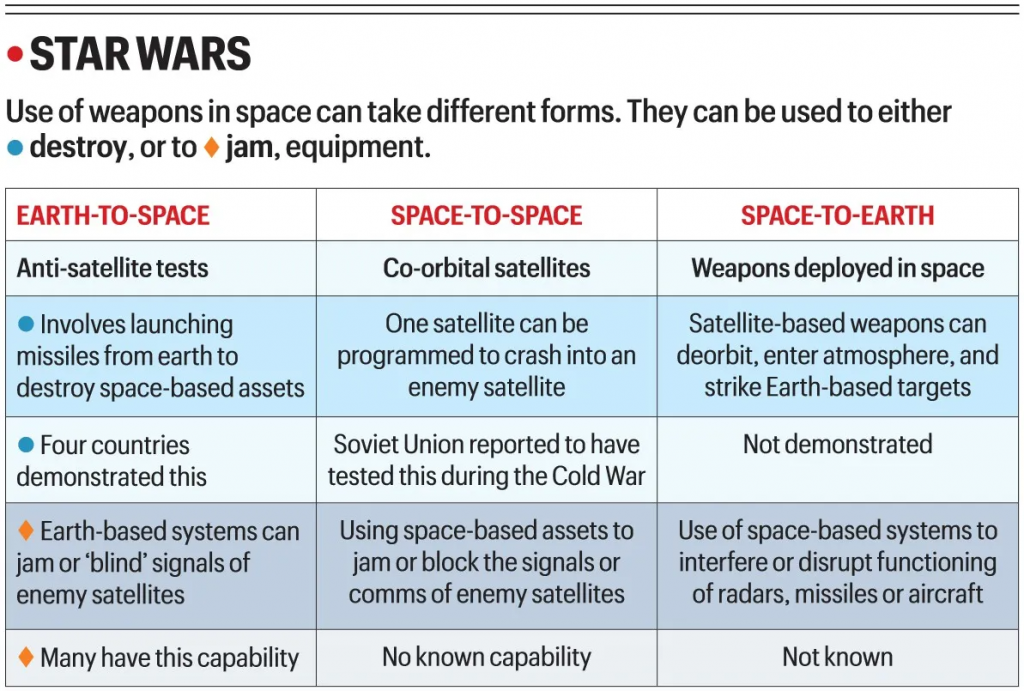
- The military use of outer space covers: the ability to launch a missile from Earth to destroy enemy satellites or other space-based assets, the ability to send weapons from space to destroy ground-based targets, or the use of space-based weapons to target space-based assets.
- The ability to disrupt or jam the enemy’s communications between its space and Earth-based systems, or attack their cyber-networks, can also be extremely effective in a conflict situation.
- Several countries have developed some, or all, of these capabilities, the most open demonstrations of such capabilities have been the anti-satellite tests, in which countries send a missile to destroy a satellite in space.
- Four countries, the US, Russia, China and India have demonstrated this.
Laws Governing Space
- All countries emphasise on peaceful uses of space and call upon each other not to militarise space.
- But there is no international law that explicitly prohibits the deployment or use of such weapons or tactics in space.
- The Outer Space Treaty of 1967 bars countries from carrying or placing nuclear weapons or “other kinds of weapons of mass destruction” in space.
- It is silent on conventional weapons, or those that target physical infrastructure in space.
- It does not say anything about earth-to-space weapons, the development of which was still some distance away in the 1960s.
- Attempts to create an international legal framework to regulate the deployment and use of weapons in space were made, but support from all the major space powers was lacking.
- The Artemis Accords, an initiative of NASA and the US State Department, is a voluntary code of conduct on exploration of space. It has over 70 signatory countries, including India.
- All cooperative activities are meant to be for peaceful purposes, but there is nothing that prevents signatories from deploying or using weapons in space.
Source: IE
Previous article
Meta to Share Child Safety Information with Indian Agencies
Next article
PM Vishwakarma Scheme
