


Port of Antwerp-Bruges Belgium
Syllabus: GS2/IR
Context
- The Belgian Prime Minister pitches the Port of Antwerp-Bruges,Belgium as India’s gateway to Europe.
About
- Bilateral trade between both countries stood at approximately $13.08 billion in 2025-26.
- Port of Antwerp-Bruges is Europe’s second-largest seaport and will be a key logistics link between India and Europe creating opportunities in diamonds, pharmaceuticals, food processing, maritime services, green hydrogen and infrastructure.
Belgium
- Belgium is a country of northwestern Europe, it is one of the smallest and most densely populated European countries.
- Belgium is bordered by France, Luxembourg, the Netherlands, and Germany.
- It has a narrow coastline along the North Sea.
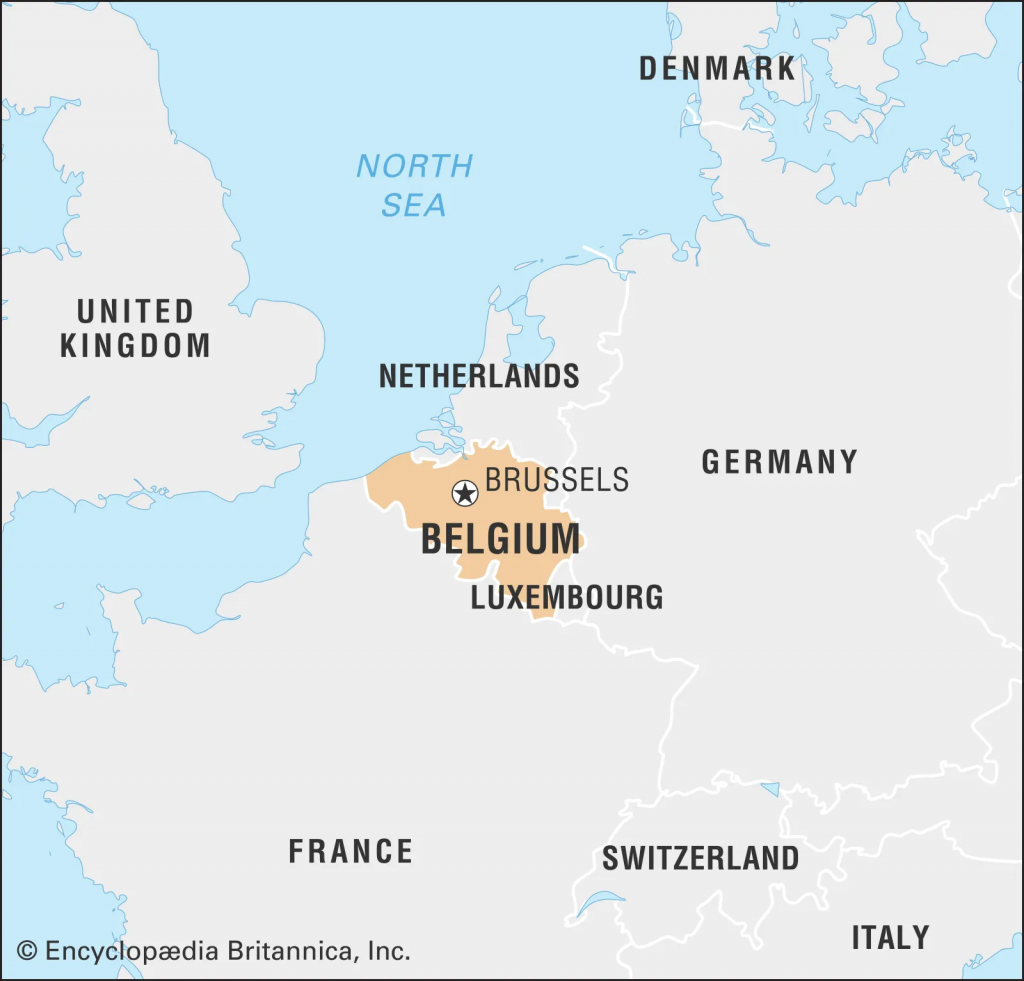
- The capital city, Brussels, is considered a center of the world economy and diplomacy, with headquarters of the European Union, the North Atlantic Treaty Organization, and other organizations located in the city.
- It is a member of the Benelux Economic Union (with the Netherlands and Luxembourg), the European Union (EU), and the North Atlantic Treaty Organization (NATO).
Source: TH
United Nations Convention on the Law of the Sea (UNCLOS)
Syllabus: GS2/IR
Context
- Magsaysay award winner Tommy Koh said that the UN Convention on the Law of the Sea is still the constitution of oceans.
United Nations Convention on the Law of the Sea (UNCLOS)
- UNCLOS was adopted in 1982 and came into force in 1994.
- It lays down a comprehensive regime of law and order in the world’s oceans and seas, establishing rules governing all uses of the oceans and their resources.
- It establishes the International Seabed Authority to regulate mining and related activities on the ocean floor beyond national jurisdiction.
The International Seabed Authority (ISA)
- The International Seabed Authority (ISA) is an autonomous international organization established under:
- The 1982 United Nations Convention on the Law of the Sea (UNCLOS) and
- The 1994 Agreement relating to the Implementation of Part XI of the United Nations Convention on the Law of the Sea.
- All States Parties to UNCLOS are members of ISA.
- ISA has 170 Members, including India.
- Headquarters: Kingston, Jamaica.
Source: TH
Global Bond Sell-off
Syllabus: GS3/Economy
In News
- Investors selling government bonds worldwide could raise government borrowing costs, complicate future borrowing plans, and increase private-sector borrowing costs, potentially reducing private investment and slowing economic growth.
Bond
- A bond is a financial contract in which an issuer borrows money from an investor and agrees to repay the principal plus interest over a predetermined period of time.
- It can be traded in the market, so their prices change with demand and supply.
- When bonds are sold off, supply goes higher, and demand goes down, pushing bond prices down.
- Since interest payments are usually fixed, the lower the price you pay, the larger the return you earn relative to what you put in.
- So bond prices and bond yields fluctuate in opposite directions.
Source : TH
Colonial Spider’s Venom Gland Mapped for Potential Cancer Drug Research
Syllabus: GS3/ Biotechnology
Context
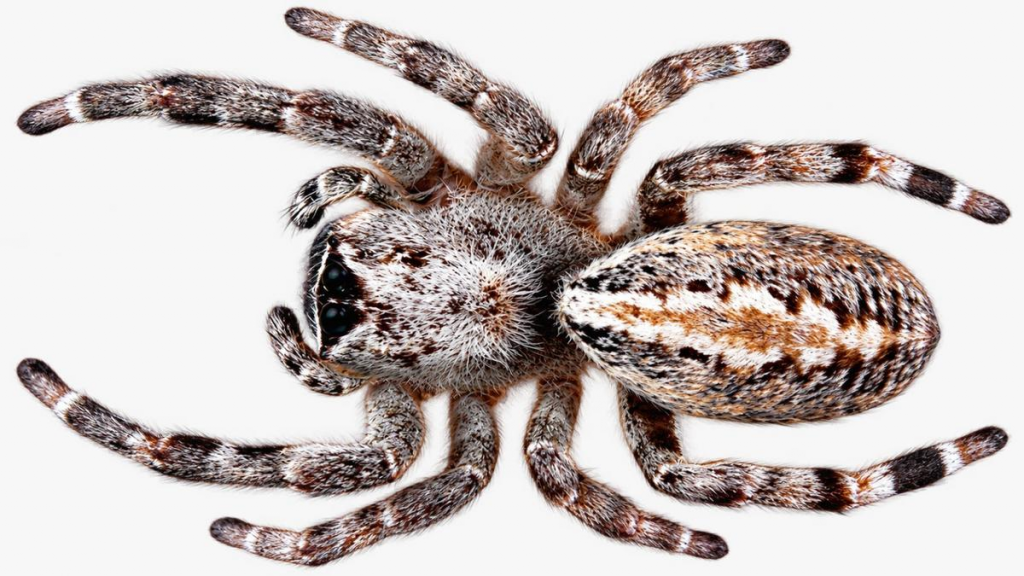
- A team of Indian researchers has produced the first comprehensive molecular and functional profile of the venom gland of Stegodyphus sarasinorum.
Techniques Used in the Study
- Transcriptomics: To analyse RNA molecules and identify genes actively expressed in the venom gland.
- Proteomics: To identify and characterise the proteins present in the venom.
- Metabolomics: To analyse small molecules and metabolic compounds.
- Confocal Raman Spectroscopy: To study the molecular and biochemical characteristics of the venom gland.
Anti-cancer Potential
- Venom gland extracts were tested against Dalton’s Lymphoma Ascites (DLA) cancer cells under laboratory conditions.
- The study identifies bioactive compounds associated with anti-cancer, antimicrobial and immune-related functions, while also demonstrating that venom gland extracts can kill cancer cells.
- It also detected U12 and U20 lycotoxins, peptide molecules that can disrupt the membranes of bacteria and cancer cells, making them promising templates for the future development of antimicrobial peptides and targeted anti-cancer compounds.
About Stegodyphus sarasinorum
- It is a colonial or permanently social spider species found across the Indian subcontinent.
- Unlike most spiders, which are solitary hunters, S. sarasinorum lives in permanent colonies, constructs communal silk nests and captures prey cooperatively.
Source: TH
ISRO Launches Earth Observation Satellite EOS-05
Syllabus: GS3/Space
In News
- The Indian Space Research Organisation (ISRO) successfully launched its advanced Earth observation satellite EOS-05 aboard the Geosynchronous Satellite Launch Vehicle (GSLV-F17).
More about the news
- The successful launch is significant for ISRO after a challenging period in which some recent missions encountered launch-vehicle or spacecraft anomalies, prompting extended reviews and checks.
- The GSLV was once informally nicknamed “naughty boy” due to challenges with its cryogenic upper stage, but has since demonstrated improved reliability through successful missions.
About
- The EOS-05, dubbed the “Eye in the Sky”, is India’s first dedicated imaging satellite to be placed in the geosynchronous orbit, about 36,000 km from Earth.
- Weighing more than 2,360-kg, the EOS-05 was the heaviest satellite to be carried by the GSLV rocket until now.
- With a 10-year mission life, the satellite is designed to image large areas of interest at frequent intervals for purposes such as monitoring natural disasters or keeping track of agriculture or forestry. It will also have defence uses.
- India has several active Earth observation satellites operating in Low Earth Orbit (LEO), which periodically pass over different parts of the country to capture imagery. However, EOS-05 operates in a geosynchronous orbit, allowing it to monitor the Indian landmass at much shorter intervals and provide near-continuous coverage.
- The satellite carries multi-spectral and hyper-spectral bands to capture selected field images every five minutes and the entire country every 30 minutes.
Source: TH
Decentralised Grain Storage Plan in Cooperative Sector
Syllabus: GS3/ Agriculture
Context
- As India’s agricultural production rises, the government is increasingly turning to decentralised storage infrastructure to ensure foodgrains are stored closer to where they are produced.
About
- According to the Third Advance Estimates for 2025-26, India’s foodgrain production is estimated at 376.563 million tonnes, up 5.3 per cent from 357.732 million tonnes a year earlier.
- At the same time, the National Food Security Act, 2013, covers around 80 crore people, making an efficient grain storage and distribution network critical to food security.
The Decentralised Grain Storage Plan in the Cooperative Sector
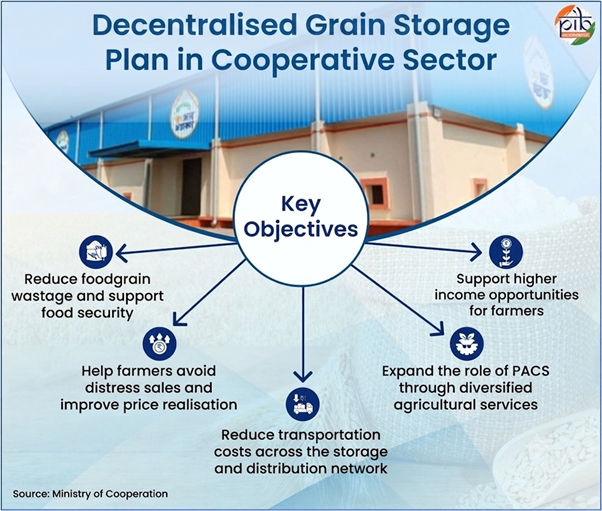
- The Decentralised Grain Storage Plan in the Cooperative Sector, launched in 2023 to build storage facilities through Primary Agricultural Credit Societies (PACS).
- The initiative seeks to bring storage, procurement, processing and distribution closer to farmers while reducing transportation costs and post-harvest losses.
Integrated Infrastructure and Convergence Framework
- The Decentralised Grain Storage Plan in Cooperative Sector operates through the convergence of existing government schemes:
- Agriculture Infrastructure Fund (AIF) scheme: Provides financing and interest subvention support for the creation and upgradation of post-harvest infrastructure.
- Agricultural Marketing Infrastructure Scheme (AMI): Provides back-ended capital subsidy for the construction of foodgrain storage facilities.
- Sub Mission on Agricultural Mechanisation (SMAM): Facilitates the establishment of Custom Hiring Centres and access to agricultural machinery.
- Pradhan Mantri Formalisation of Micro Food Processing Enterprises scheme (PMFME): Promotes the formalisation and growth of micro food processing units.
Key facilities and services under the Decentralised Grain Storage Plan in Cooperative Sector
- Custom hiring centres enable PACS to procure agricultural machinery for rental to farmers. Equipment may include tractors, harvesters, tillers, and other farm machinery.
- Fair Price Shops facilitate grain distribution and the sale of processed food products within local communities.
- Primary processing units undertake processing activities such as grain cleaning, sorting, and drying, thereby improving the quality and marketability of the produce.
- Procurement centres support grain procurement by PACS for state agencies and FCI.
- The Plan provides for silo-based storage infrastructure of 50 metric tonnes (MT), 100 MT, and 200 MT capacities under the cooperative storage model.
Source: PIB
GPT-6 Astra
Syllabus: GS3/Science and Tech
Context
- OpenAI has released GPT-6 Astra, its newest frontier artificial intelligence (AI) model, claiming gains in computer use, coding, long-running tasks and cybersecurity.
About
- Astra is designed for end-to-end, multi-step tasks, moving beyond simple question-answering towards more autonomous, tool-using AI systems.
- It can operate computers and browsers, conduct web research, fill forms, manage documents and emails, analyse data, build websites, write and test software, and troubleshoot problems.
- A key feature is its ability to handle incomplete instructions, using available context to make routine decisions while seeking clarification when missing information could significantly affect the outcome.
- Astra also marks a significant development in AI cybersecurity, as OpenAI classifies it as the first model to reach its “Critical” cybersecurity capability level, indicating its ability, with appropriate tools and access, to identify and exploit previously unknown vulnerabilities.
Source: IE
Green Climate Fund (GCF)
Syllabus: GS3/Environment
In News
- The Green Climate Fund (GCF) has faced criticism over the seven-year delay in approving Nepal’s $49.9 million project to reduce risks from Glacial Lake Outburst Floods (GLOFs).
Green Climate Fund (GCF)
- It was established in 2010 by the 194 parties to the United Nations Framework Convention on Climate Change (UNFCCC)
- It is the world’s largest dedicated climate fund, created to address the climate crisis.
- It aims to foster low-emission, climate-resilient development pathways in developing countries.
- It supports developing countries in achieving their climate ambitions and plays a key role in implementing the Paris Agreement.
Source: DTE
