


Hanging Glaciers
Syllabus: GS1/ Physical Geography
Context
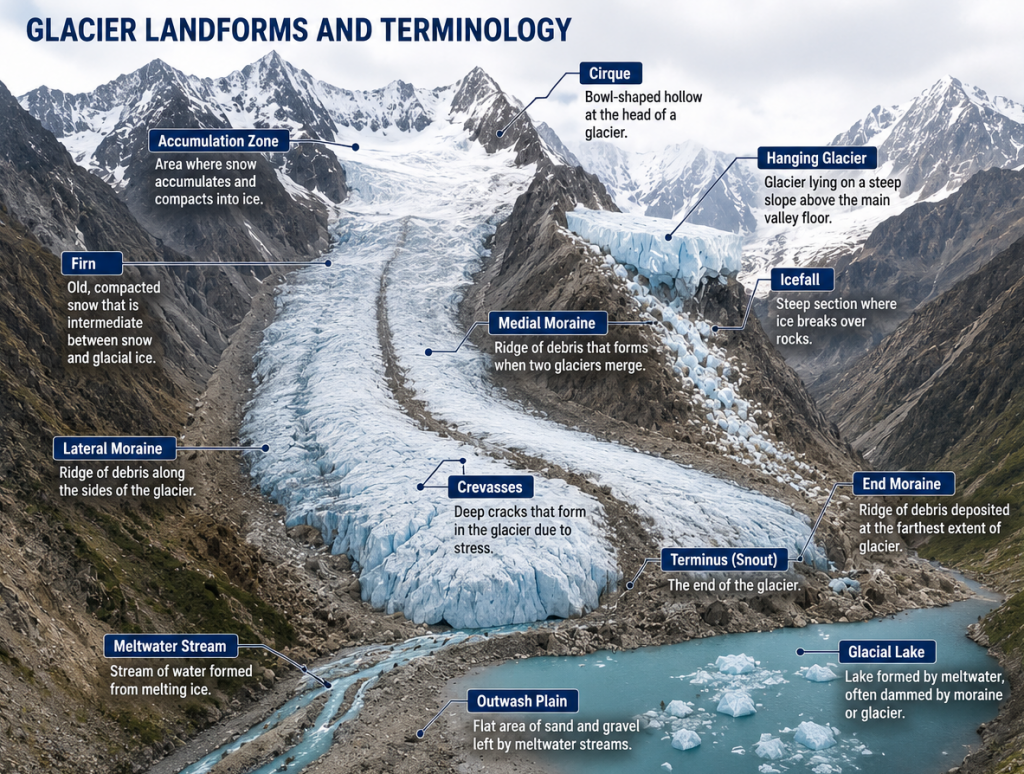
- As rising temperatures and shifting regional precipitation patterns reduce the stability of the Himalayan glaciers, some of them could evolve into “hanging glaciers”.
Hanging Glaciers
- Hanging Glaciers are the ice masses perched on steep slopes that can detach and trigger massive avalanches.
- As per a recent study there are as many as 219 hanging glaciers in the Alaknanda basin of the Garhwal Himalayas.
- Himalayan glaciers are increasingly exhibiting “geometric and dynamic instability” owing to rapid warming and climate variability.
- Hanging glaciers pose a significant risk of break-offs. The break-offs from hanging glaciers can also trigger secondary hazards such as glacial lake outburst floods (GLOFs).
Source: IE
Baltic Way Movement
Syllabus:GS2/IR
In News
- Baltic Way remains both a symbol of national freedom and a contemporary example of the global influence of Gandhian thought.
Baltic states
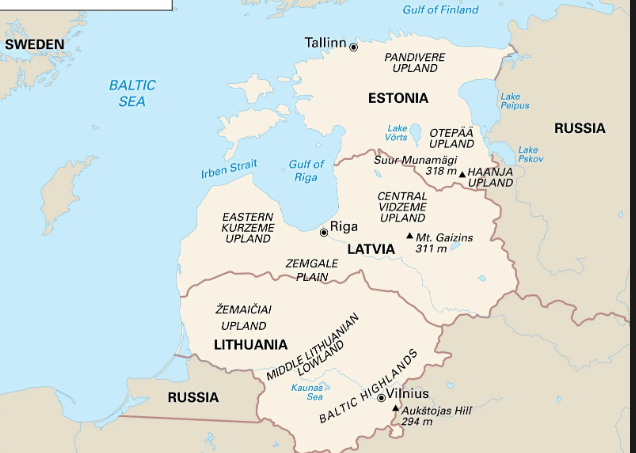
- They are an area in north-eastern Europe, comprising Estonia, Latvia and Lithuania on the eastern banks of the Baltic Sea.
- To the west and north they border the Baltic Sea, to the east Russia, to the southeast Belarus, and to the southwest Poland and a Russian exclave.
- These countries have similar trajectories, from independence, to Soviet occupation and re-independence in the early 1990s.
- After the collapse of the Soviet Union, the Baltic republics became market economies and linked with Western Europe, joining the European Union and NATO in 2004.
Cooperation with India
- Mahatma Gandhi’s influence was strengthened by cultural links between India and the Baltics, including Lithuania-born Hermann Kallenbach, Vydūnas, Antanas Poška and translations of Gandhi’s works.
- Leaders such as Gražina Miniotaitė promoted non-violent civilian defence, while the 1982 film Gandhi was broadcast on Lithuanian television to educate people about peaceful resistance.
- India-Baltic relations expanded into trade, technology, sustainability, the blue economy and culture.
- The Government of India’s Ministry of Commerce and Industry estimates show that India’s total bilateral trade with Lithuania reached $490.61 million; with Latvia, $475.66 million, and with Estonia, $219.69 million in 2025-26.
Baltic Way
- The Baltic Way was a historic non-violent protest organised on August 23, 1989, during the Singing Revolution (1986–91) in Lithuania, Latvia and Estonia.
- It became a landmark of the Singing Revolution (1986–91) and the Baltic states’ peaceful struggle for independence from Soviet rule.
- Around two million people formed a 675-km human chain linking Tallinn, Riga and Vilnius to demand freedom from Soviet rule.
- It was organised on the 50th anniversary of the Molotov-Ribbentrop Pact, it exposed the secret protocol that had enabled the Soviet annexation of the Baltic states.
- It was inspired partly by Mahatma Gandhi’s principles of ahimsa, satyagraha, non-cooperation and civil resistance
Source: TH
Distinguished Jurist
Syllabus: GS2/Polity
Context
- Article 124(3) allows distinguished jurists to be appointed as Supreme Court judges, but no one has taken this route in 76 years.
About
- Article 124 sets out how the Supreme Court is constituted.
- Article 124(3) lists who can be appointed as a judge, ie., a citizen of India who has either served as a High Court judge for five years, practised as an advocate for ten years, or “is, in the opinion of the President, a distinguished jurist.”
- Most judges have been elevated from the High Courts, while a smaller number of lawyers have been appointed directly from the Bar.
- A “distinguished jurist” is generally understood to be anyone engaged in serious work in the practice, teaching or research of law, including those who do not require courtroom experience to fit the description.
Why No Distinguished Jurist has been Appointed?
- The Bar Council rules generally prevent full-time law teachers from practising law.
- Appointments today are initiated through the collegium system, meaning that a jurist would first have to be recommended by the Supreme Court collegium before the appointment goes to the government.
Source: IE
Indus Water Treaty
Syllabus: GS2/International Relations
Context
- India has rejected the Permanent Court of Arbitration (PCA), The Hague’s ruling on the Indus Waters Treaty (IWT), asserting that the arbitral body was illegally constituted and lacks jurisdiction over India.
About
- India decided to put the IWT in abeyance as part of a series of diplomatic and economic measures unveiled soon after the Pahalgam terror attack.
- The PCA held that the Indus Waters Treaty remains fully in force and that India must continue to comply with its obligations under the treaty.
- The tribunal ordered India to limit construction on the Ratle Hydro-Electric Plant in Kashmir, prohibiting work on the dam wall and power intake structure above certain levels
What is the Indus Water Treaty?
- In 1960, India and Pakistan signed the Indus Waters Treaty with the World Bank as a signatory of the pact.
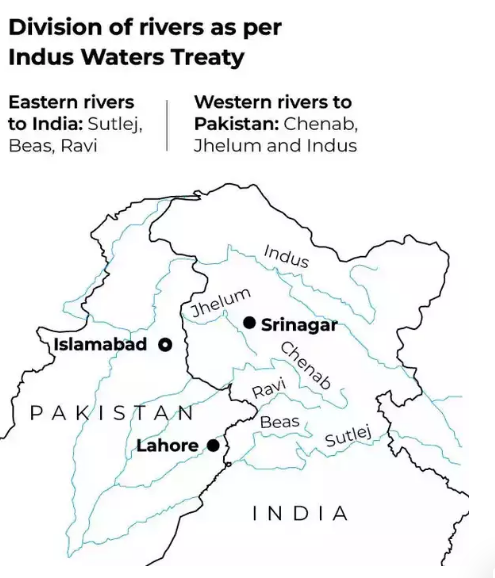
- Under the treaty, India got control over the three eastern rivers Beas, Ravi, and Sutlej while Pakistan got control of the western rivers Indus, Jhelum, and the Chenab.
- According to the treaty, India has the right to generate hydroelectricity through the run-of-the-river (RoR) projects on the western rivers which are subject to specific criteria for design and operation.
Source: TH
Ramon Magsaysay Award 2026
Syllabus: Miscellaneous
Context
- Tommy Koh (Singapore), Runa Khan (Bangladesh), and Bo Kyi (Myanmar) have been honoured with the Ramon Magsaysay Award 2026.
About Ramon Magsaysay
- Established: 1958, in memory of Ramon Magsaysay, the 7th President of the Philippines, known for his integrity, courage, and democratic leadership.
- Instituted by: The Rockefeller Brothers Fund (RBF), in partnership with the Philippine government.
- Administered by: The Ramon Magsaysay Award Foundation (RMAF), Manila.
- Nature: Recognizes individuals or organizations in Asia who show selfless service and transformative leadership.
- Prestige: Considered Asia’s highest honour, equivalent in stature to the Nobel Prize in Asia.
- From 1958 to 2008, the Award was given in six categories annually, these are:
- Government Service, Public Service, Community Leadership, Journalism, Literature, Creative Communication Arts, Peace and International Understanding, and Emergent Leadership.
- Starting in 2009, the Ramon Magsaysay Award is no longer being given in fixed Award categories, except for Emergent Leadership.
Source: TH
Previous article
N-E Models of Waste Management
Next article
26th Shanghai Cooperation Organisation (SCO) Summit
