


Syllabus: GS2/Governance; GS3/Economy
Context
- Maharashtra’s Food and Drug Administration is leading an aggressive crackdown on food adulteration, highlighting the growing food safety concerns and need for stricter enforcement in India.
Food Adulteration
- It is a process by which substances are either intentionally added to food items or food gets contaminated due to negligence or poor handling practices.
- Adulterants could be harmful chemicals or harmless fillers, which can be added at any stage of the production process. For instance, the dilution of milk by farmers or the mixing of edible oil with mineral oil are examples of food adulteration.
- The issue of food adulteration is present in both organised and unorganised sectors.
Impact
- Food adulteration can cause a range of health issues, including digestive disorders, allergic reactions, nutritional deficiencies, weakened immune system, and chronic diseases like cancer and liver damage.
- The World Health Organization (WHO) reports that each year worldwide, unsafe food causes 600 million cases of foodborne diseases and 420,000 deaths.
- Children under five bear around 40% of the global foodborne disease burden, despite constituting only about 9% of the world’s population.
Key international standards and frameworks governing food safety
- FAOLEX: It is one of the world’s largest digital collections of national laws and regulations on food, agriculture and renewable natural resources.
- Sanitary and Phytosanitary Measures (SPS): It sets out the basic rules for food safety and animal and plant health standards. It allows countries to set their standards. SPS agreement entered into force with the establishment of the World Trade Organization on 1 January 1995.
- Codex Alimentarius: Also known as the “Food Code,” it is a collection of standards, guidelines, and codes of practice adopted by the Codex Alimentarius Commission. The Codex Alimentarius Commission is a joint intergovernmental body of the FAO and WHO. Currently, it has 189 members and India is a member.
- International Plant Protection Convention (IPCC): It aims to protect the world’s plants, agricultural products, and natural resources from plant pests. It is an intergovernmental treaty. It has been ratified by 185 contracting parties, and India is also a contracting party to it.
Indian Framework
- Food Safety and Standard Act, 2006: It aims to establish a single reference point for all matters relating to food safety and standards, by moving from multi-level, multi-departmental control to a single line of command. The Act established Food Safety and Standards Authority of India (FSSAI) and the State Food Safety Authorities for each State.
- FSSAI: Ministry of Health & Family Welfare, Government of India is the administrative Ministry of FSSAI. Its headquarters is in Delhi. The FSSAI is responsible for regulating and overseeing food safety. It conducts periodic pan-India surveillance of food products, especially staple food and commodities that are prone to adulteration.
- Food Safety and Standards Rule, 2011: It provides for the Food Safety Appellate Tribunal and the Registrar of the Appellate Tribunal, food safety standards for organic food, and regulates food advertising.
Important Initiatives For Food Safety in India
- Eat Right India Movement: To transform the country’s food system to ensure safe, healthy, and sustainable food for all Indians. It is aligned with the National Health Policy 2017 with its focus on preventive and promotive healthcare and flagship programmes like Ayushman Bharat, POSHAN Abhiyaan, Anemia Mukt Bharat, and Swachh Bharat Mission.
- Eat Right Station Certification: It is awarded by FSSAI to railway stations that have set benchmarks (as per the Food Safety and Standards Act, 2006) in providing safe and wholesome food to passengers.
- State Food Safety Index (SFSI): Developed by the FSSAI, the index aims to measure the performance of states and Union Territories on selected “parameters” of food safety. The SFSI is released annually for a financial year. SFSI measures the performance of states on five parameters of food safety. The parameters include human resources and institutional data, compliance, food testing, infrastructure and surveillance, training and capacity building, and consumer empowerment.
- Hexagonal Warning Labels: The FSSAI has proposed red, hexagonal warning labels on packaged foods high in sugar, salt or saturated fat to help consumers make informed choices.
- Also, in recent reforms, the Street vendors already registered under the Street Vendors Act, 2014 are now automatically deemed FSSAI registered, removing duplication.
Challenges
- Weak testing infrastructure: Less laboratories nationwide, many lacking capacity for heavy metal, pesticide, or bacterial testing (Standing Committee).
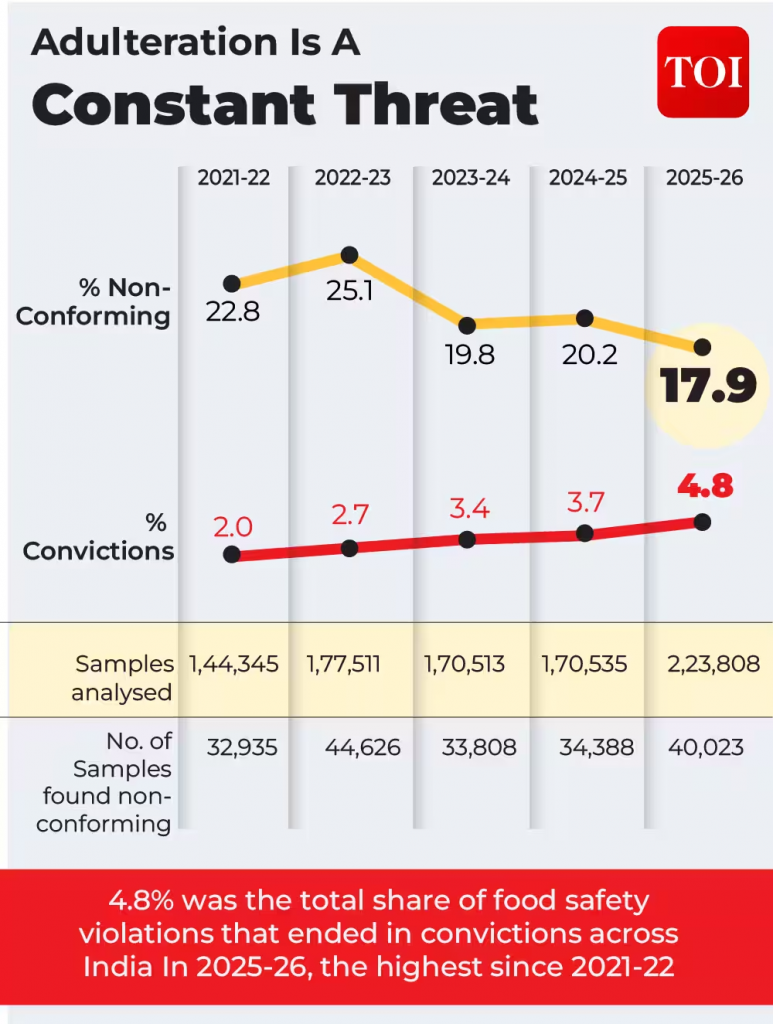
- Poor surveillance: A Parliamentary Committee flagged that just 2% of inspections reported non-compliance, an implausibly low figure suggesting under-detection rather than genuine safety.
- Vast informal sector remains largely outside effective monitoring.
- Resource Crunches: Shortage of Food Safety Officers undermines enforcement despite a strong legal framework.
- Deceptive marketing: Like in the nutraceutical and supplement space exploits regulatory gaps using unsubstantiated claims like “clinically tested” or “Ayurvedic.”
Conclusion
- India’s food safety architecture must balance deregulation for ease of business with stronger enforcement.
- Priorities should include expanding accredited testing laboratories, filling vacancies of Food Safety Officers, integrating supply chain traceability, and formalising informal food vendors through simplified registration already enabled by the 2026 reforms.
World Food Safety Day
- World Food Safety Day is observed annually on June 7 to draw attention and inspire action to prevent, detect, and manage foodborne risks.
- The United Nations General Assembly established World Food Safety Day in 2018 to raise awareness of this important issue.
- WHO and the Food and Agriculture Organization of the United Nations jointly facilitate the observance of World Food Safety Day, in collaboration with the Member States and other stakeholders.
- The theme for World Food Safety Day 2026 is “From burden to solutions – safe food everywhere.”
Source: IE
Previous article
India’s GDP Growth Overshot Expectations Amid Global Uncertainties
Next article
Semicon 2.0
