


Syllabus: GS3/Space
In News
- Researchers from Manipal Academy of Higher Education, ISRO, Department of Space and other institutions have used Aditya-L1’s data for studying solar flares.
Aditya-L1
- Aditya-L1 spacecraft is launched from Satish Dhavan Space Center (SDCS), Shriharikota onboard PSLV-C57 with PSLV-XL configuration in 2023.
- It is the first space-based observatory-class Indian solar mission to study the Sun.
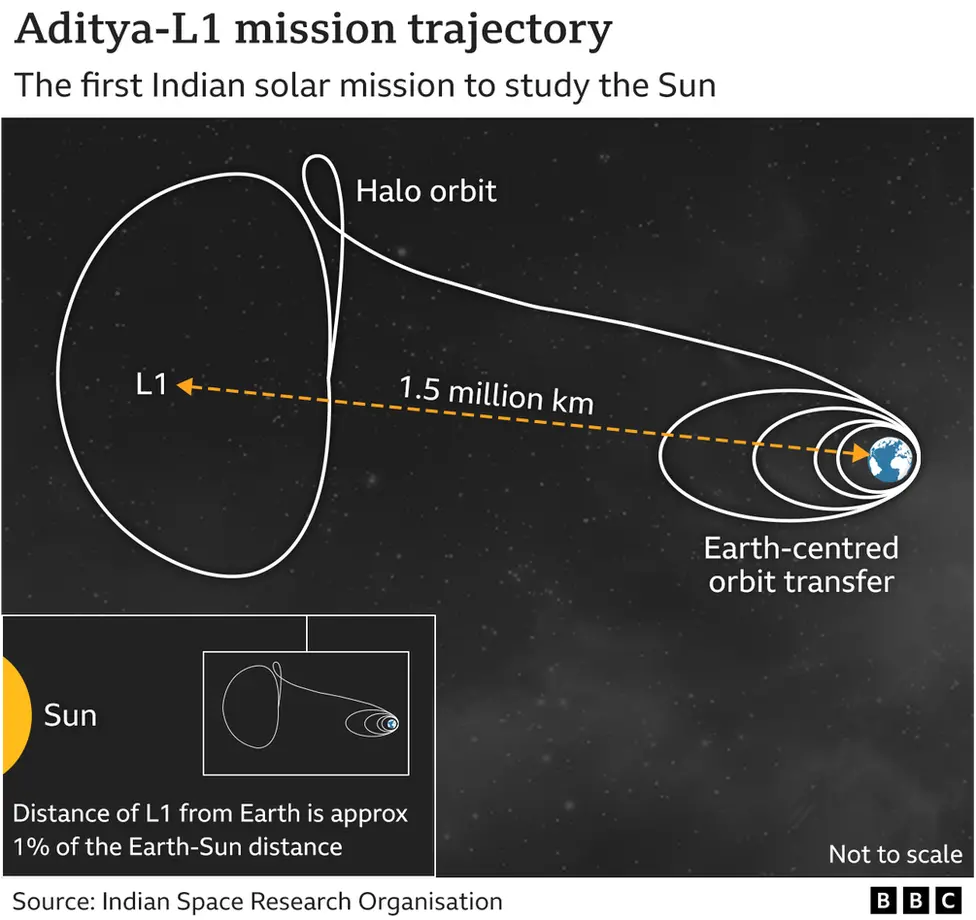
- It is placed in a halo orbit around the Lagrangian point 1 (L1) of the Sun-Earth system, which is about 1.5 million km from the Earth.
- A satellite placed in the halo orbit around the L1 point has the major advantage of continuously viewing the Sun without any occultation/eclipse.
Solar Flares
- Solar flares are sudden and intense bursts of electromagnetic radiation from the Sun.
- It is understood to result from the release of magnetic energy.
- Solar flares often accompany solar magnetic storms called coronal mass ejections (CME).
- Solar flares become more frequent around every 11 years.
Types
- There are five categories, listed here in order from most intense to least intense:
- X-class flares are the biggest and they are major events that can trigger radio blackouts around the whole world and long-lasting radiation storms in the upper atmosphere.
- M-class flares are medium-sized and they generally cause brief radio blackouts that affect Earth’s polar regions.
- Minor radiation storms sometimes follow an M-class flare.
- C-class flares are small with few noticeable consequences here on Earth.
- At its peak, a C-class flare is ten times less powerful than an M-class flare.
- B-class flares are ten times smaller or weaker than C-class flares.
- A-class flares are at least ten times less intense than B-class flares, with no noticeable consequences on Earth.
How Aditya-L1 Observes Solar Flares?
- Aditya-L1, located at the Sun-Earth L1 point, allows uninterrupted views of solar activity at different wavelengths.
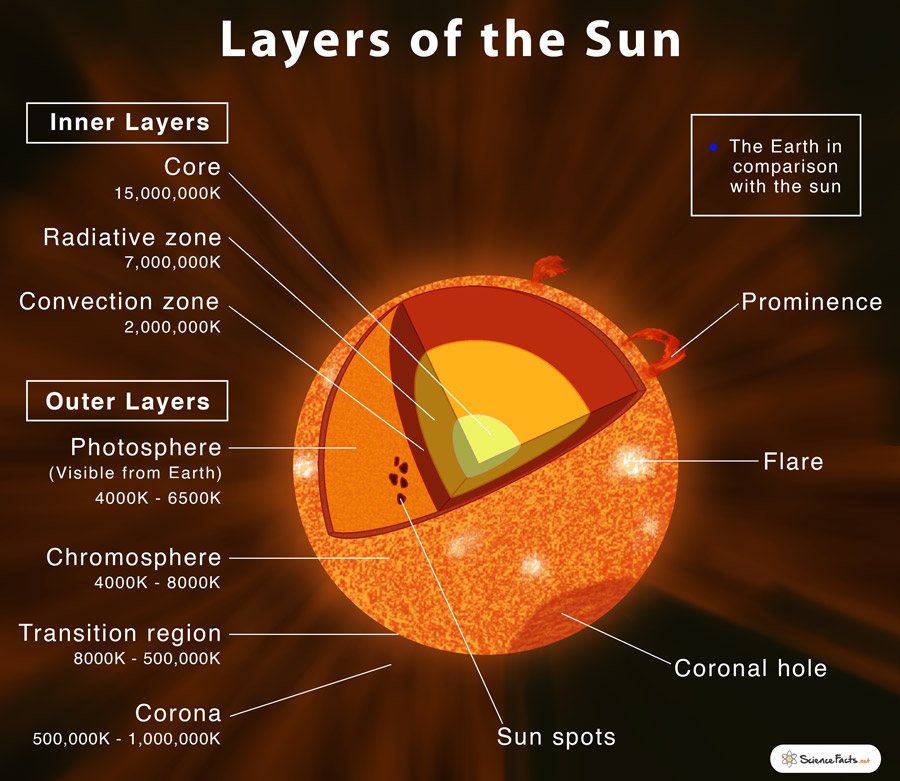
- Its Solar Ultraviolet Imaging Telescope (SUIT) payload studies the Sun in 11 near-ultraviolet (NUV) filters, exploring layers from the top photosphere to the chromosphere.
- Solar Low Energy X-ray Spectrometer (SoLEXS) and the High Energy L1 Orbiting X-ray Spectrometer (HEL1OS) monitor X-ray emissions from intense processes in the solar corona.
- Combined, NUV and X-ray measurements enable scientists to understand how activity in the lower solar atmosphere is tied to energy release in the corona during the build-up of solar flares.
Impacts
- The findings suggest that repeated small-scale energy releases may gradually destabilise magnetic fields, triggering major flares.
- It improves understanding of solar-flare formation and
- It could contribute to more reliable flare and space-weather forecasting, helping protect satellites, astronauts, communication systems and other critical technologies.
Source :TH
Previous article
Hybrid Annuity Model in Indian Railways
Next article
News In Short 31-08-2026
