


Syllabus: GS2/IR
Context
- India and the United Kingdom reviewed their defence-industrial cooperation, military exchanges and maritime security partnership during the 25th India–U.K. Defence Consultative Group (DCG) meeting held in New Delhi.
Key Developments in India–U.K. Defence Cooperation
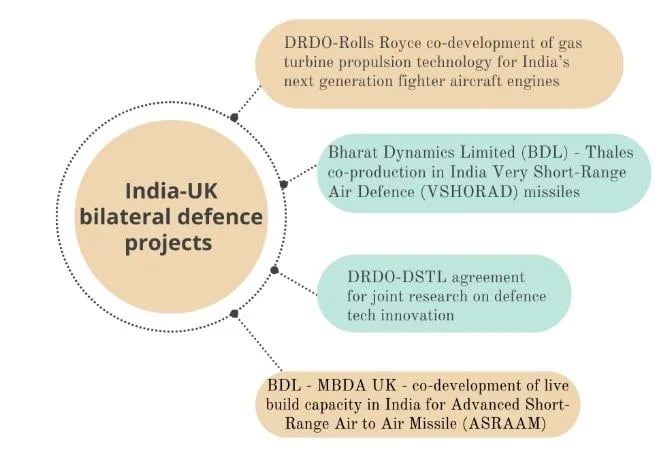
- Defence Industrial Cooperation: India and the U.K. reviewed ongoing defence-industrial cooperation with a particular focus on research and development (R&D) under the India–U.K. Vision 2035 and the 10-year Defence Industrial Roadmap.
- Both the nations are cooperating on the establishment of the Regional Maritime Security Centre of Excellence (RMSCE) under India’s Indo-Pacific Oceans Initiative (IPOI) to strengthen regional maritime security capabilities.
- Military Cooperation: Agreed to expand exchanges between the armed forces through joint exercises, training programmes and capacity-building initiatives.
Brief on India-UK Relations
- India–U.K. Comprehensive Strategic Partnership: Upgraded in 2021, with a 10-year roadmap to strengthen cooperation across trade, defence, technology, health and other areas.
- India and the U.K. hold a 2+2 dialogue involving their Foreign/External Affairs and Defence Ministers.
- Trade Relations: India is the UK’s 11th largest trading partner, while the UK ranks 14th for India.
- India – UK bilateral trade (both goods and services) stood at £47.9 billion in the four quarters to the end of Q4 2025, an increase of 10.0% or £4.3 billion in current prices from the same period in 2024
- India-UK Comprehensive Economic and Trade Agreement (CETA) which entered into force on 15 July 2026, provides an unprecedented dutyfree access to 99 per cent of India’s exports to the UK, and 91 % of UK’s exports covering nearly 100% of the trade value.
- This includes labour-intensive sectors such as textiles, leather, marine products, gems and jewellery, and toys as well as high-growth sectors like engineering goods, chemicals, and auto components
- Defence and Security: The UK contributed only 3% of India’s defence imports in the last decade.
- India aims to diversify from Russian defence imports & develop indigenous defence industries.
- The UK can aid in technology transfers & advanced defence capabilities.
- Open General Export Licence (OGEL) (2022) – UK’s first such license for an Indo-Pacific country, easing military tech exports to India.
- Joint Exercises: Ex Ajeya Warrior, Exercise Konkan, Ex Cobra Warrior.
- Multilateral Collaboration: Indian Ocean Rim Association (IORA) (India – Member, UK – Dialogue Partner).
- Indian Ocean Naval Symposium (IONS) (Both the UK and India are members).
- Indo-Pacific Oceans Initiative (IPOI) (India and the UK co-lead the Maritime Security pillar).
- The UK supports India’s bid for a permanent seat in the UN Security Council (UNSC).
- India and the UK cooperate within the G20 on global trade, economic stability, and climate change.
- People-to-people ties: Rise of Indian-origin politicians.
- The Indian diaspora is considered a “model minority”, excelling in multiple fields.
- British Indian Community: Over 1.6 million (2.5% of UK’s population).
Issues and Concerns
- Sovereignty & Anti-India Activities: India’s persistent security concerns surrounding Pro-Khalistan extremist activity and radicalised networks in the UK, and calls for more diplomatic and law enforcement action.
- Delays in Extradition – Increasing legal delays in the extradition of economic criminals and fugitives wanted by the Indian authorities to the U.K.
- Domestic Political Friction over Mobility: UK Political Debates on Social Security Exemptions (NICs) and Broader Immigration Quotas for Temporary Indian Workers.
- Geopolitical Differences: Divergent strategic perspectives on Eastern European conflicts and specific regional sanctions regimes, necessitating careful diplomatic navigation.
Way Ahead
- India-U.K. ties are moving from a historically linked connection to a stronger economic, technological and strategic relationship.
- India and the U.K. should prioritise joint R&D, co-development and co-production over conventional buyer–seller arrangements.
- Bilateral cooperation should focus on emerging technologies such as artificial intelligence, autonomous systems, drones, cyber security, space and advanced propulsion.
- Both countries should strengthen maritime-domain awareness, information sharing and capacity-building in the Indo-Pacific.
Source: TH
Previous article
India’s Revised FDI Framework
Next article
India’s Civil Nuclear Power Sector
