


Syllabus: GS3/Defence
Context
- The Ministry of Defence notified the sixth Positive Indigenisation List (PIL), comprising 405 items with an estimated business potential of Rs 3,070 crore.
About
- The list is notified by the Department of Defence Production (DDP) and covers Line Replaceable Units (LRU), sub-systems, sub-assemblies, spares, components and raw materials for key defence platforms.
- These include Advanced Light Helicopter, Light Utility Helicopter, Chetak and Cheetah helicopters; fighter jets including the Su-30MKIs, Jaguars and MiG-29s; the Light Combat Aircraft and AL-31FP Engine.
- The sixth list marks another step in the Government’s efforts to promote self-reliance in defence manufacturing under the Aatmanirbhar Bharat initiative.
- It is expected to strengthen the domestic defence manufacturing ecosystem, promote investment and innovation, and contribute to reducing dependence on imports.
- All listed items must be indigenised within a specified timeframe, once successfully developed locally, they will be procured exclusively from the Indian industry.
Defence Production in India
- India’s annual defence production has surged to an all-time high of Rs 1.78 lakh crore in the Financial Year (FY) 2025-26. The milestone represents a 15.6% growth over the previous fiscal year.
- Sectoral Contribution: Defence Public Sector Undertakings and other PSUs accounted for approximately 76% of total production, while the private sector contributed 24%.
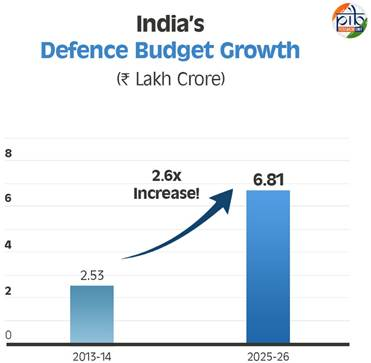
- Defence Budget Growth: Increased from ₹2.53 lakh crore in 2013-14 to ₹6.81 lakh crore in 2025-26.
- India is exporting defence equipment to more than 80 countries as of FY 2025-26.
- Surge in Indigenous Defence Production: 65% of defence equipment is now manufactured domestically, a significant shift from the earlier 65-70% import dependency.
- India targets ₹3 lakh crore in defence production by 2029, reinforcing its position as a global defence manufacturing hub.
Need for Defence Indigenisation Reforms
- Strategic Autonomy & National Security: Reduces dependence on foreign suppliers, especially during crises and geopolitical tensions.
- Addressing Capability Gaps: India faces complex security challenges across borders and in the Indian Ocean Region (IOR). Modernisation is required to replace ageing platforms in the Army, Navy, and Air Force.
- Reducing Import Bill & Promoting Economic Efficiency: India is among the world’s largest arms importers, indigenous production lowers costs in the long run, reduces foreign exchange outflow, and strengthens the domestic defence economy.
- Boosting Domestic Defence Industrial Base: Indigenisation stimulates innovation and growth of DPSUs, MSMEs, and private industry.
- Faster Procurement & Operational Readiness: Domestic manufacturing shortens procurement cycles and ensures timely delivery.
- Improved Customisation & Adaptability: Indigenous platforms can be tailored to Indian terrain (Himalayan high-altitudes, deserts, maritime zones) which allows continuous upgrades to meet evolving threat environments.
- Technology Sovereignty: Developing indigenous technologies ensures freedom in design, production, and future upgrades. It also prevents vulnerability due to sanctions, supply chain disruptions, or technology denials.
What are the Challenges?
- India continues to depend on imports for several advanced defence technologies and critical components.
- Research and development expenditure in the defence sector remains comparatively limited.
- Technological gaps exist in areas such as jet engines, semiconductors, cyber warfare, and advanced sensors.
- Private sector participation still faces regulatory and procurement-related challenges.
- Achieving global competitiveness in defence exports requires sustained investment and quality assurance mechanisms.
Defence Acquisition & Indigenisation Reforms
- DAP 2020 with Focus on Indian-IDDM: It gives the highest priority to the ‘Buy (Indian–Indigenously Designed, Developed and Manufactured)’ category to ensure that major defence purchases are made from Indian sources.
- Simplified ‘Make’ Procedure: Encourages Indian industry to design, develop, and manufacture defence products, reducing import dependence.
- Under Make-I, the government funds up to 70% of development costs and reserves certain projects for MSMEs.
- The Make-II category (industry-funded) offers relaxed eligibility, minimal paperwork, and accepts proposals from industry or individuals.
- So far, 62 projects for the Army, Navy, and Air Force have received ‘Approval in Principle’.
- Liberalised FDI in Defence: Foreign Direct Investment limit raised to 74% via automatic route for new defence industrial licences, and up to 100% by government approval in cases involving access to advanced technology.
- Defence Industrial Corridors: Two corridors, Uttar Pradesh Defence Industrial Corridor (UPDIC) and Tamil Nadu Defence Industrial Corridor (TNDIC), are the lifelines of this transformation.
- In 2025, they have attracted investments worth over ₹9,145 crore, with 289 MoUs signed.
- Defence Testing Infrastructure Scheme (DTIS): DTIS aims to boost indigenisation by providing financial assistance for setting up eight Greenfield testing and certification facilities in the aerospace and defence sector.
- Seven test facilities are already approved in areas like unmanned aerial systems, electronic warfare, electro-optics, and communications.
- Boosting Innovation:iDEX & TDF Innovations for Defence Excellence (iDEX), launched in 2018, supports startups, MSMEs, academia, and innovators with grants and funding to develop technologies for defence and aerospace.
- Technology Development Fund (TDF) Scheme also funds industries, especially Start-ups and MSMEs upto an amount of Rs. 10 Crore, for innovation, research and development of defence technologies.
- Strategic Partnership (SP) Model: Introduced in 2017 to create long-term partnerships between Indian companies and global Original Equipment Manufacturers (OEMs).
- These partnerships focus on technology transfer and setting up manufacturing infrastructure in India.
- Indigenisation Portals: SRIJAN Portal (launched in 2020) lists defence items previously imported, inviting industry to develop them locally.
- Ease of Doing Business in Defence: Defence products requiring industrial licences have been rationalised, and most parts/components no longer need a licence.
- Industrial licence validity has been extended from 3 years to 15 years, with a possible 3-year extension, making investment planning easier.
Way Ahead
- India should strengthen indigenous research and development capabilities in emerging defence technologies.
- Greater collaboration between DRDO, private industries, startups, and academic institutions is required.
- Defence industrial corridors and manufacturing clusters should be expanded further.
- Specialised skill development and training programmes should be launched to create a skilled workforce for emerging defence technologies.
Source: IE
Next article
News In Short 21-08-2026
