


Syllabus: GS3/Economy
Context
- According to data shared by the government, the total amount of bad loans written off by public sector banks (PSBs) has been declining each year, while recoveries from these loans have been steadily expanding.
Key Trends in Loan Write-off
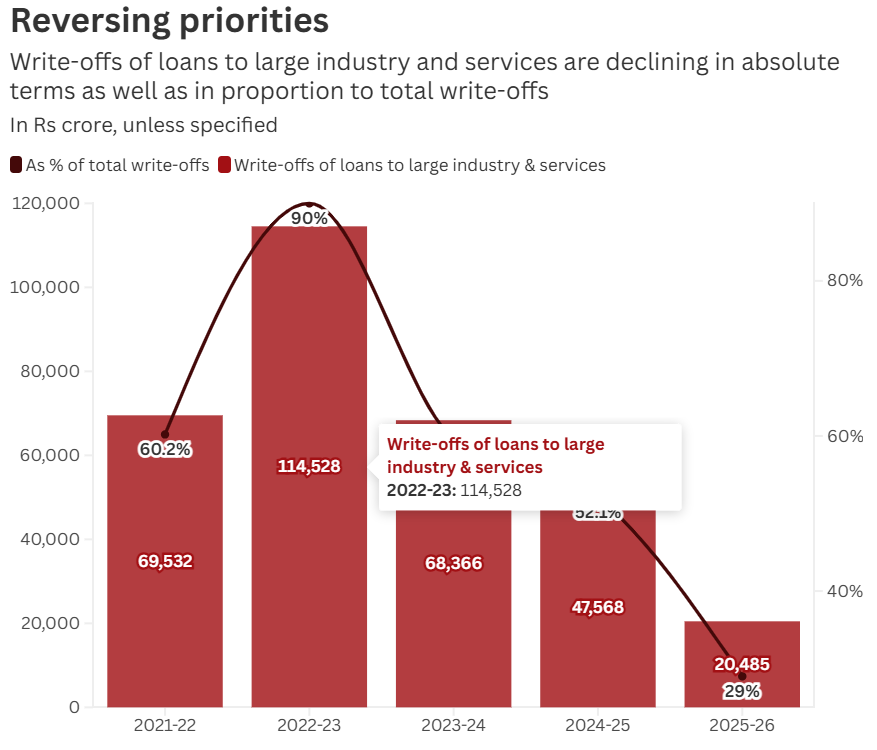
- Declining write-offs: PSB bad-loan write-offs fell from ₹1.15 lakh crore in 2021-22 to ₹70,528 crore in 2025-26, a decline of nearly 40%.
- Write-offs had peaked at around ₹1.30 lakh crore in 2022-23, partly reflecting the stress following the COVID-19 period.
- Recoveries improved: Recoveries from written-off loans increased from ₹24,739 crore in 2021-22 to ₹42,889 crore in 2025-26.
- Consequently, the recovery-to-write-off ratio improved from 21.4% to 60.8% during the same period.
- SBI accounted for the largest share of PSB write-offs. Its write-offs declined from ₹24,061 crore in 2022-23 to ₹17,803 crore in 2025-26.
What is a loan write-off?
- Debt write-off is an accounting measure used by a bank to remove a bad loan from its books after making the necessary provisions.
- It is an accounting exercise that provides no relief to the debtor. Also, banks may continue recovery proceedings even after the loan has been written off.
Reasons for Improvement in Recoveries
- Insolvency and Bankruptcy Code (IBC), 2016: IBC provides a time-bound framework for the resolution of the insolvency of companies and recovery of dues from the stressed borrowers.
- It has given banks the power to control the resolution process through the Committee of Creditors (CoC).
- Debt Recovery Tribunals (DRTs): DRTs provide a specialised judicial process for the recovery of outstanding debts for banks and financial institutions.
- These tribunals are provided with a legal framework under the Recovery of Debts and Bankruptcy Act, 1993.
- Improved identification and resolution of stressed assets: Post the Asset Quality Review (AQR) undertaken by the RBI in 2015, banks have been better at systematically identifying stressed as well as non-performing assets.
- Bank provisioning: Banks need to build provisions for potential losses arising from stressed loans.
- The banks have already adequately provisioned for a substantial part of the expected loss, so the resolution or write-off is less disruptive to the banks’ balance sheets.
What are the concerns?
- The recovery is still incomplete: The recovery-to-write-off ratio of 60.8% does not mean that 60.8% of all the loans that have ever been written off have been recovered.
- There is a need for careful monitoring to differentiate between genuine financial distress and wilful default given the increasing share of write-offs in the case of individuals, MSMEs and farmers.
- Large write-offs, if perceived to benefit large defaulters, can undermine public confidence in banking institutions.
- Judicial and insolvency proceedings are delayed, reducing the value of recoverable assets.
- Emerging stress, if not monitored properly, can be hidden by repeated restructuring of loans or by evergreening.
Way Ahead
- Strengthening recovery institutions: There is a need to improve the capacity and efficiency of IBC, DRTs and other recovery mechanisms.
- Improve credit appraisal: Use better data analytics and early-warning systems to identify stressed borrowers.
- Balance recovery with rehabilitation: Viable MSMEs and small borrowers facing temporary distress should receive appropriate restructuring rather than immediate liquidation.
Source: TH
Next article
News In Short 13-08-2026
