


Syllabus: GS3/Science & Technology
Context
- Recently, a total solar eclipse occurred, providing an important opportunity to understand celestial mechanics, the Earth–Moon system and solar phenomena.
About Solar Eclipse
- It occurs when the Moon is between the Sun and Earth and the shadow of the Moon is cast on Earth, blocking the Sun’s light from reaching certain parts of the world.
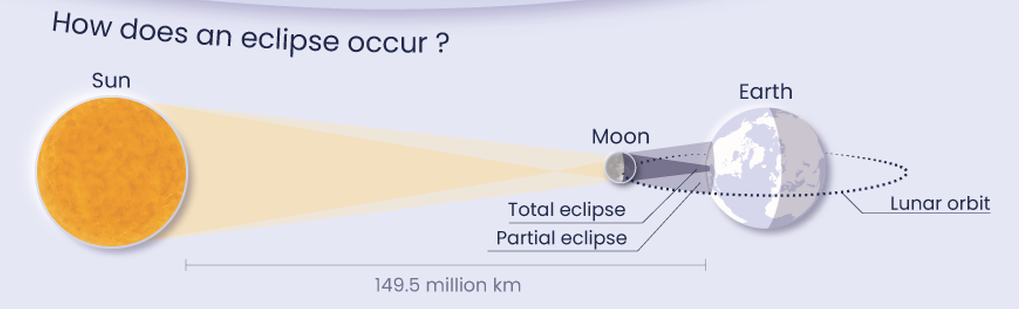
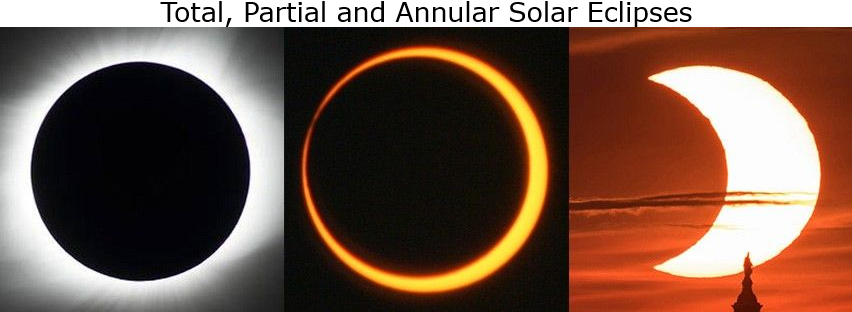
- Solar eclipses are classified mainly into three types:
- Total Solar Eclipse (Umbra): The Moon fully blocks the visible disc of the Sun. Those in the line of totality will get to experience a brief darkness in the daylight.
- Partial Solar Eclipse (Penumbra): The Moon obscures part of the Sun, causing a ‘bite’ to be taken out of the solar disc.
- Annular Solar Eclipse (Antumbra): When the Moon is approaching the point of its orbit farthest from Earth, its apparent size is smaller than the Sun. It therefore leaves a dazzling outer ring, commonly known as the ‘Ring of Fire’.
Significance & Importance of Solar Eclipse
- Study of the Solar Corona: During a total solar eclipse, the Moon blocks the bright solar disc, making the solar corona visible.
- It provides an opportunity to study its structure, temperature, magnetic fields and dynamics, which are important for understanding solar activity and space weather.
- Understanding Solar–Earth Relations: Eclipses temporarily reduce incoming solar radiation over a region.
- Scientists can study changes in atmospheric temperature and winds, ionosphere, radiative and meteorological parameters, and near-earth space environment.
- Such observations contribute to understanding space-weather processes and their possible effects on communication and navigation systems.
- Verification of Scientific Theories: Solar eclipses have historically served as natural laboratories for testing astronomical and physical theories.
- The total solar eclipse (1919), for instance, provided observations that supported Einstein’s prediction of the bending of starlight by gravity.
- Understanding Celestial Mechanics: The occurrence and precise prediction of eclipses demonstrate our understanding of the orbital motion of the Earth and Moon.
- Their timing and path can be calculated with great accuracy, reflecting advances in astronomy and mathematical modelling.
- Historical and Cultural Significance: Solar eclipses have been recorded in historical chronicles across civilizations, including India, China and the Middle East.
- Such records can help researchers reconstruct past astronomical conditions and, in some cases, study variations in Earth’s rotation.
- Scientific Temper and Public Awareness: Eclipses provide an opportunity to promote scientific temper by explaining an apparently unusual phenomenon through astronomy rather than superstition.
- They generate public interest in astronomy, space science and STEM education.
Previous article
News In Short 12-08-2026
Next article
Reforming the National Food Security Framework
