


Syllabus: GS2/Polity and Governance
Context
- The Rajya Sabha has passed the Supreme Court (Number of Judges) Amendment Bill, 2026.
- The Bill was passed as a money Bill, a route it had also taken in 2019 when the Supreme Court strength was raised to 34.
About
- The issue of whether a Bill can be certified as a money Bill is a key question pending for consideration by a seven-judge Constitution Bench.
- In 2023, the then Chief Justice of India D Y Chandrachud had said that the case would be listed for hearing soon. However, the issue is yet to be taken up.
Types of Bills
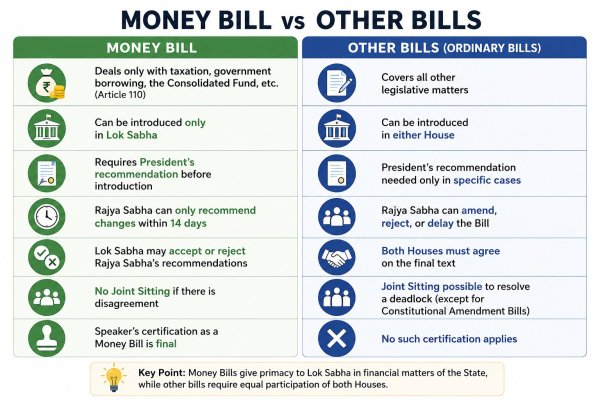
- There are four types of Bills: Constitution Amendment Bills; Money Bills; Financial Bills; and Ordinary Bills.
- Constitution Amendment Bills: These are Bills which seek to amend the Constitution.
- Money Bills: A Bill is said to be a Money Bill if it only contains provisions related to taxation, borrowing of money by the government, expenditure from or receipt to the Consolidated Fund of India.
- Bills that only contain provisions that are incidental to these matters would also be regarded as Money Bills.
- Financial Bills: A Bill that contains some provisions related to taxation and expenditure, and additionally contains provisions related to any other matter is called a Financial Bill.
- Therefore, if a Bill merely involves expenditure by the government, and addresses other issues, it will be a financial bill.
- Ordinary Bills: All other Bills are called ordinary bills.
Article 110(1) (g)
- Article 110(1) (g) adds that “any matter incidental to any of the matters specified in Articles 110(1)(a)-(f)” can also be a money Bill.
- This additional clause has been the basis for the government to pass key legislations as money Bills in its previous terms.
- The Opposition had argued then that this was done only because the government did not have the numbers to get these legislations cleared in the Rajya Sabha.
- The Speaker certifies a Bill as a Money Bill, and the Speaker’s decision is final.
- Also, the Constitution states that parliamentary proceedings as well as officers responsible for the conduct of business (such as the Speaker) may not be questioned by any Court.
Supreme Court’s Take
- The constitutionality of three major laws, including the Prevention of Money Laundering Act, are yet to be examined by the larger bench in the light of whether these laws qualify to be passed as a money Bill.
- The other two are the Aadhaar Act and the 2017 amendments altering service conditions of Tribunals.
- While the PMLA and Aadhaar Act were substantially upheld by the Court, the Supreme Court struck down the tribunal amendments as unconstitutional.
- However, in both rulings the issue of money Bill was left to a larger bench to decide.
Source: IE
Previous article
News In Short 07-08-2026
