

Syllabus: GS3/Economy; Energy
Context
- Recently, the Union Cabinet has approved the National Circular Bioenergy Scheme (GOBARdhan – Galvanising Organic Bio-Agro Resources Dhan) with a total outlay of ₹23,731 crore.
What is the GOBARdhan Scheme?
- The National Circular Bioenergy Scheme is designed to build a strong environment for CBG production, managed pricing mechanism, capital subsidies, pipeline infrastructure support, and easier access to finance.
- It is meant to catalyse domestic CBG output to over 10 times, creating a stable and predictable investment environment for the sector.
- It builds on the foundation laid through earlier programmes such as:
- Sustainable Alternative Towards Affordable Transportation (SATAT) initiative;
- Market Development Assistance (MDA) Scheme for organic manure;
- Biomass Aggregation Machinery (BAM) Scheme;
- Development of Pipeline Infrastructure (DPI) Scheme; and
- National Bioenergy Programme for financial assistance.
- It encourages the production of compressed biogas from diverse organic wastes like agricultural leftovers, animal manure, sugar industry waste (such press mud), municipal organic waste and other biodegradable biomass.
- The CBG produced can be mixed with Compressed Natural Gas (CNG) for transportation and distributed through Piped Natural Gas (PNG) networks.
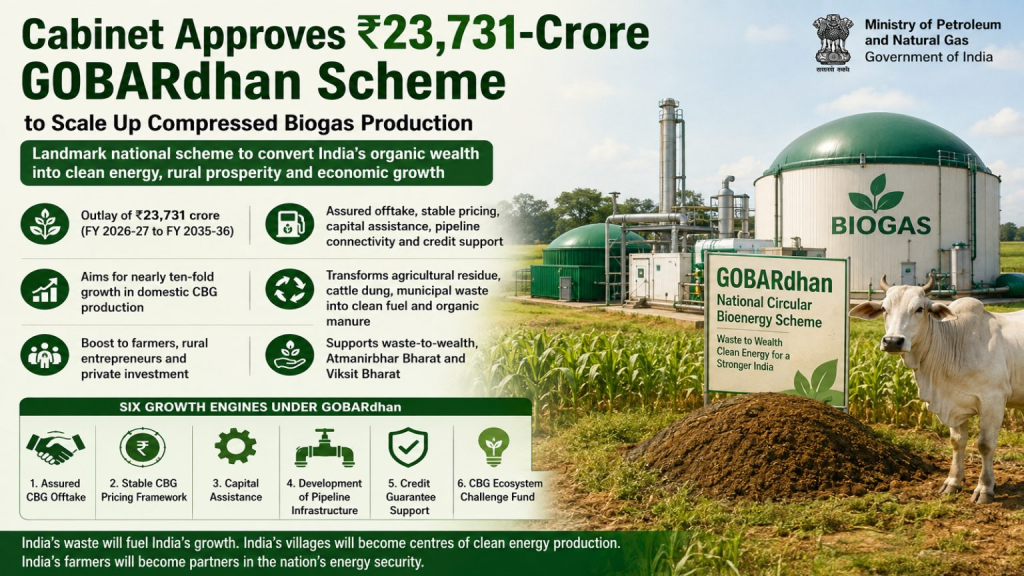
Major Features of the Scheme
- Assured Market and Administered Pricing: CBG is fixed at an administered price of ₹2,110 per Metric Million British Thermal Unit (MMBTU) with assured market and administered pricing.
- It creates long-term revenue stability for producers and affordable costs for consumers by combining government support and market-based cost sharing.
- Capital Assistance: Eligible greenfield and brownfield CBG projects for capacity expansion will be provided capital assistance up to ₹2 crore per tonne per day (TPD) of installed CBG capacity.
- It covers core plant machinery, feedstock aggregation infrastructure, and manure processing.
- It is projected to minimise the initial costs of projects and increase participation of private enterprises, MSMEs, cooperatives and rural entrepreneurs.
- Development of Pipeline Infrastructure: A crucial part of the project is the development of pipeline infrastructure.
- It supports cluster-based pipeline networks, standalone pipelines connecting CBG plants to trunk pipelines, and Integration with City Gas Distribution (CGD) networks.
- Improved connectivity is expected to reduce transportation and evacuation costs, ensure reliable offtake, expand market access, and increase utilisation of domestically produced CBG.
Significance
- The scheme supports multiple national priorities i.e. energy security, circular economy, waste-to-wealth mission, atmanirbhar bharat, climate change mitigation, doubling farmers’ income through diversified revenue, and viksit Bharat vision
- It addresses three long-standing requirements of the sector i.e remunerative pricing, assured offtake, and capital support which are expected to facilitate expansion from around 300 operational CBG plants to nearly 5,000 plants over time.
Expected Benefits
- Energy Security: Reduces dependence on imported fossil fuels, and increases domestic production of clean gaseous fuel.
- Waste Management: Converts agricultural, livestock, industrial, and municipal waste into useful energy, and supports scientific disposal of organic waste.
- Rural Economy: Offers extra avenues of income for farmers by selling agricultural residues and livestock dung; creates job possibilities in rural regions by setting up and running CBG units.
- Environmental Benefits: Helps in reducing greenhouse gas emissions, reduces stubble burning and open dumping of organic waste and stimulates formation of organic manure and improves soil health.
- Private Investment: Stable pricing and capital support are anticipated to draw investments into the bioenergy sector and accelerate the financial conclusion of projects.
Challenges
- Timely development of pipeline infrastructure.
- Reliable collection and aggregation of feedstock.
- Better coordination between Central Agencies, States and Local Bodies.
- Financial Sustainability and Operational Effectiveness of CBG Plants.
- Maintaining quality standards of CBG and organic manure.
Way Forward
- The success of the GOBARdhan Scheme would depend on successful implementation, strong infrastructure, timely financial support and active participation of private investors and rural enterprises.
- It has the potential to turn India’s CBG sector into a significant pillar of clean energy, sustainable waste management and rural economic growth with a predictable pricing regime, better connectivity and capital support.
