


Syllabus: GS1/ Indian Heritage & Culture, GS3/ Economy
Context
- On the 12th National Handloom Day, the GoI recognised the contribution of the handloom sector of India in attaining the vision of Viksit Bharat 2047 by converging the cultural heritage with sustainable economic growth.
About National Handloom Day
- National Handloom Day is celebrated annually on 7 August. It commemorates the launch of the Swadeshi Movement in 1905, which promoted indigenous goods and encouraged self-reliance.
- The Government of India declared 7th August as National Handloom Day in 2015.
- The occasion celebrates India’s weaving traditions and recognises the socio-economic and cultural contribution of handloom workers.
- It recognises 35.22 lakh weavers and allied workers, over 72% of whom are women.
Handloom Industry of India
- The Indian handloom industry is one of the oldest and most vibrant cottage industries in the world.
- Handloom Census:
- India has conducted four censuses so far: 1987-88, 1995-96, 2009-10 and 2019-20.
- They are conducted at intervals averaging 8-12 years.
- According to the 4th All India Handloom Census (2019–20), about 35.22 lakh households are involved in this work, and around 72% of economic handloom weavers are women.
- Top Export Destination: In FY 2024-25, the United States remained the largest destination, followed by the United Arab Emirates, the Netherlands, France, and the United Kingdom, respectively.
- Products: Made-ups such as cushion covers, curtains, table linen, and other household items contributed 42.4% in 2024-25, followed by floor coverings like carpets, rugs, and mats, which made up 40.6%.
- Clothing accessories contributed 12.7%, while fabrics accounted for 4.3%.
Major Challenges Faced by the Industry
- Declining Number of Weavers: Younger generations moving away due to low income, lack of social security, and absence of modern skill training.
- Traditional weavers are aging, leading to a shrinking workforce.
- Economic Distress: Prices of raw materials (cotton, silk and dyes) were high while selling prices were low due to exploitation by middlemen.
- Competition from Powerlooms & Mills: Machines create Fabrics in large quantities which are cheaper, faster to make and control the marketplace.
- Handloom products of better quality and distinctive are priced non competitively.
- Weak Marketing & Branding: Poor penetration in domestic and worldwide markets due to lack of branding, modern retail and e-commerce acceptance.
- Technological & Skill Gaps: Traditional looms are less productive and labour consuming.
- Globalisation & Import Competition: Cheap imports (especially from China and Bangladesh) are flooding Indian markets.
- Indian handloom struggles to compete internationally due to high production costs and a lack of aggressive export promotion.
An Ecosystem of Support for Handloom Weavers
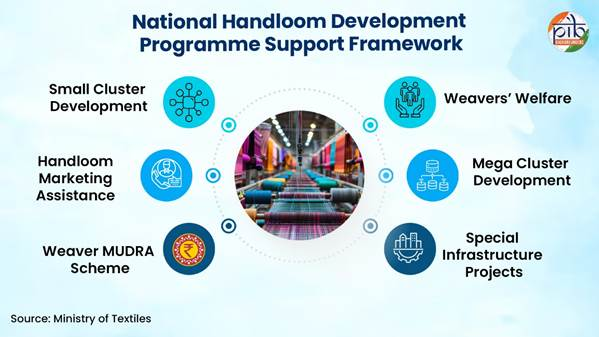
- National Handloom Development Programme (NHDP): NHDP was formulated for implementation from 2021-22 to 2025-26.
- It follows a need-based approach to the integrated development of the handloom sector, focusing on the welfare of handloom weavers.
- Raw Material Supply Scheme (RMSS): The Scheme supports access to yarn by reimbursing freight charges on all types of yarn.
- It also provides a 15% price subsidy on specified yarns, subject to prescribed quantity limits.
- GST Relief for Handlooms and Traditional Crafts: The Next-Generation GST reforms recommended at the 56th GST Council meeting in 2025 included measures supporting the handloom sector.
- Under the GST rationalisation, the tax rate on 36 handicraft items was reduced from 12% to 5%.
- Cotton handloom rugs and handwoven carpets were also brought under the 5% GST rate.
- The rate on domestic and industrial sewing machines was similarly reduced from 12% to 5%, easing costs for tailoring units and supporting domestic manufacturing.
- The Union Budget 2026-27 placed special emphasis on textiles through several new measures:
- The National Fibre Scheme is designed to strengthen the textile raw-material base.
- Traditional clusters will be modernised under the Textile Expansion and Employment Scheme.
- The Mahatma Gandhi Gram Swaraj Initiative will strengthen khadi, handloom and handicrafts while benefiting weavers, village industries, rural youth and the One District One Product (ODOP) initiative.
Concluding remarks
- India’s handloom sector represents a unique blend of heritage, sustainability, and economic opportunity.
- Handloom can be a significant pillar of Viksit Bharat 2047 by integrating traditional craftsmanship with modern technology, design innovation, and access to global markets, helping to preserve India’s unique cultural identity and creating inclusive, women-led rural livelihoods.
Previous article
News In Short 06-08-2026
