
The World Development Report 2026

Syllabus: GS3/Economy

Context

  • The World Bank has released The World Development Report 2026.

About

  • It has been published annually since 1978, each report provides in-depth analysis and policy recommendations on a specific and important aspect of development
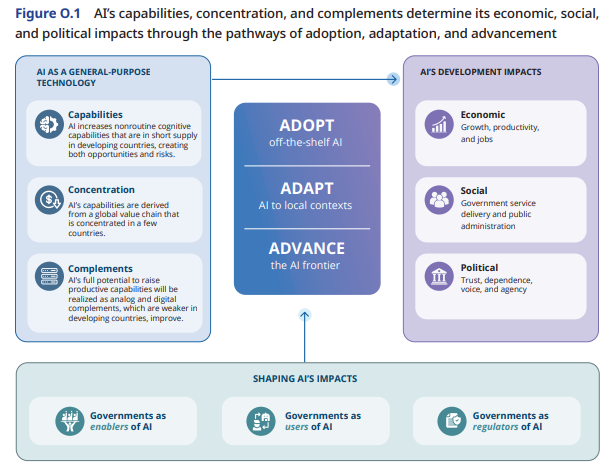
  • The 2026 Report offers a clear framework to adopt, adapt, and advance for the road ahead to help countries capture AI’s benefits without wasting scarce resources or deepening dependence on any single supplier. 

Major Findings

  • Automation Risks: Jobs in high-income countries are more than three times as likely to face automation risk from generative AI as those in low- and middle-income countries.
  • Boost in Productivity: AI could boost productivity in more than 16% of existing jobs in developing economies, compared with more than 18% in advanced economies.
  • AI in Agriculture: Separate research on agriculture found that AI could improve productivity and resilience, but only with supportive policies, infrastructure and equitable access.
major findings
  • Challenges:
    • Trying to replicate the most sophisticated AI systems too early could prove expensive and ineffective.
    • Developing countries still lack many of the basics needed to use AI effectively, including reliable electricity, internet access, data systems, skills and institutions.
    • Without addressing these gaps, AI could widen the divide between rich and developing nations and increase inequality within countries.
  • Recommendations:
    • Countries should first adopt AI tools that are already available, then adapt them for local needs, and only later invest in building advanced AI capabilities of their own.
    • Countries should encourage responsible AI practices, apply existing laws to address harms where necessary and build public trust by protecting privacy and preventing bias in AI-powered decision-making.

Source: DTE


Other News of the Day

Syllabus: GS1/ Society, GS3/ Economy Context NITI Aayog, in its report “Reimagining Care: Strategies for Empowering Caregivers in Viksit Bharat @2047,” has advocated the setting up of a National Carer Council (NCC) to regulate, standardise and professionalise the caregiving services in India. What is the Care Economy? Caregiving involves the physical, emotional, and social support...
Read More

Syllabus: GS2/Governance In News The Indian Statistical Institute (ISI) Bill, 2026 has been introduced in Parliament.  Background of Indian Statistical Institute (ISI) Origin: The Indian Statistical Institute (ISI) was established in December 1931 in Kolkata as a learned society in the Statistical Laboratory at Presidency CollegeIt was set up by the eminent statistician P. C....
Read More

Syllabus: GS3/Cybersecurity Context The Supreme Court passed a detailed order directing the Centre, States, the Reserve Bank of India and telecom authorities to prepare standard operating procedures (SOPs) to curb “digital arrests” scams. What is Digital Arrest Scams? A digital arrest is a cyber extortion scam where fraudsters impersonate law enforcement or government officials, using...
Read More

Syllabus: GS2/Governance, GS3/Economy Context As per the Ministry of Home Affairs, India has brought back 274 fugitive criminals from 36 countries between 2019 and 2026. What is a Fugitive Economic Offender (FEO)? A Fugitive Economic Offender (FEO) is a person: Against whom an arrest warrant has been issued for committing a scheduled economic offence involving...
Read More

Syllabus: GS3/Energy Infrastructure; Environment  Context The eMobility is turning into a key driver of economic growth, energy security, and a cleaner future, as India is rapidly shifting to electric vehicles (EVs). What is an Electric Vehicle (EV)? An EV is a vehicle powered by an electric motor that uses energy stored in a battery. It...
Read More

Uzbekistan Syllabus: GS1/Geography Context India and Uzbekistan have agreed to expand their strategic partnership. About Uzbekistan Uzbekistan is Central Asia’s most populous country, with a population of 30.8 million people. It shares borders with Kazakhstan, Turkmenistan, Kyrgyzstan, Tajikistan, and Afghanistan.  Along with Liechtenstein, it is one of the world’s only two doubly landlocked countries (all...
Read More
scroll to top