


Syllabus: GS3/Economy
Context
- The 16th Finance Commission under the chairmanship of Dr Arvind Panagariya published its report for 2026–31. It recommended radical reforms in tax devolution and grants, sparking disputes on fiscal federalism, equity and Centre–State relations.
About the Finance Commission in India
- The Finance Commission (FC) is a constitutional body formed under Article 280 to recommend the devolution of financial resources between the Union and the States.
- It aims to promote cooperative fiscal federalism, eliminate vertical and horizontal fiscal imbalances and ensure that States are endowed with appropriate resources to perform their constitutional obligations.
Constitutional Basis
- Article 280: It provides for the constitution of the Finance Commission every five years by the President.
- Article 270: It governs the distribution of taxes between the Centre and States.
- Article 275: It empowers the Union to provide grants-in-aid to States requiring financial assistance.
- Article 281: It requires the President to place the Commission’s recommendations before Parliament with an explanatory memorandum.
16th Finance Commission (FC-16)
- Objective: Recommend tax devolution, grants-in-aid and initiatives to enhance budgetary sustainability and local governance.
- It maintains the States’ share in the divisible pool at 41%, as recommended by the 15th Finance Commission.
Major Recommendations of FC-16
- 41% Vertical Tax Devolution Retained: States’ share has been retained at 41% when several States had demanded it to be raised to 50%.
- Major Restructuring of Grants-in-Aid: Total grants reduced to ₹9.47 lakh crore (from ₹10.1 lakh crore under FC-15).
- Share of grants in total Finance Commission transfers declines from 19.4% to 8.3%.
- Revenue Deficit Grants (RDGs), sector-specific grants, and State-specific grants have been discontinued.
- Grants are largely confined to local bodies, and disaster management.
- Greater Focus on Performance-Based Transfers: Local bodies have been allocated around Rs 7.2 lakh crore.
- Funds will be disbursed against conditions such as water and sanitation outcomes, revenue mobilisation and properly audited accounts.
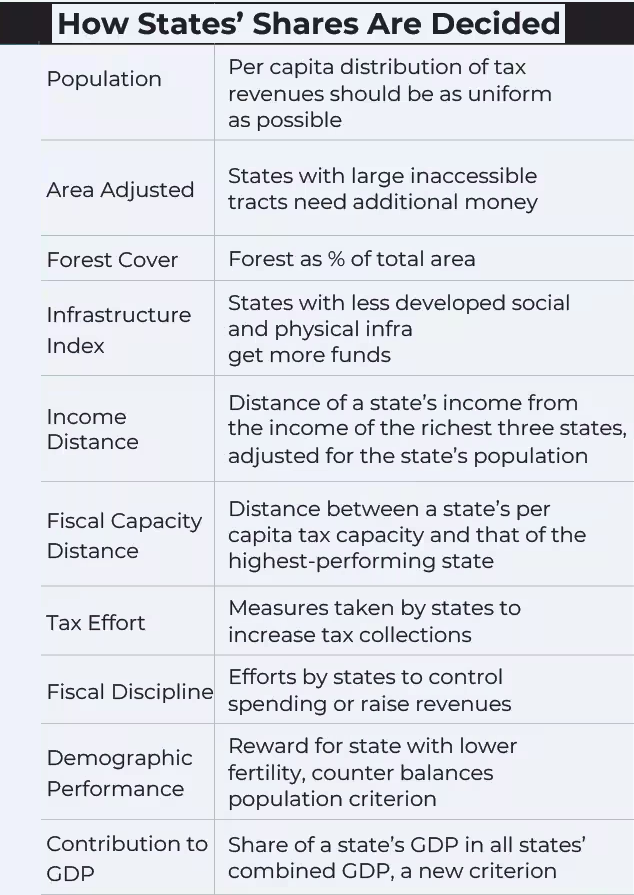
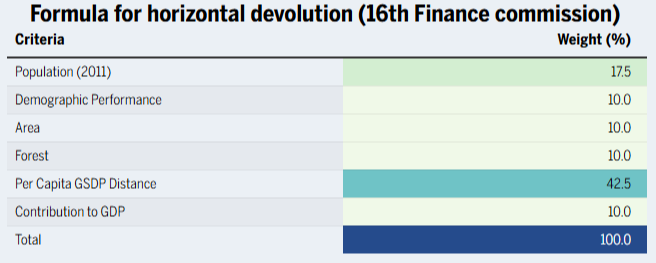
- Devolution Formula Changes: Income Distance weighting reduced from 45% to 42.5%.
- 10% weight given for contribution to GDP, rewarding the economically stronger States.
- Cesses and Surcharges: Recommends a ‘grand bargain’ to absorb cesses into the divisible pool gradually, without suggesting any binding rollback.
Key Concerns
- Weakening the Equalisation Role: The discontinuation of Revenue Deficit Grants (RDGs) is a big shift.
- Grants under Article 275 were meant to take care of State-specific fiscal impediments which cannot be taken care of by way of devolution of taxes on a formula basis.
- Efficiency Above Equity: The Commission considers that equalisation can be replaced with improved fiscal discipline. Nevertheless, States vary considerably in fiscal capability, geography, degrees of development and demographic and social sector duties.
- It can deepen regional inequality.
- Disadvantaged States to Suffer Double Whammy: Some of the States, notably in the North-East and those under budgetary difficulties like West Bengal, may suffer from reduced tax devolution and loss of compensatory subsidies.
- This, along with a lower weight on income distance, could worsen existing fiscal hardship.
- Asymmetry in Fiscal Discipline: The Commission has been lenient to cesses and surcharges that are outside the divisible pool and lower the States’ share of central income, whereas RDGs have been abolished on the grounds of avoiding moral hazard.
- Fiscal Autonomy Reduced: performance-linked payments boost accountability but also conditionality, restricting states autonomy in setting expenditure priorities.
Way Forward: Strengthening India’s Fiscal Federalism
- Targeted funds to States with structural disadvantages should be retained to restore the principle of equalisation.
- Balance efficiency and equity, such that incentives do not offend constitutional obligations to cooperative federalism.
- Rationalise cesses and surcharges by gradually including them in the divisible pool to improve transparency and fairness.
- Improve horizontal fairness by using devolution criteria that adequately reflect fiscal capacity, geography and development gaps.
- Enhance the budgetary autonomy of States, but provide accountability through outcome-based monitoring and not through excessive conditionalities.
- Adopt a differentiated strategy that rewards good performance by States, without penalising those who are bound by historical or structural constraints.
| Daily Mains Practice Question [Q] Critically examine the emerging tension between performance-based fiscal transfers and the equalisation principle in Indian fiscal federalism. |
Previous article
Indian Aviation Needs More Competition
