


Syllabus: GS3/Infrastructure
Context
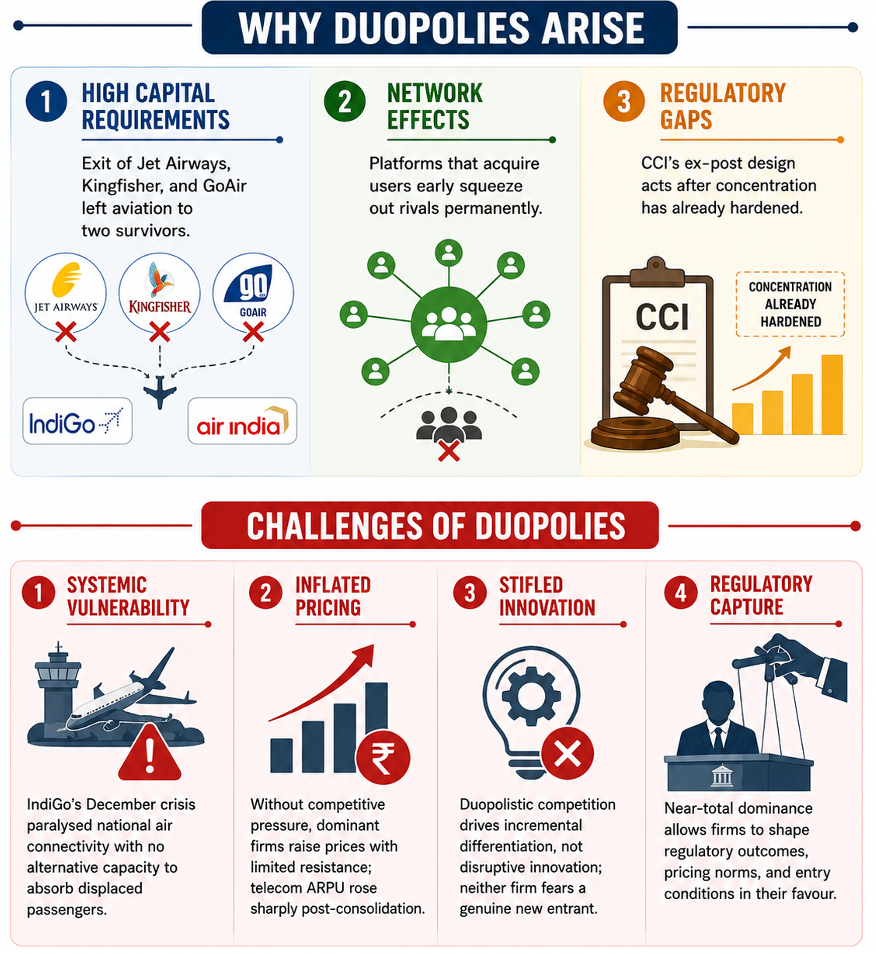
- Recent Indigo fiasco has exposed the systematic risks of of near-duopoly market structures across airlines & revived the discussion on the market concentration, competition and structural reforms in India’s fast-growing aviation sector.
About India’s Aviation Sector
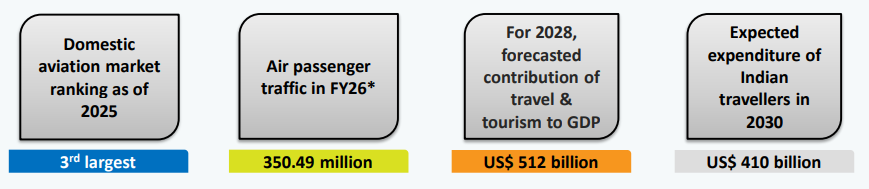
- India is the third largest domestic aviation market in the world with more than 400 million passengers travelling every year.
- The Union Ministry of Civil Aviation said passenger traffic is projected to rise above one billion by 2047 driven by increasing incomes, urbanisation, tourism and regional connectivity.
- The sector has experienced major infrastructure development through:
- UDAN (Ude Desh ka Aam Nagrik) for regional connectivity;
- Greenfield airport development and airport refurbishment under the National Infrastructure Pipeline.
- Privatisation of Air India, expansion of airport operations through Public-Private Partnerships.
- However, industry consolidation has led to a dominance of the market by IndiGo and the Air India Group, with concerns about long-term competition and consumer welfare.
IndiGo: A Success Story
- IndiGo launched operations on 4 August 2006 with an Airbus A320 route from New Delhi to Imphal.
- It went into a fiercely competitive market with Air India, Jet Airways, Kingfisher Airlines, SpiceJet, Air Deccan and GoAir.
- The growth has been fuelled by:
- Low cost carrier (LCC) business model.
- High aircraft utilisation and operational efficiency.
- Modern and fuel efficient fleet.
- On-time delivery is strong and cost control is tight.
Concerns and Issues in India’s Aviation Sector
- Increasing Market Share: IndiGo controls almost two-thirds of the domestic passenger traffic.
- After Air India’s privatisation and subsequent consolidation, the sector is almost a duopoly.
- Limited competition may lead to less consumer choice and pricing efficiency.
- High Operational Costs: Aviation Turbine Fuel (ATF) is heavily taxed, which drives up airline operating costs.
- Also, higher airport charges at the main airports hit profitability.
- Infrastructure and Connectivity Challenges: The passenger increase is outstripping the airport capacity in some of the metropolitan areas.
- Government help has not solved the viability issues for regional routes.
- External and Geopolitical Constraints: The COVID-19 pandemic hit the worldwide airline industry very hard.
- Closure of Pakistan’s airspace has resulted in longer flying time, more fuel consumption and higher operating expenses for many Indian international flights.
- Human Resource Constraints: Lack of trained pilots and cabin personnel has emerged as a serious concern.
- Widespread flight disruptions in December 2025 owing to Flight Duty Time Limitations (FDTL) compliance underscore the need for greater workforce planning.
- Pilot tiredness and regulatory compliance continue to be important safety hazards.
- Regulatory and Financial Challenges: Low profit margins and high capital requirements deter new entrants.
- The policy challenge is to ensure competition is fair, and safety is assured.
Regulatory Frameworks
- DGCA: India’s apex aviation safety regulator, responsible for airworthiness standards, pilot licensing, accident investigation, and ICAO coordination under the Ministry of Civil Aviation.
- Bharatiya Vayuyan Adhiniyam, 2024: The Act replaces the colonial Aircraft Act, 1934 and align India’s aviation law with Chicago Convention standards while promoting Make in India in aviation manufacturing and modernising governance frameworks.
- Revised FDTL Norms (2025): Weekly pilot rest increased from 36 to 48 consecutive hours, night landings capped at 2 (down from 6), no more than 2 continuous night duties permitted & quarterly fatigue risk reporting mandated for all airlines.
Government Initiatives
- UDAN (Regional connection Scheme): To increase air connection to unserved and underserved airports.
- Reduces air travel costs for smaller cities.
- eGCA 2.0: Digital platform streamlining licensing, approvals, and regulatory compliance, improving transparency across aviation stakeholders.
- National Civil Aviation Policy (NCAP), 2016: Entry into open market. Removed the previous 5/20 rule that let qualifying airlines start foreign operations early.
- Bharatmala and Airport PPP Models: Greenfield airport development and PPP-based operations are being scaled to meet the 350-400 airport target by 2047.
- CORSIA Compliance: India is aligning with ICAO’s Carbon Offsetting and Reduction Scheme for International Aviation, integrating Sustainable Aviation Fuel (SAF) in long-term aviation planning.
Way Forward: Strengthening India’s Aviation Sector
- Encourage Good Competition: Transparent and predictable regulatory rules to encourage financially viable airlines to enter the market.
- Avoid the emergence of monopolistic or duopolistic market systems.
- Reduce Cost Burden Rationalise: ATF taxation by increased coordination with states.
- Review of airport user charges to increase the viability of airlines.
- Developing Human Capital: Support pilot training academies and development of aviation skills.
- Improve Safety: Improve working conditions and FDTL standards compliance.
- Expand Infrastructure: Speed up airport capacity expansion in high demand cities.
- Enhance multimodal airport connections.
- Strengthen Regulatory Oversight: Strengthen DGCA oversight on safety, competition and operational resilience.
- Encourage the use of digital technologies for effective airline and air traffic operations.
Conclusion
- IndiGo’s two-decade odyssey is the story of India’s aviation liberalisation success story and the potential of effective low-cost operations.
- However, for continued expansion in a market projected to handle more than one billion people by 2047, more than one dominating airline is required.
- A competitive market, lower operating costs, strong infrastructure, qualified workforce and balanced regulation will be important factors to keep India’s aviation sector safe, inexpensive and globally competitive.
| Daily Mains Practice Question [Q] Examine the need for greater competition and consumer choice in India’s aviation sector and discuss the key challenges facing the sector and suggest measures to strengthen its growth. |
Previous article
The Problem With India’s Free Trade Agreement Strategy
Next article
Fiscal Federalism: Efficiency Versus Equity Concerns
