

Syllabus: GS2/Welfare Schemes and Governance; GS3/Inclusive Growth
Context
- Recently, the government highlighted the increasing impact of the Start-up Village Entrepreneurship Programme (SVEP) that has assisted more than 4.32 lakh rural firms and improved rural lives through community-led entrepreneurship under DAY-NRLM.
About Start-up Village Entrepreneurship Programme (SVEP)
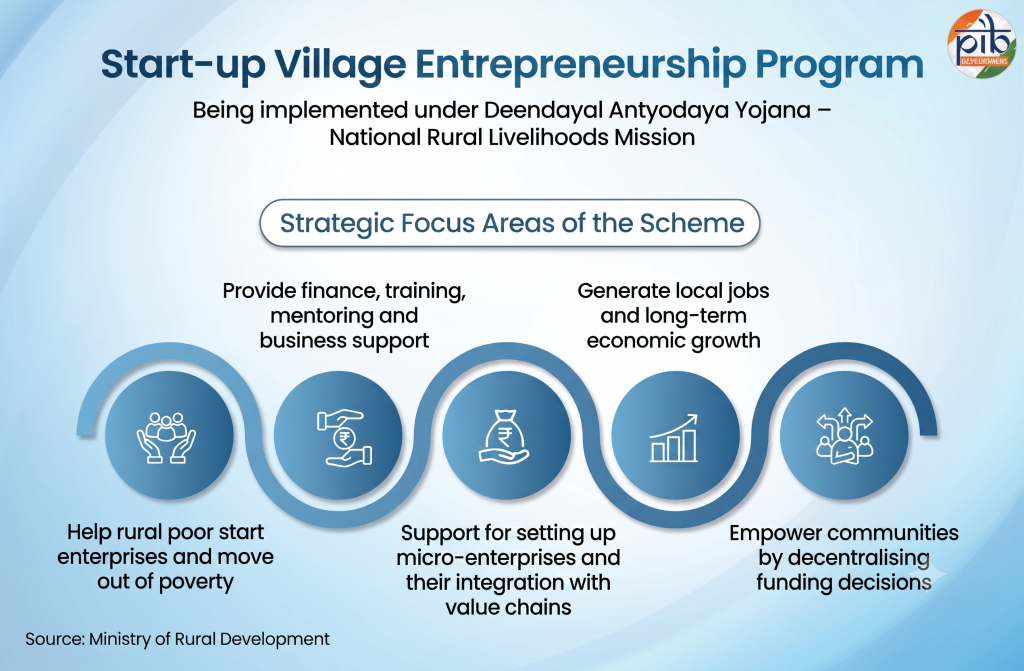
- It was launched in 2016 as a sub-scheme of the Deendayal Antyodaya Yojana–National Rural Livelihoods Mission (DAY-NRLM) by the Ministry of Rural Development.
- Objectives:
- To promote non-farm rural enterprises.
- To generate self-employment and sustainable livelihoods.
- To empower first generation entrepreneurs, especially women and marginalised populations.
- To diversify sources of income in rural areas to lessen dependence on agriculture.
- To create community-based enterprises that create strong local economies.
- Key Features:
- Community Enterprise Fund (CEF) funding.
- Business planning, skills development, coaching and enterprise management support.
- Convergence with government plans and credit facilitation through banks.
- Digital tools for business planning, credit evaluation and corporate monitoring.
- Community-based decision-making in the selection and funding of enterprises.
Institutional Framework of SVEP
- National Level: Implemented under DAY-NRLM, Ministry of Rural Development.
- State Level: Executed through State Rural Livelihood Missions (SRLMs).
- Block Level: Block Resource Centres–Enterprise Promotion (BRC-EPs) coordinate implementation.
- Provision of ₹6.50 crore per block.
- Average investment of ₹27,083 per enterprise.
- Community Level: Enterprise Promotion (CRP-EPs) Community Resource Persons provide business mentoring, enterprise planning, loan facilitation and market connection help.
- Each CRP-EP provides mentorship to up to 50 firms.
- Role of Self Help Groups (SHGs): Identify suitable entrepreneurs; handle the Community Enterprise Fund loans; assess enterprise performance; and give ongoing hand holding support.
Inclusive Design of the Programme
- Women-Centric Approach: At least 60% of the beneficiaries are women; At least 60% of CRP-EPs are women; Around 90% of CRP-EPs are recruited from SHG households.
- Focus on Vulnerable Sections: Priority to SC/ST communities, minorities, Persons with Disabilities (PwDs), poor rural households and individuals with little educational attainment.
- Community Ownership: Enterprises are selected based on poverty status, local needs, entrepreneurial potential and enterprise viability assessment.
Achievements of SVEP
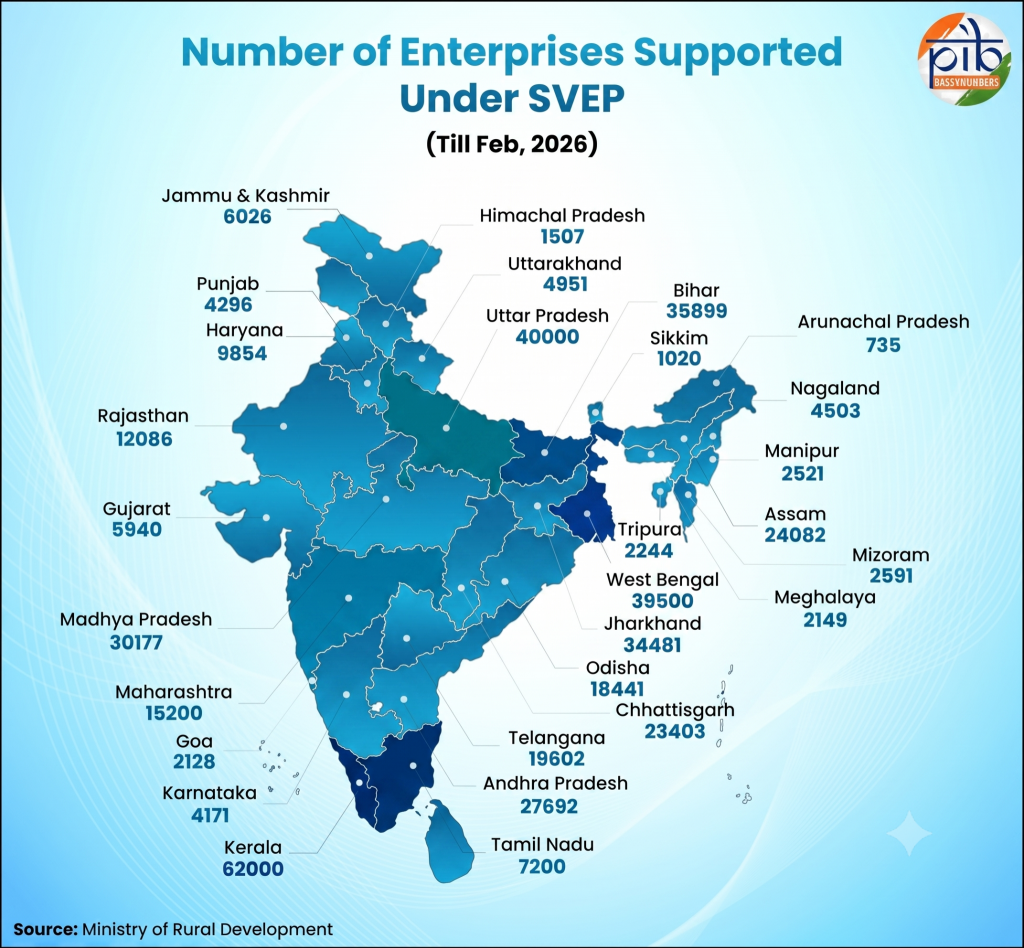
- Enterprise Development: Supported over 4.32 lakh rural enterprises.
- Highest implementation in Assam, Bihar, Jharkhand, West Bengal and Madhya Pradesh.
- Impact Assessment (Quality Council of India): Major findings include:
- 99% enterprises were profitable.
- Enterprises contributed 57% of household income.
- Average monthly revenue from enterprise: ₹39,000
- Manufacturing businesses earned about ₹47,800 a month.
- 96% of entrepreneurs said they saw an increase in savings.
- 75% of firms were women-owned or managed.
- Socio-Economic Outcomes: Greater financial inclusion, higher household incomes, better nutrition, education, sanitation and health, greater confidence and social standing of women and support for first generation rural entrepreneurs.
Case Study: Success Stories
- Bhagyashri Londhe, Maharashtra: Expanded her food processing business with the help of an SVEP loan of ₹45,000.
- Earned ₹5 lakh within 10 days at Mahalaxmi Saras.
- Created employment for rural women.
- Poonam (Uttar Pradesh): Became a certified CRP-EP; mentored around 40 enterprises; and facilitated credit, business planning, and market access.
Other Rural Development Programmes
- DAY-NRLM: Women’s SHGs and livelihood promotion. It has constructed a strong institutional framework on which the success of SVEP is built.
- Key Highlights:
- Organises rural poor households into Self Help Groups (SHGs).
- Mainly targeting women’s economic empowerment.
- Promotes financial inclusion, skill development and diversification of income sources.
- Key Highlights:
- PM Formalisation of Micro Food Processing Enterprises (PMFME) Support to micro food processing enterprises
- PMEGP: Credit Linked Employment Generation
- MUDRA Yojana: Collateral free loans to smaller enterprises
- Stand-Up India: Women and SC/ST entrepreneurship
- SFURTI: Up-gradation of Traditional Industries and Clusters
- National Rural Economic Transformation Project (NRETP): Development of enterprise through SHGs
Related Challenges
- Limited market access: Rural firms have long faced challenges in areas like branding, packaging and marketing.
- Credit Constraints: Reliance on community donations and no access to official credit.
- Limited digital literacy: Low technology adoption Low technology adoption.
- Infrastructure Gaps: Lack of logistics, storage, transport and internet connectivity.
- Capacity Constraints: Continuous skill upgradation is a necessity for enterprise survival.
- Regional Imbalances: Concentrated in few states, many regions still under-covered.
- Growth Hurdles: Small businesses can grow only in local markets.
Way Forward
- Boost rural start-up ecosystem: Set up incubation centres and innovation hubs in remote regions.
- Strengthen Market Linkages: Promote e-commerce platforms such as GeM, ONDC, digital marketplaces.
- Enhance Access to Finance: Expand credit guarantee schemes and link with MUDRA and Stand-Up India.
- Technology Adoption: Promote digital bookkeeping, UPI payments, AI-enabled market intelligence and e-commerce.
- Skill Development: Provide sector specific entrepreneurial training through Krishi Vigyan Kendras (KVKs), Industrial Training Institutes (ITIs) and Rural Self Employment Training Institutes (RSETIs)
- Cluster-Based Development: Develop producer collectives and value chains to strengthen competitiveness.
- Robust Monitoring: Enhance MIS-based monitoring and impact evaluation to support evidence-based policy adjustments.
Previous article
Soil Diversity in India
