

Syllabus: GS3/ Economy
Context
- As India’s growth estimates are being revised downward and household financial stress is increasing, concerns have emerged that the economy is moving toward a K-shaped pattern of growth.
What is the K-Shaped Economy?
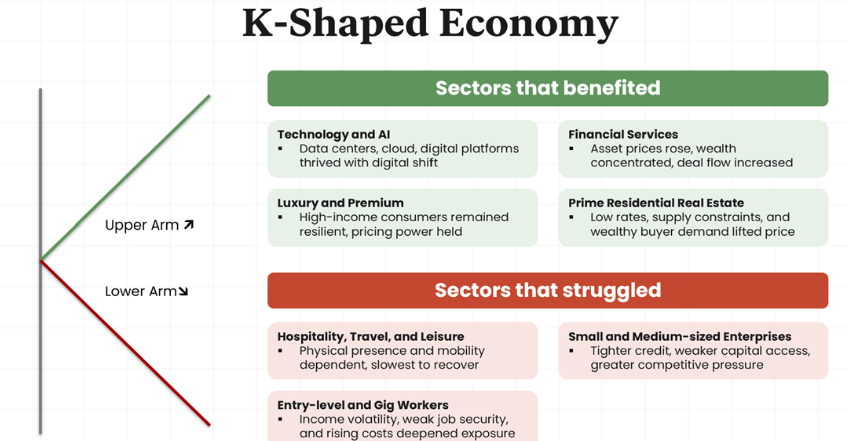
- A K-shaped economy is a condition where different sections of the economy move in opposite directions at the same time.
- The upper arm of a K-Shaped represents people, sectors, and firms whose income, profits, and wealth are increasing.
- The lower arm represents households, workers, and small businesses whose incomes stagnate, debt rises, and economic conditions worsen.
How is India showing K-shaped characteristics?
- Positive trends in Indian Economy (Upward arm):
- The Service sector is the main growth driver and a buffer against the slowdown of the global economy.
- The construction sector is expanding, contributing to job creation and domestic demand.
- Some manufacturing sectors are proving resilient, especially those tied to investment and infrastructure spending.
- Early corporate earnings point towards healthy profit growth, suggesting large formal firms continue to benefit from stronger balance sheets and demand in premium segments.
- The banking sector is in a healthy state with historically low NPAs, adequate capital adequacy buffers and improved asset quality.
- Emerging vulnerabilities in Indian Economy (Downward arm):
- Household debt has increased to 48% of GDP which indicates a rising dependence on borrowing by households.
- A growth in retail credit is used for consumption purposes and not for housing, business expansion, or education, which raises concerns about debt sustainability.
- Gold loans have expanded and many families are using higher gold prices to borrow larger amounts and roll over existing debt obligations.
- Lower-income households account for a larger share of fresh retail loan defaults which points to concentrated financial stress among vulnerable borrowers.
- RBI consumer confidence surveys show that urban confidence has declined for three consecutive rounds.
- Household debt has increased to 48% of GDP which indicates a rising dependence on borrowing by households.
Structural causes of a K-shaped economy in India
- Formalization shock: GST and digital compliance have improved efficiency for large firms. However smaller informal enterprises have faced higher compliance and adjustment costs.
- Unequal access to technology: AI, automation and digital platforms benefit skilled workers and technology-intensive firms. The workers with limited digital skills risk displacement and income stagnation.
- Asset inequality: The rise in stock market and real-estate values mainly benefit households that already own financial and physical assets.
- Jobless Growth: GDP growth has not translated into sufficient quality employment opportunities, especially for youth and low-skilled workers.
- Oil as the Swing factor: India imports almost nine-tenths of its crude oil requirement, making global oil prices a critical determinant of domestic inflation, growth, and external stability.
Economic implications
- Rising inequality: A prolonged K-shaped pattern will widen income inequality, wealth inequality and regional disparities.
- Weak aggregate demand: If income growth is concentrated at the top, overall consumption demand may remain subdued because the rich have a lower marginal propensity to consume.
- Social and political risks: Continuous divergence will lead to declining consumer confidence, social frustration and pressure for populist policies.
- The pipeline effect: Cost-push inflation:
- Rising fuel and power prices increase the production and transportation costs in the economy. The higher input costs are gradually passed on to consumers with higher food and retail prices.
- The delayed transmission of energy costs into consumer inflation is called “inflation waiting in the pipeline.”
Way Ahead
- Supply-side management: Inflation should be addressed through supply management before it becomes entrenched in the economy.
- Timely imports of pulses, edible oils, and animal-feed ingredients, release of food stocks, improved logistics, and calibrated fuel-tax reductions can be more effective than relying solely on interest-rate hikes.
- Debt-supported to income-supported consumption: Faster job creation, real wage growth, lower household expenditure on health and education, and stronger protection against sudden income shocks are essential for sustaining consumption demand.
- Protect capital expenditure: Governments should protect capital expenditure on infrastructure, irrigation, power systems, schools, healthcare, and logistics, as these investments raise productivity and rural incomes in long terms.
- Convert scientific capability into economic strategy: Greater focus on semiconductors, advanced materials, biotechnology, clean energy, space technology, and defence manufacturing will help India move into high-value global supply chains.
| Daily Mains Practice Question [Q] India’s recent growth pattern has raised concerns about a K-shaped economy. Examine the causes of K-shaped growth in India and discuss its implications for household consumption, inequality, and macroeconomic stability. |
Source: IE
Previous article
India–Canada Defence Relations In a Changing Global Order
