

Syllabus: GS3/ Economy
Context
- The 5th Foundation Day of the Ministry of Cooperation was celebrated on July 6, 2026, in New Delhi.
About the Foundation Day
- The government laid the foundation stones for 47 grain storage godowns to enhance cooperative storage infrastructure.
- A Milk Supply Review Dashboard Portal for the National Dairy Development Board was launched to improve management of milk procurement and distribution.
- Two flagship initiatives of the National Urban Cooperative Finance and Development Corporation (NUCFDC) were unveiled – Sahakar CBS and Sahakar Sahyogi.
- Sahakar CBS is a centralized Core Banking Solution for Urban Cooperative Banks.
- Sahakar Sahyogi is a conversational AI-powered platform designed to enhance customer services and banking operations.
What are Cooperatives?
- A cooperative (or co-op) is an organization or business that is owned and operated by a group of individuals who share a common interest, goal, or need.
- These individuals, known as members, participate in the cooperative’s activities and decision-making process, typically on a one-member, one-vote basis, regardless of the amount of capital or resources each member contributes.
- The main purpose of a cooperative is to meet the economic, social, or cultural needs of its members, rather than to maximize profits for external shareholders.
- India has one of the largest cooperative ecosystems in the world.
- These institutions form the backbone of grassroots economic participation, linking farmers, dairy producers, fishers, artisans, and workers to income opportunities.
Strengthening Cooperatives through Structural Reforms
- Primary Agricultural Credit Societies (PACS) form the grassroots foundation of the short-term cooperative credit structure. They are actively functioning as multi-service institutions that serve as the first point of contact for rural economic services.
- White Revolution 2.0: The cooperative dairy sector is being strengthened under White Revolution 2.0 with a focus on increasing milk procurement by 50% by 2028-29.
- 25,282 dairy cooperative societies have been registered so far with focus on women-led dairy cooperatives and wider cooperative coverage.
- Cooperative Education: Tribhuvan Sahkari University (TSU) has been established as India’s first cooperative university. The University supports education, research, and skill development in the cooperative sector.
- Training programmes are conducted through the National Council for Cooperative Training (NCCT) and NABARD.
- Bharat Taxi: It is an initiative of Sahakar Taxi Cooperative Limited which is a driver-centric mobility platform based on the cooperative model.
- It aims to economically empower drivers while offering affordable, safe, and reliable transport services to the public.
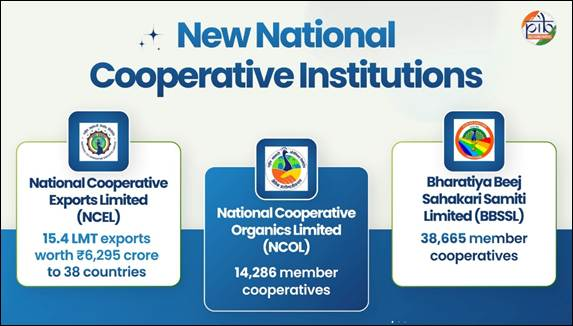
Success Stories of Cooperatives in India
- Amul (Gujarat): Amul, a dairy cooperative, is one of India’s most successful cooperatives in India. It has transformed the dairy sector by empowering millions of small farmers and bringing India to the forefront of the global dairy market.
- IFFCO (Indian Farmers Fertiliser Cooperative Limited): One of the world’s largest fertilizer cooperatives, IFFCO supplies fertilizers, agricultural inputs, crop advisory services and digital solutions to millions of farmers.
- The Self-Employed Women’s Association (SEWA) has promoted women-led cooperatives in sectors such as dairy, handicrafts, agriculture and financial services.
- Maharashtra’s cooperative sugar sector, led by institutions such as the Pravara Cooperative Sugar Factory (India’s first cooperative sugar factory) and the Warana Cooperative Complex, has transformed the rural economy by integrating sugar production with education, banking, dairy, healthcare and agro-processing.
Challenges faced by Cooperatives
- Political interference in the functioning of cooperative institutions.
- Weak governance and inadequate professional management.
- Limited financial resources and low capital base of Cooperatives
- Uneven development of the cooperative movement across States.
- Limited awareness among members regarding cooperative governance and rights.
97th Constitutional Amendment Act 2011
- It established the right to form cooperative societies as a fundamental right (Article 19).
- It included a new Directive Principle of State Policy on the Promotion of Cooperative Societies (Article 43-B).
- Part IX-B (Partially Struck Down): It added a new Part IX-B to the Constitution titled “The Co-operative Societies” (Articles 243-ZH to 243-ZT).
- In 2021, the Supreme Court of India in the Union of India v. Rajendra N. Shah’s case struck down a significant portion of Part IX-B.
Source: PIB
Previous article
Landslide
Next article
Armed Forces Seek Greater Retention of Agniveers
