


Syllabus: GS3/Energy
Context:
- Recently, Indian National Science Academy (INSA) highlights the importance of a unified national energy framework, and aims to align India’s energy security, sustainability and developmental objectives while advancing the goals of energy self-reliance by 2047 and net-zero emissions by 2070.
India’s Current Energy Situation
- India is one of the world’s fastest-growing energy markets and has made a lot of progress in providing people with energy and expanding its energy mix over the last decade. Major accomplishments include:
- Saubhagya: Universal household electrification.
- Pradhan Mantri Ujjwala Yojana (PMUY): Increasing clean cooking access.
- Expanding capacity for renewable energy generation (from nearly 40 GW in 2015 to about 260 GW in 2025).
- The world’s third-largest renewable energy producer.
- Reaching 500 GW of non-fossil energy capacity in 2030 and net-zero emissions in 2070.
- There are several initiatives in India which support integrated energy development.
- These initiatives include National Green Hydrogen Mission, National Solar Mission, PM-KUSUM Scheme for solarization of agriculture, National Biofuel Policy (2018), FAME Scheme for electric mobility, Revamped Distribution Sector Scheme (RDSS), One Nation-One Grid Initiative, National Smart Grid Mission, International Solar Alliance (ISA) and Panchamrit Commitments announced at COP26.
- However, the importance of traditional fuels such as coal in providing baseload energy and supporting industry is still high.
- Moreover, there are problems associated with imports dependency, increased energy consumption, fragmented governance, affordability concerns, regional and social inequalities.
Why India Needs an Integrated National Energy Framework?
- Increasing complexity of India’s energy system requires the development of a common framework for planning and governance. An integrated framework is needed to:
- Ensure energy security through diversified and resilient energy systems.
- Support coordination across various fuels, technologies and institutions.
- Balancing the goals of growth, affordability and sustainability.
- Long-term planning of emerging energy technologies (green hydrogen, battery storage, CCUS).
- Efficient utilization of resources and reduction of duplication in policy implementation.
- Supporting India’s goal of becoming self-reliant in energy till 2047.
- India’s energy transition must be seen as a whole system change and not just a transition from one fuel source to another.
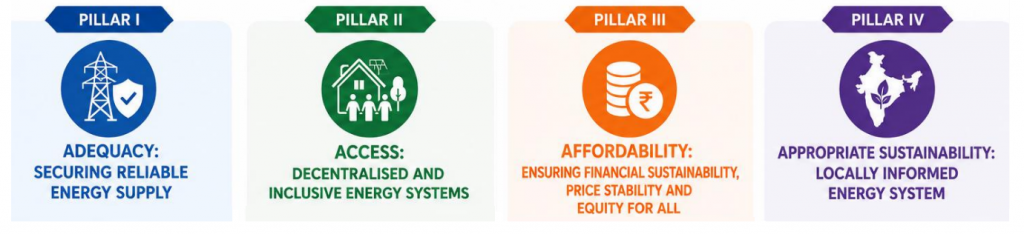
Pillars of Integrated Energy Framework proposed by INSA
- Adequacy: This pillar focuses on the provision of reliable and diversified sources of energy. The aim is to create resilience and reduce vulnerabilities in the future. Strategies involved in this pillar are:
- Balanced use of conventional and renewable energy sources.
- Improvement in energy transport and distribution systems.
- Increase in energy storage capacity.
- Digitalization in energy management.
- Access: Accessing energy services to all citizens in a reliable and equitable way. The priority areas for this pillar are:
- Last mile connectivity.
- Quality of power.
- Renewable energy system expansion through decentralization.
- Continual access to cooking energy.
- Affordability: Economic growth and industrial competitiveness require affordable energy. Economically viable energy transition is essential. This framework focuses on:
- Consumer protection.
- Efficiency of the energy market.
- Financial innovation.
- Cost-effective deployment of clean technology.
- Sustainability: Instead of adopting a universal view, the aspect of sustainability depends on the development priorities of India. These priorities are:
- Regional transitions.
- Assistance to fossil fuel dependent communities.
- Skills development of the workforce.
- Development-friendly but sustainable solutions.
- Furthermore, Circular Economy and Carbon Capture, Utilization and Storage (CCUS) are cross-cutting enablers.
Way Forward: Actions Needed to Create Stronger India’s Energy Ecosystem
- Institutional Measures: Creation of a national-level framework for energy governance in order to increase coordination between various ministries.
- Energy Infrastructure Development: Upgrading transmission infrastructure, smart grid infrastructure and battery infrastructure.
- Fast-track renewable energy: Increasing adoption of renewable energy technologies, offshore wind energy, green hydrogen and advanced bioenergy technologies.
- Improvement in Domestic Manufacturing Capacity: Improvement in domestic manufacturing capacity through ‘Make in India’ policy.
- Just Transition: Providing social security, reskilling and diversification of livelihoods to fossil fuel dependent communities.
- Funding and Innovations: Increase in funding for R&D and innovation-based financing instruments for cutting-edge technologies.
Conclusion
- The Indian energy transition is not only about generating more power; it is about building an energy ecosystem that is resilient, cheap, and sustainable.
- The INSA’s INEF is a holistic strategy which involves bringing all the fragmented energy strategies together and integrating them in line with the development goals of the nation.
- Such a coordinated effort will be essential for ensuring energy independence by 2047 and net-zero emissions by 2070.
| Daily Mains Practice Question [Q] India’s energy transition requires an integrated and context-specific approach rather than a sector-specific strategy. Examine the significance of a Unified National Energy Framework for India’s energy future. |
Previous article
Kirana Stores and Quick Commerce in India
Next article
Food Sovereignty: Lessons From France & India
