

Syllabus: GS3/Infrastructure
Context
- Over the past decade, India accelerated infrastructure creation across transport, housing, water, energy, logistics, and digital networks.
Infrastructure Development in India
Transport & Connectivity:
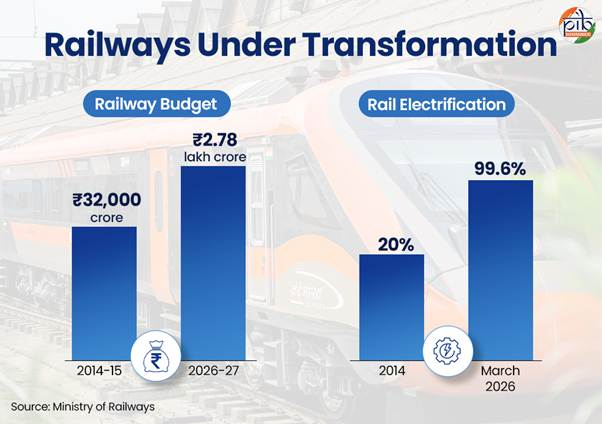
- Major Railway Bridges: Chenab Bridge (2025), Anji Khad Bridge (2025), Pamban Bridge (2025) and Bairabi–Sairang (2025)
- Roads and Highways: National Highways expanded by 61% to 1.46 lakh km; 3,644 km of expressways operational.
- Operational airports increased from 74 (2014) to 165 (2026); UDAN connected 95 airports and benefited 1.64 crore passengers.
- Operationalisation of GAGAN in 2015, world’s first equatorial Satellite-Based Augmentation System (SBAS) enhanced navigation accuracy and flight safety.
Maritime & Logistics Infrastructure:
- Port capacity nearly doubled to 1,726 MMTPA.
- National Waterways increased from 5 to 111.
- India’s rank in the World Bank Logistics Performance Index improved from 54 (2014) to 38 (2023).
- India has expanded its network of National Waterways from 5 in 2014 to 111 in 2026.
Water Infrastructure:
- Under Jal Jeevan Mission, rural tap water coverage increased from 17% (2019) to about 82% (2026).
- Progress in irrigation, river rejuvenation, and river-linking projects such as Ken–Betwa.
Energy Security:
- Installed power capacity increased from 248 GW to 533 GW.
- Power shortages reduced from 4.2% to 0.03%.
- India became the world’s 3rd-largest clean energy producer.
- Nearly 2.86 crore households electrified under Saubhagya scheme.
Clean Cooking Fuel:
- LPG coverage increased from 55.9% to 107.2%.
- PM Ujjwala Yojana expanded clean cooking access to poor households, with over 33 crore LPG consumers nationwide.
Digital Infrastructure:
- Internet connections rose from 25 crore to over 100 crore.
- Broadband connections reached nearly 100 crore.
- As of 2026, 5G services are available in 99.9% of districts with about 85% population coverage.
Challenges in India’s Infrastructure Development
- Financing Constraints: Large infrastructure projects require massive investments, creating pressure on public finances and increasing dependence on private capital.
- Land Acquisition Issues: Delays due to disputes, rehabilitation concerns, and lengthy approval processes increase project costs and timelines.
- Environmental and Social Concerns: Infrastructure expansion can lead to ecological degradation, deforestation, biodiversity loss, and displacement of communities.
- Implementation Delays: Bureaucratic hurdles, litigation, and coordination problems among multiple agencies often slow project execution.
- Regional Imbalances: Infrastructure development remains uneven, with northeastern, hilly, and remote regions lagging behind.
- Urban Infrastructure Stress: Rapid urbanization has outpaced the development of transport, housing, water supply, and waste management systems.
- Operation and Maintenance Gaps: Inadequate maintenance reduces the efficiency and lifespan of infrastructure assets.
- Climate and Disaster Risks: Extreme weather events, floods, cyclones, and heatwaves pose increasing risks to infrastructure resilience.
Way Ahead
- Strengthen public-private partnerships (PPPs).
- Accelerate land and environmental clearances through transparent mechanisms.
- Promote climate-resilient and sustainable infrastructure.
- Enhance maintenance and asset management systems.
- Improve last-mile connectivity in underserved regions.
- Build institutional and technical capacities for efficient project execution.
Conclusion
- India’s infrastructure transformation has emerged as a key driver of economic growth, connectivity, and social inclusion.
- While significant progress has been made in transport, energy, housing, water, and digital infrastructure, addressing challenges remains crucial.
- A balanced approach that emphasizes quality, resilience, and inclusiveness will be essential to realize the vision of a developed and globally competitive India by 2047.
Source: PIB
Previous article
Rise in India’s Fertiliser Subsidy Burden
