

Syllabus: GS3/ Economy
Context
- India’s fertiliser subsidy burden is expected to rise sharply to around ₹3.4 lakh crore in 2026-27, nearly double the Budget Estimate of ₹1.71 lakh crore, due to surging global fertiliser prices, supply disruptions, and geopolitical tensions in West Asia.
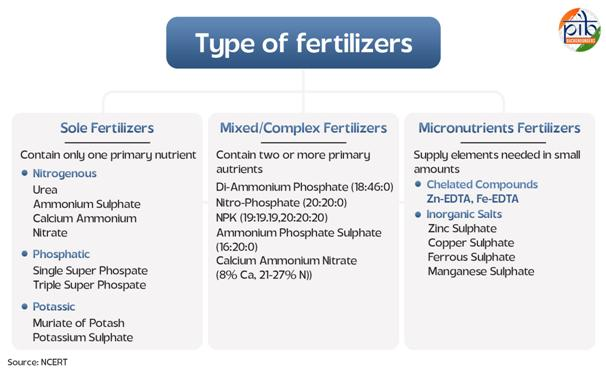
What are Fertilizers?
- Fertilizers are concentrated plant nutrients made from inorganic chemicals.
- Unlike organic manure, fertilizers contain nutrients in higher amounts and are applied in smaller quantities.
Mechanism of Subsidy
- Subsidy on Sale Price: The government provides financial support to fertilizer manufacturers or importers, lowering the price of fertilizers sold to farmers.
- Direct Benefit Transfer (DBT): In some cases, the subsidy is transferred directly to farmers through their bank accounts to reduce intermediaries and ensure transparency.
- Fixed Subsidy Rates: For urea, the subsidy is fixed per kilogram of the product, and for others like DAP, it is adjusted periodically based on market prices.
Why is the Fertiliser Subsidy Rising?
- Global Supply Disruptions: The ongoing conflict in West Asia and disruption of the Strait of Hormuz have increased fertilizer and energy prices globally.
- Major suppliers, including China, have restricted exports to secure domestic supplies.
- Sharp Increase in Import Prices: India’s recent urea imports were contracted at $935–959 per tonne, compared to $410–420 per tonne a year earlier.
- The cost of a fertiliser sack has increased from around ₹3000 post-Covid to ₹4,500, while farmers continue to receive it at heavily subsidised rates.
- Dependence on Imports: India remains one of the world’s largest fertiliser importers. Gulf countries such as Oman, Qatar, Saudi Arabia, UAE, and Bahrain account for around 40% of India’s urea imports.
Government’s Initiatives in the Fertilizer Sector
- PM PRANAM scheme: PM Programme for Restoration, Awareness Generation, Nourishment and Amelioration of Mother – Earth (PMPRANAM) was launched to incentivize States/ Union Territories to promote alternate fertilizers and balanced use of chemical fertilizers.
- Neem-coated urea: The government has introduced 100% Neem Coating on all subsidized agricultural grade urea in the country in order to increase the nutrient efficiency, crop yield, soil health and check the diversion of agricultural grade urea for non-agricultural activities.
- Sulfur Coated Urea (Urea Gold) was introduced to overcome the sulfur deficiency in the soil and reduce the input cost of the farmers.
- Nutrient-based subsidy policy: It aims to promote the balanced use of fertilizers by linking subsidies to the nutrient content (nitrogen, phosphorus, potash, and sulfur) rather than the final product.
- Under this scheme, the government sets a fixed subsidy amount per kilogram for each nutrient in P&K fertilizers.
- Nano Urea: It is a liquid fertilizer developed by IFFCO. It is an alternative to conventional urea.
Way Ahead
- Capacity Expansion: Speeding up commissioning of domestic urea plants under “Atmanirbhar Bharat” will reduce import reliance.
- Sustainable Practices: Wider adoption of nano-urea, bio-fertilisers, and soil health cards can reduce chemical fertiliser intensity over time.
- Improving Supply Chain Resilience: India should diversify its import sources to reduce dependence on specific regions. Strategic reserves of fertilisers should be developed to manage future disruptions.
- Encouraging Biostimulants: Biostimulants should be promoted as they enhance nutrient uptake and improve plant metabolism.
- These products can reduce the effective requirement of chemical fertilisers by improving their efficiency.
Source: IE
Previous article
Report on Datasets for State Finance Commissions
Next article
Infrastructure at the Core of India’s Development
