


Syllabus: GS2/International Relations
Context
- The ongoing Iran conflict and disruptions in the Strait of Hormuz have revived global concerns over energy security, maritime choke points and the strategic relevance of the India-Middle East-Europe Economic Corridor (IMEC).
About India-Middle East-Europe Economic Corridor (IMEC)
- It was officially launched during the G-20 Summit in New Delhi in 2023. It is a major connectivity initiative aimed at linking India with Europe through West Asia.
- It is envisioned as a modern multimodal corridor that can reduce transportation costs, improve supply chain resilience and enhance economic integration among Asia, West Asia and Europe.
- It seeks to develop an integrated network of railways, ports, highways, energy pipelines, digital connectivity infrastructure, and green hydrogen corridors.
- The corridor is viewed as a strategic alternative to traditional maritime routes dependent on the Suez Canal and the Strait of Hormuz.
Structure of IMEC
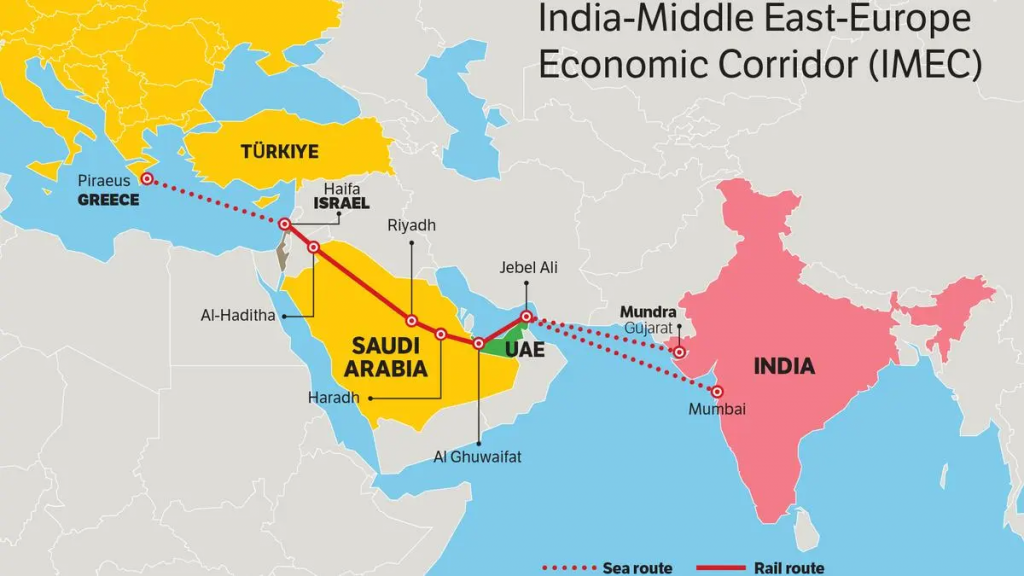
- Eastern Corridor: Connects India to the United Arab Emirates (UAE) through sea routes.
- Indian ports are linked with ports such as Jebel Ali and Fujairah in the UAE.
- Central Corridor: An overland rail and road network passing through UAE, Saudi Arabia, Jordan, and Israel.
- Terminates at the Israeli port of Haifa on the Mediterranean coast.
- Western Corridor: Maritime route connecting Haifa to European ports. Europe’s existing transport networks further distribute goods across the continent.
Importance of IMEC Amid Closure of Strategic Choke Points
- Reduces Dependence on Vulnerable Maritime Routes: The Iran conflict demonstrated how disruptions in the Strait of Hormuz can destabilise the global economy.
- IMEC offers an alternative route that can reduce excessive dependence on traditional choke points.
- Enhances India’s Energy Security: India’s large dependence on imported crude oil makes diversification of transport corridors essential.
- IMEC can improve resilience against supply disruptions.
- Strengthens Supply Chain Resilience: Global trade increasingly requires diversified and secure logistics networks.
- IMEC can provide faster and more reliable transportation between India and Europe.
- Strategic Counter to China’s Belt and Road Initiative (BRI): IMEC is often seen as a collaborative and transparent alternative to China’s BRI, promoting rules-based connectivity.
- Promotes Economic Integration: The corridor can increase trade, investments, industrial cooperation and technological connectivity among participating countries.
- Supports Green Energy Transition: The inclusion of green hydrogen corridors and energy grids aligns with global climate and sustainability goals.
What are the Key Concerns and Issues Surrounding IMEC?
- Regional Instability in West Asia: The Gaza conflict and the Iran-Israel confrontation have directly affected the proposed route, especially areas involving Israel and the port of Haifa.
- Vulnerability of Gulf Ports: Iranian attacks and tensions around the Strait of Hormuz exposed the strategic risks faced by ports in the UAE such as Jebel Ali and Fujairah.
- Saudi Arabia-UAE Strategic Differences: Diverging geopolitical positions between Saudi Arabia and the UAE may affect coordination and implementation of the corridor.
- Dependence on Political Stability: IMEC’s success depends on sustained regional cooperation, which remains uncertain in a conflict-prone region.
- Security of Infrastructure: Railways, ports and energy pipelines passing through sensitive regions remain vulnerable to sabotage, missile attacks and geopolitical rivalries.
- Financing and Execution Challenges: The corridor requires massive investments, policy coordination and long-term political commitment among multiple countries.
Way Forward For IMEC
- Develop Alternative Routes: India and partner countries should explore safer alternatives such as:
- Oman’s ports (Salalah, Duqm and Muscat) as eastern entry points.
- Egyptian Mediterranean ports as western alternatives to Haifa.
- Flexible and Adaptive Framework: IMEC should evolve into a flexible connectivity architecture capable of adjusting routes based on geopolitical developments.
- Strengthen Regional Diplomacy: Countries such as India, France and Italy should actively mediate and promote regional cooperation among Gulf nations.
- Enhance Maritime Security Cooperation: Joint naval exercises, intelligence sharing and infrastructure protection mechanisms should be institutionalised.
- Promote Economic Interdependence: Greater trade and investment linkages among participating countries can reduce strategic mistrust and improve cooperation.
- Institutional Coordination Mechanism: A permanent multilateral coordination body may help ensure policy continuity, infrastructure financing and dispute resolution.
Conclusion
- The Iran conflict has reinforced the strategic necessity of alternative trade and connectivity corridors capable of bypassing conflict zones and maritime choke points.
- IMEC represents a geopolitical and strategic project along with economic initiative aimed at enhancing supply chain resilience and regional integration.
- However, its success will depend on the ability of participating countries to navigate the complex geopolitical realities of West Asia.
- For India, IMEC offers a historic opportunity to strengthen connectivity with Europe, secure energy interests and emerge as a central player in shaping the future global trade architecture.
| Daily Mains Practice Question [Q] Discuss the strategic significance of India-Middle East-Europe Economic Corridor (IMEC) for India in the backdrop of emerging geopolitical tensions in West Asia. Examine the major challenges facing the corridor and suggest measures to ensure its successful implementation. |
Previous article
Empowering Panchayats: Hyperlocal Representation Alone Will Not Help
Next article
Future of India’s Chip Industry
